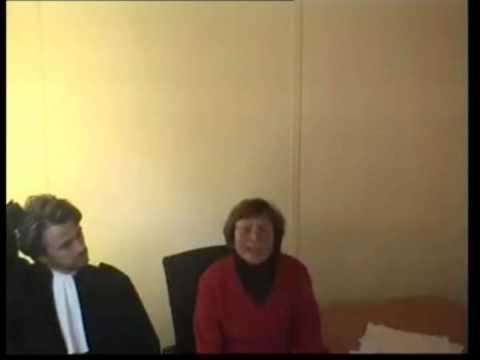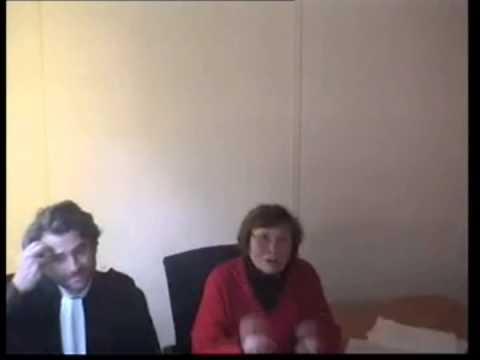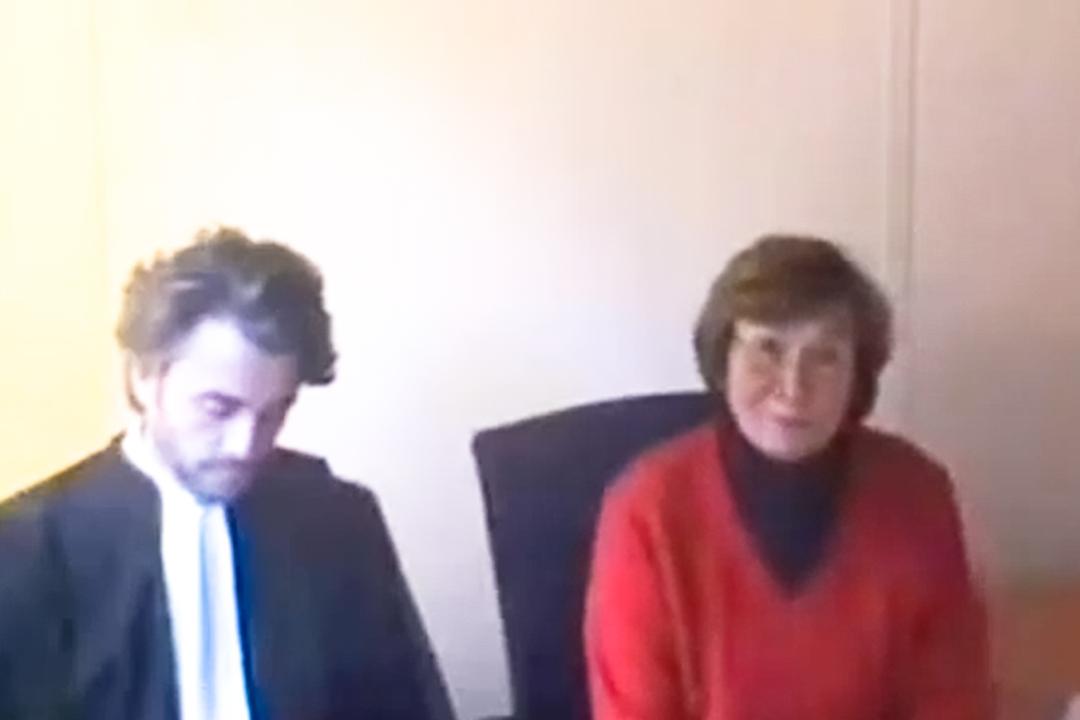
AFFONÇO Denise
Pseudonym: TCCP-1
Cases: Case 002/01
Category: Civil Party
Background and role
Mrs. Denise Affonco, a French national, lived in Phnom Penh before the Khmer Rouge regime.
1
She worked as an officer in the cultural service department at the French Embassy and at a private company until 1973.
2
When the situation in Cambodia worsened before 1975, the French authorities began instructing their citizens to leave Cambodia.
3
However, she decided to remain with her husband, her children and her sister-in-law.
4
She gave evidence in Case 002/01 about her experiences in April 1975.
The evacuation of Phnom Penh in April 1975
The civil party described how her life “switched to hell” overnight as she was chased from her house and her properties were expropriated by the Khmer Rouge.
5
She was instructed to leave her home for two or three days to avoid U.S bombs.
6
People who refused to leave Phnom Penh were considered to be “traitors, and imperialists, and people who were in the pay of the old regime” and executed.
7
Everyone was evacuated including the old and young, and the sick and injured from the city’s hospitals.
8
She was not allowed to go to the French Embassy as the roads were cut off, so she and her family were sent southwards.
9
At a roadblock after Takhmau, the Khmer Rouge tore up her French identity papers.
10
Evacuees were forced by the Khmer Rouge to travel, sometimes for weeks.
11
As a result, they, young children in particular, suffered from exhaustion and could barely walk.
12
Evacuees from Phnom Penh settled in rural areas in DK zones throughout the country, including Battambang, Kampong Cham, Kampong Chhnang, Kampong Speu, Kampong Thom, Kampot, Kandal, Prey Veng, Pursat, Svay Rieng and Takeo.
13
During the march out of Phnom Penh, the civil party experienced harrowing events. She walked past rotting corpses of Lon Nol soldiers and civilians.
14
The Khmer Rouge soldiers did not provide evacuees with food, water, medicine or even transport, nor assistance to those who were weak, elderly or injured.
15
The civil party testified about the killing of a school friend, who had stayed to wait for her husband.
16
The husband never came back and her friend was executed on the spot.
17
The Supreme Court Chamber noted that, even though Denise Affonco did not witness the killing of her school friend, her testimony presented a reasonable level of detail, establishing a high probability that her friend was killed as described.
18
Working conditions at the cooperative
The civil party described the terrible experience of working at the Kaoh Tuk Veal cooperative where she and her family members were transferred.
19
She described it as an open prison where prisoners were deprived of freedom and spied on.
20
There was no electricity nor running water.
21
She was forced to get rid of her colorful clothes and do labor-intensive work in the field.
22
She was harassed and forced to work even when sick.
23
Her husband and her son were forced to clear the forest (her daughter stayed behind) and suffered from malnourishment.
24
People died every day, through lack of care and medicine, because they were sick and nobody cared for them, or of hunger and malnutrition.
25
Her daughter died from hunger; she asked her mother for a bowl of rice to eat when she was dying, but the civil party was unable to give her that before she died.
26
Children were taken away from their parents without information. The Khmer Rouge claimed that the children were the children of “Angkar”
27
and “Angkar” were looking after them.
28
When the children got back, they were indoctrinated and changed by the Khmer Rouge.
29
Statement of suffering
Denise Affonco recounted how thirty years after the regime she is still plagued by nightmares, haunted by her experiences and does not wish to set foot in Cambodia:
34
“My life had been proceeding happily in a peaceful country, and it suddenly switched to hell […] I have undergone an awful lot of harm as a result. From the fact that we didn't have any kind of medical care or doctors and that we were malnourished and lived in total absence of any hygiene, I contracted a great many diseases. The major one was tuberculosis[...] We were deported, we were forced to leave our homes, we were told lies, saying it was just for a few days. Well, in fact, when you leave your house, you never, ever see it again; you don't see any of your possessions again […], your children are taken away from you, without even telling you where they're going […] And when you get back to your children, in fact, they aren't your children anymore because they've been completely indoctrinated and changed. When you see your daughter dying of hunger, and she says, "Mommy, can I have a bowl of rice?", and I was never able to give her that bowl of rice before she died […].”
Videos