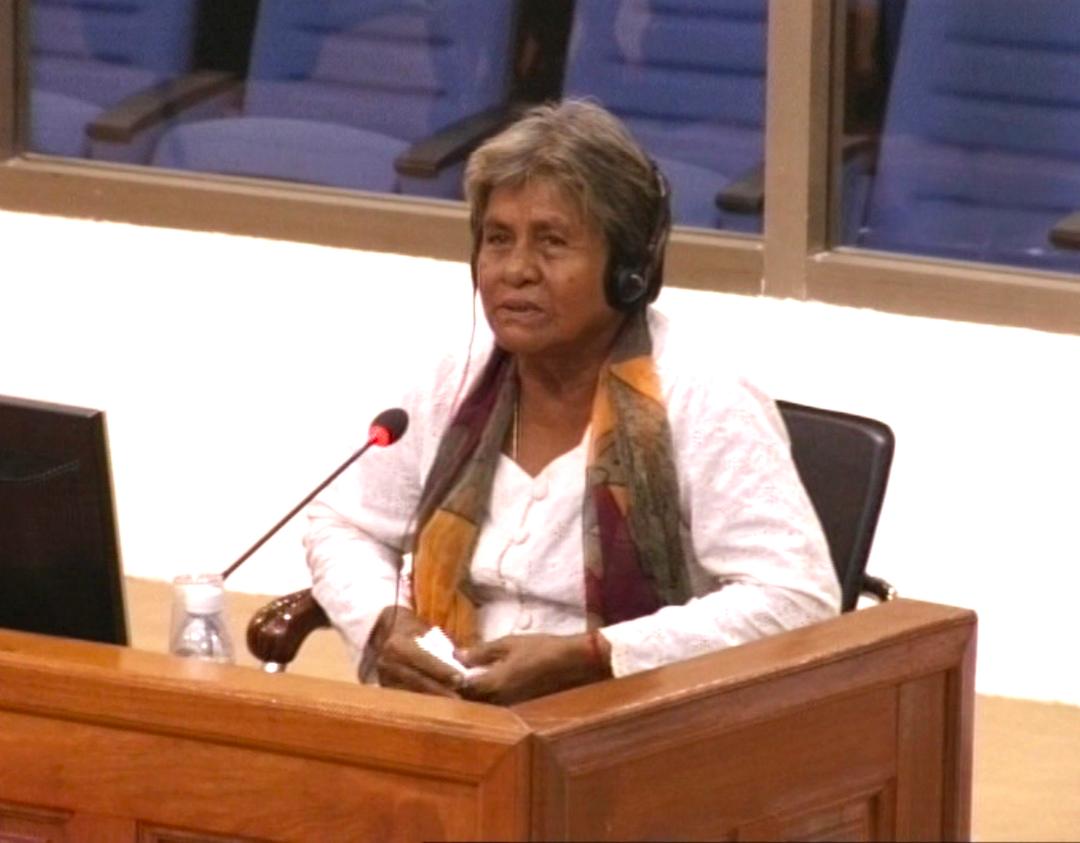
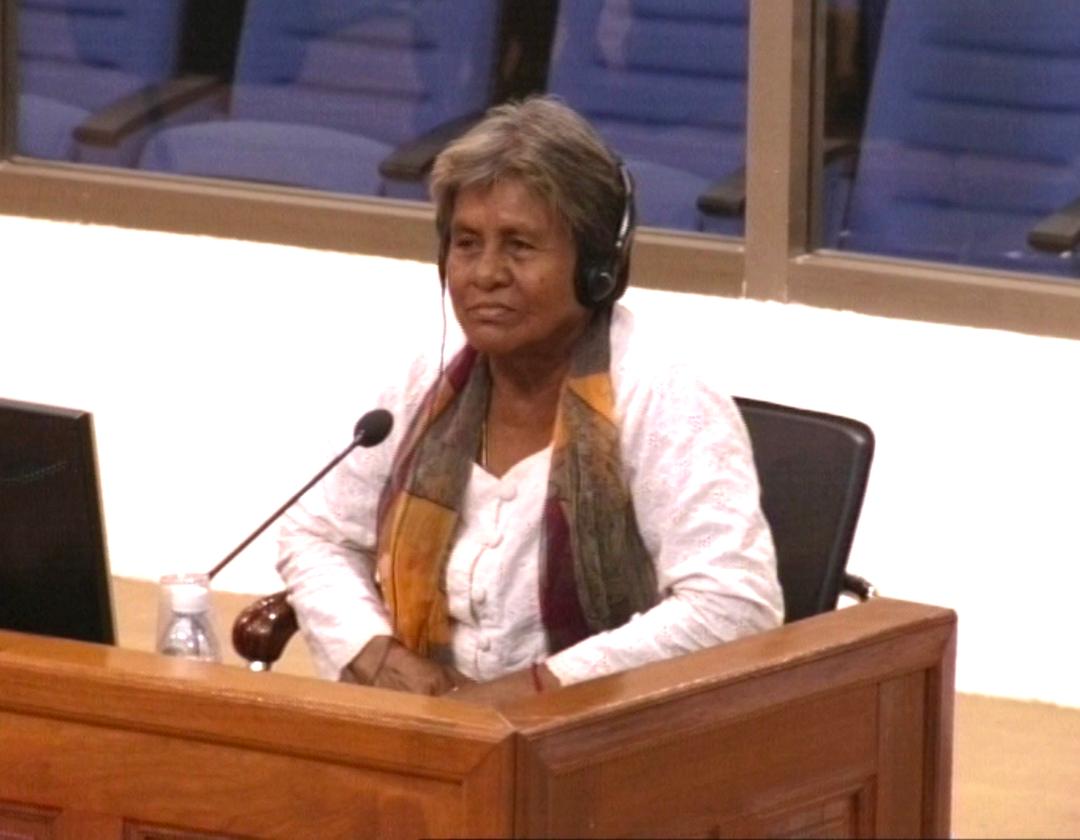
BOU Thon
Pseudonym: KW-29
Cases: Case 001
Category: Witness
Background and role
Bou Thon and her husband, Phok Horn, were categorised “New people”, or “17th of April people” during the regime
1
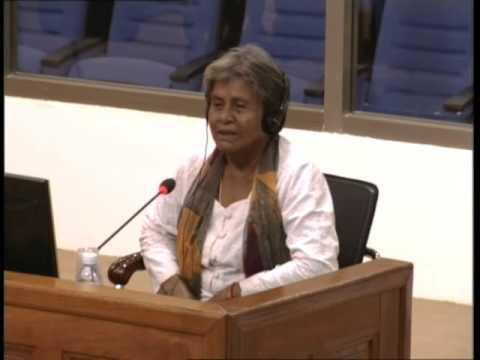
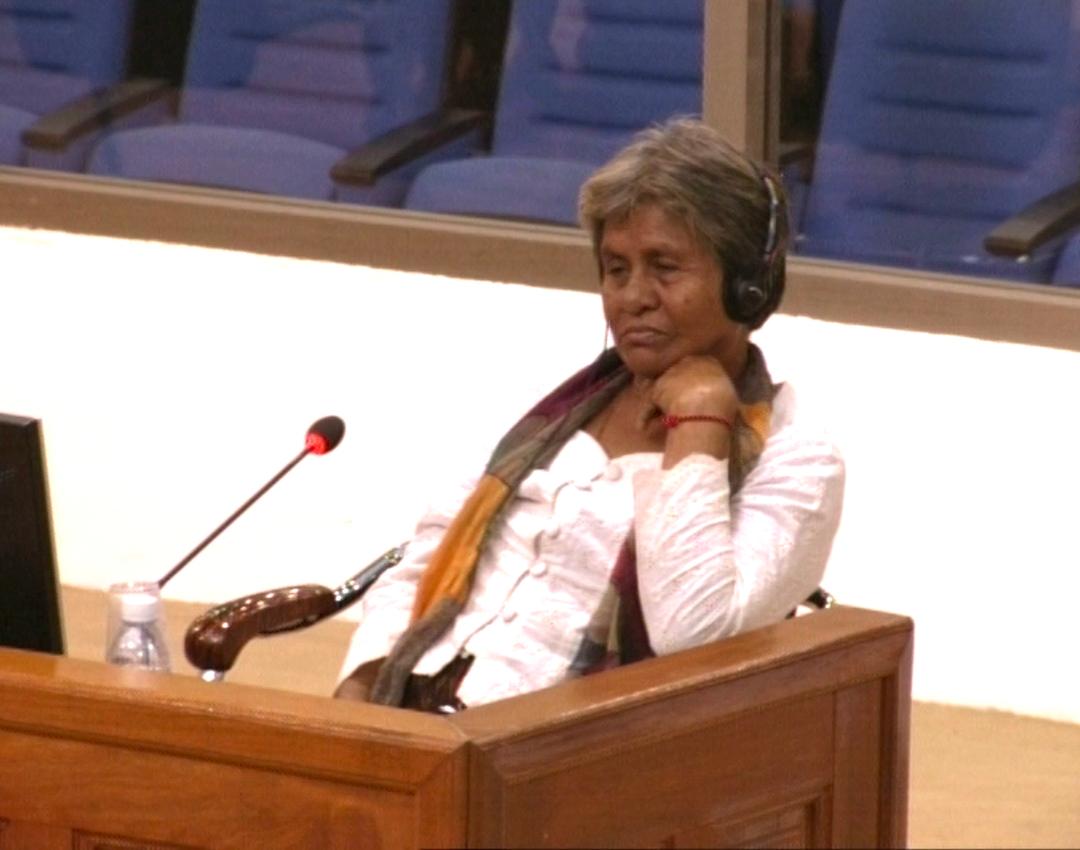
She testified as a witness during the Case 001 trial proceedings on their roles at the Ministry of Energy, the execution of her husband who was detained at S-21, conditions and disappearances at S-24 where she was detained, and the suffering she endured during the regime, including the death of her four children.
Prior to April 1975, they lived in Phnom Penh with their children.
2
When the Khmer Rouge seized control of the city, they attempted to flee but were redirected by Pol Pot soldiers.
3
She described how then “Angkar took us back to Phnom Penh and they introduced us to the revolution.”
4
Bou Thon testified that after a few months, her husband was assigned to work at the Ministry of Energy.
5
He drove a fuel tanker, which he received from Royal Air Cambodge to carry war booties,
6
while she worked as a cook preparing meals for the staff of the Ministry.
7
They resided at the Popeal Khae gas station.
8
Sometime in 1977, after the birth of their fourth child, her husband disappeared.
9
She later learned that he was arrested because Kuy Thuon, the chief of the North Zone who had “introduced” them to the revolution,
10
had been labelled a traitor.
11
She stated that she was unaware of the circumstances of her husband’s arrest and death, but saw his photo at S-21 years later.
12
Conditions at S-24
In 1977,
13
Bou Thon was transported to Anlong Kong, also known as K-14,
14
a component of S-24. As noted by the Trial Chamber, S-24, also known as Prey Sar, was a re-education camp under the authority of Duch, which was located outside of Phnom Penh near the execution site of Choeung Ek in the Dangkao district of Kandal Province.
15
The Chamber further noted that “detainees at S-24 were largely comprised of the relatives or subordinates of people detained at the S-21 complex, and of combatants and personnel from ministries or from other public institutions”.
16
Bou Thon testified that she was sent to S-24 because she was “regarded as the enemy”.
17
On arrival, she was photographed and asked about her biography.
18
She described S-24 as “a depository location before the prisoners were dispensed to other locations”.
19
There, she was ordered to cut firewood, catch fish and cultivate rice and vegetables,
20
although she not allowed to eat them.
21
She was given only two meals a day, being rice followed by a thin gruel,
22
and recalled that some of the detainees were “very thin”.
23
She described sleeping in a communal shelter, with approximately 10 to 20 other people.
24
She commenced work early in the morning and continued into the afternoon.
25
The Trial Chamber considered her recollection of these conditions as authentic.
26
Bou Thon recalled that people were taken away at night.
27
At times, truckloads of people arrived only to disappear the following day.
28
She had no knowledge of where those people came from or where they were taken, and did not dare ask.
29
She described the impact this had on her mental health as follows:
I was terrified but I did not talk because I just told myself that today or tonight these people were taken out; maybe the next day it would be my turn.
30
Bou Thon spoke about the severe deprivation of liberty and autonomy she experienced at S-24 in her testimony, a large portion of which was cited by the Trial Chamber in its judgment.
31
She stated that she was not free to talk with other people who worked alongside her and “had no freedom of expression”.
32
She was not able to move about freely, describing S-24 as “like being detained in a prison without walls”.
33
She described how she was beaten and mistreated,
34
and felt “dehumanized because my life was in the hands of them and they could make any decision to kill me any time they wished to do so”.
35
Loss of children
Bou Thon had four children: three daughters and a son. Her daughters were taken to a mobile child unit and she was allowed to meet them only occasionally.
36
After the liberation, they disappeared forever.
37
Only her son remained with her at S-24.
38
He stayed with a caretaker while she worked and she breastfed him on her breaks.
39
There were about 10 children who stayed at the childcare centre.
40
The Trial Chamber cited Bou Thon’s testimony on this point in its judgment:
Witness BOU Thon observed ten babies at a child care centre at S-24, whose mothers were not permitted to care for them. Some were sick and some died.
41
Her son died following the 7 January 1979 liberation by the Vietnamese, when she fled to Battambang,
42
before eventually returning to her hometown.
43
Of her family, only she survived; she lost her husband and all of her children.
44
Videos