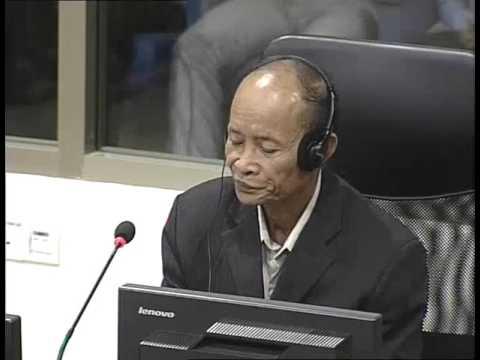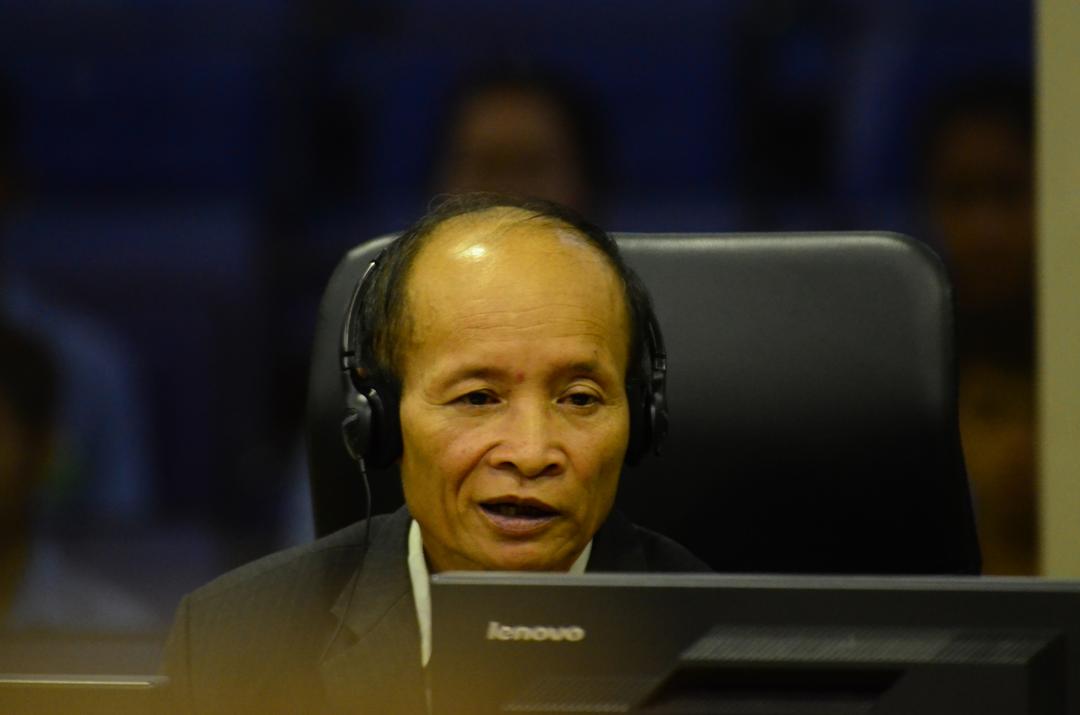
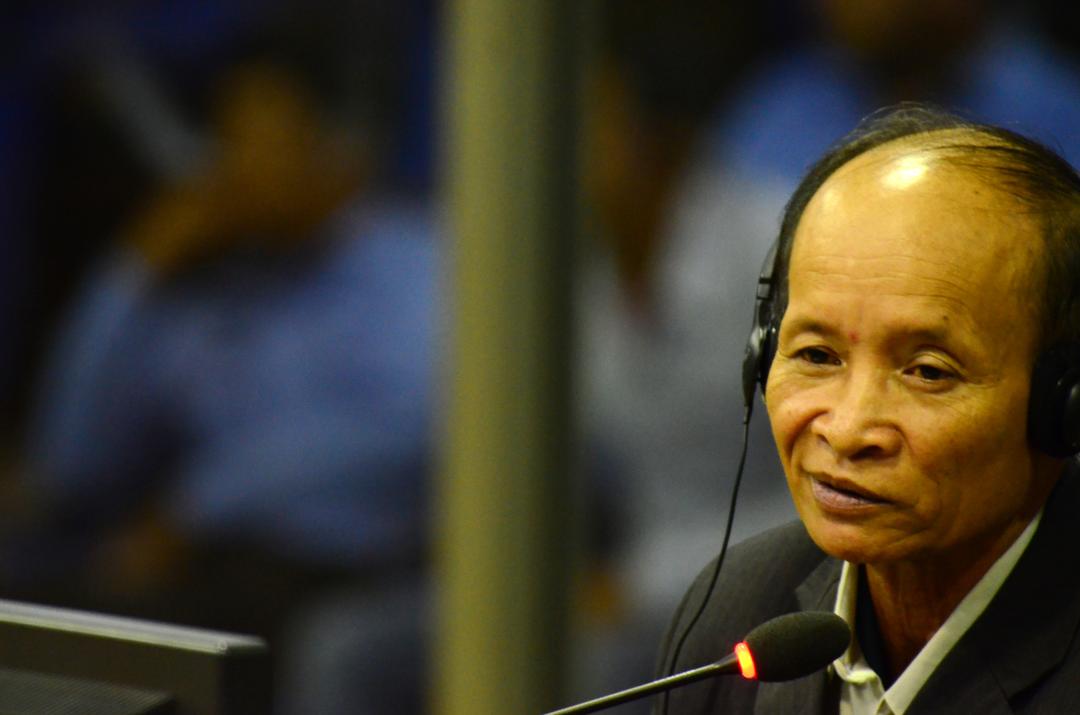
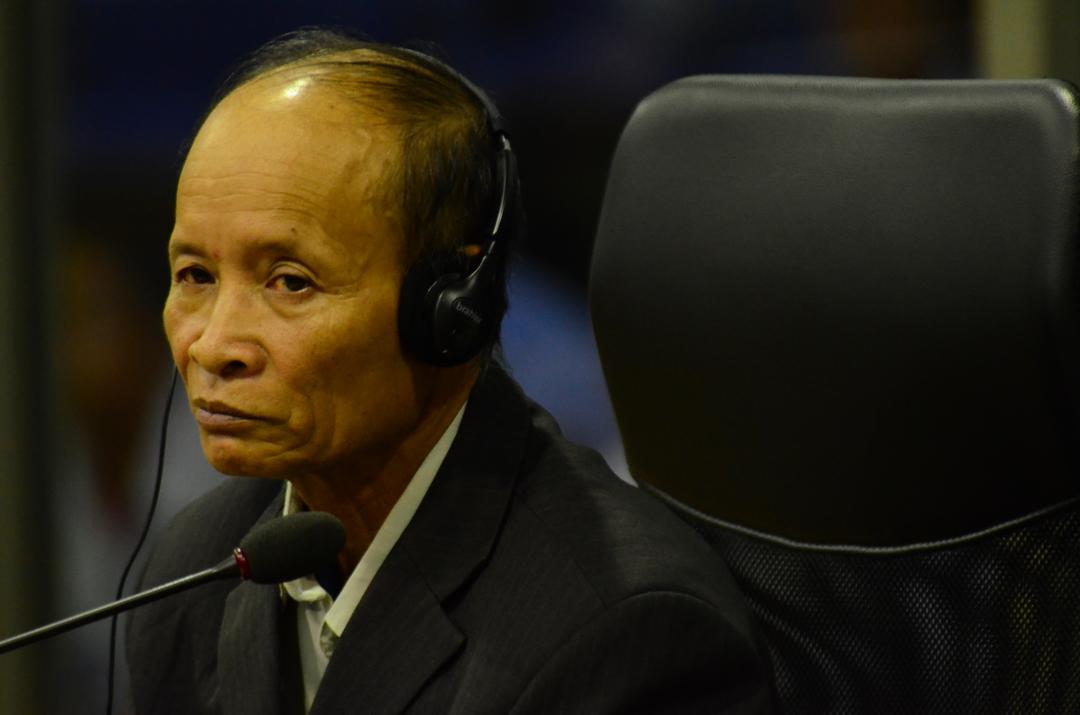
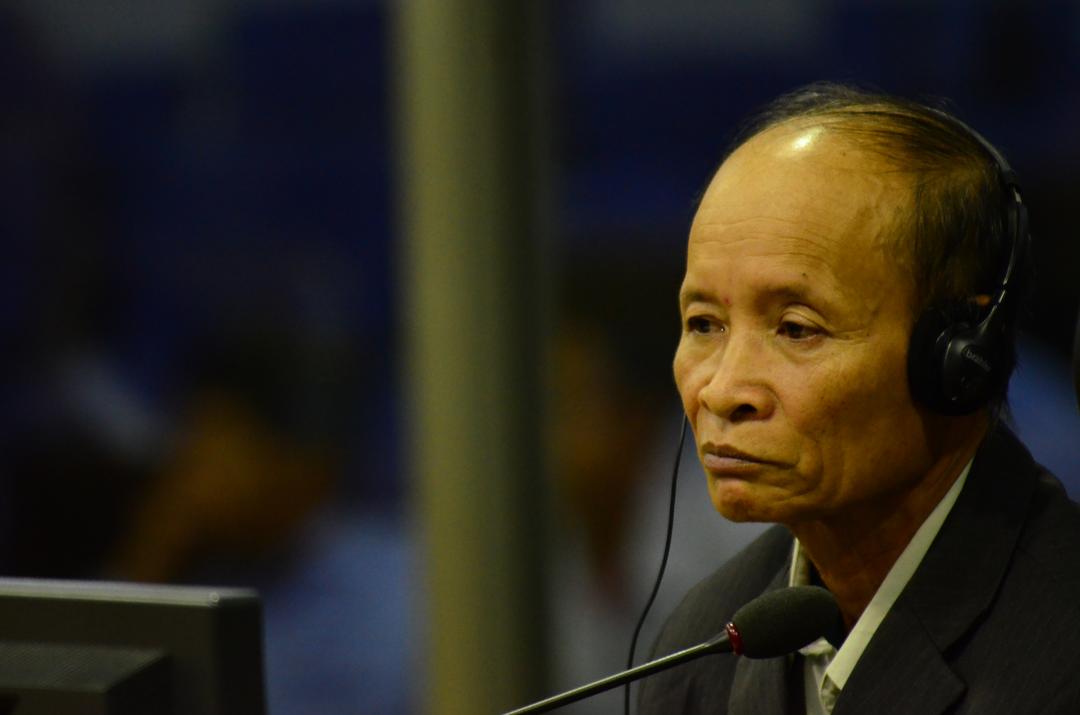
BUN Loeng Chauy
Pseudonym: 2-TCW-838
Cases: Case 002/02
Category: Witness
Background and Role
Bun Loeng Chauy alias Chan Bunleath was Deputy Chief of the Kaev Seima District Office from 1975 until his arrest in February 1977.
1
He became a combatant in 1968 and joined the Communist Party of Kampuchea in 1975.
2
In the same year, he was recruited to become a member of the Youth League and was appointed as a group chief of five or six members.
3
He testified as a witness in Case 002/02 in relation to the Phnom Kraol security centre and internal purges in Sector 105.
4
The Trial Chamber relied on Bun’s testimony in its findings relating to the location, operations, and leadership in Sector 105 offices and particularly at Phnom Kraol, and in finding that perceived enemies from Sector 105 and their associations were arrested, detained, and killed.
5
Sector 105 Offices and Phnom Kraol Security Centre
Before he was sent to Roya worksite (K-37), Bun was detained at the Sector 105 economics office, K-16, which was approximately two kilometres from K-17.
6
K-17 was the office of Sector 105,
7
which operated under the supervision of Tin
8
and Vin Lay.
9
Sector 105 Committee was headed by Laing
10
until he was killed by Kham Phoun,
11
and Ta Sarun replaced Laing in late 1977 or early 1978.
12
During the Democratic Kampuchea period, Laing and Sarun personally received reports from district secretaries
13
and held meetings to appoint district officials.
14
Bun described Phnom Kraol security centre as the “administrative multiplex”
15
located in Kaoh Nheaek, which also contained a detention facility therein.
16
K-11, the headquarters of the Sector 105 Military office
17
and a temporary detention and re-education facility for light offenders,
18
was situated outside the perimeter of Phnom Kraol
19
a few hundred metres to the southeast of K-17
20
and operated by the Sector 105 Military Commander.
21
Bun gave details of the layout and operations of the Phnom Kraol
22
and Trapeang Pring (a burial site).
23
Bun observed from a distance that Phnom Kraol “was not better than a place to keep the cattle”.
24
He heard that smaller groups of prisoners at Phnom Kraol were sent away to Trapeang Pring for execution, while larger groups were transported by a vehicle to Kratie province to be killed.
25
The Trial Chamber relied on Bun’s testimony in finding that: (i) K-16 was the Sector 105 economics office located several hundred metres to a few kilometres south of K-17 and K-11;
26
(ii) K-17, the office of Sector 105, was located on the road from Kaoh Nheaek to Kratie at the north-western foot of Phnom Kraol, on the opposite side of the Phnom Kraol dam;
27
(iii) the Sector office operated under the supervision of Tin (until 1978) and Vin Lay (until October 1978);
28
(iv) the Sector 105 Chairman directly oversaw K-17’s operations;
29
(v) the Sector 105 Committee was headed by Laing as Secretary from late 1976
30
until Sao Sarun was appointed to replace Laing after the latter’s death in late 1977;
31
(vi) Sector 105 Secretaries Laing and Sarun channelled information between districts and the Party Centre;
32
(vii) K-11 consisted of at least one concrete building;
33
(viii) Phnom Kraol was operated by the Sector 105 Military;
34
and (ix) Trapeang Pring was a burial site located approximately four kilometres southwest of the Phnom Kraol security centre complex.
35
However, the Trial Chamber did not rely on Bun’s testimony in finding that Trapeang Pring was the place of execution for prisoners at Phnom Kraol, concluding that Bun did not personally witness the executions.
36
Internal Purges in Sector 105
Various groups of people, including those whose relatives lived in Vietnam, were accused of being part of the Vietnamese network, arrested, and killed.
37
If a commander was arrested and killed, the subordinates under his command and their relatives were also purged.
38
Those who had good behaviour would be spared.
39
In relation to the purges in Sector 105, Bun recalled that Kaoh Nheaek District Secretary, Tit Hem alias Svay, committed suicide in early 1977 after being questioned about hiding Vietnamese and later killing two Sector 105 officials.
40
He witnessed his former colleagues and soldiers from Sector 105 imprisoned in a building near the Roya worksite, which was located approximately a kilometre from K-17.
41
His uncle, the Kaev Seima District Secretary, Kasy, and Kasy’s wife, relatives, and neighbours were taken away from K-16 and killed on 22 February 1977, with only one or two surviving the ordeal.
42
Bun said that he was arrested because of his relationship with his uncle, Kasy.
43
The Sector 105 Military Commander, Sophea, was also arrested.
44
The wives and children of a number of Kaev Seima District members who fled from K-16 were arrested,
45
including two of the members’ wives who were executed at S-21.
46
The Trial Chamber relied on Bun’s testimony in finding that: (i) upper echelons progressively denounced, arrested, and detained and/or executed cadres suspected of collaborating, communicating, or otherwise dealing with Vietnamese forces, civilians, or relatives;
47
(ii) those perceived as ideologically opposed to Angkar or its policies, or suspected of the slightest subversion, were killed;
48
(iii) military personnel associated with enemies were routinely purged down the chain of command and by association;
49
(iv) precipitated by accusations that he had entertained or harboured Vietnamese soldiers, the Kaoh Nheaek District Secretary committed suicide following skirmishes with Sector 105 officials;
50
(v) the entire population from Kaev Seima District was relocated and imprisoned at K-16 and the Roya worksite following its District Secretary, Kasy’s, denunciation;
51
(vi) Kasy and his family were arrested in February 1977, detained at K-16, and executed, and only “one or two came back”;
52
and (vii) the wives and children of K-16 escapees were arrested and executed in late 1977 as a result of their husbands’ flight.
53
Videos