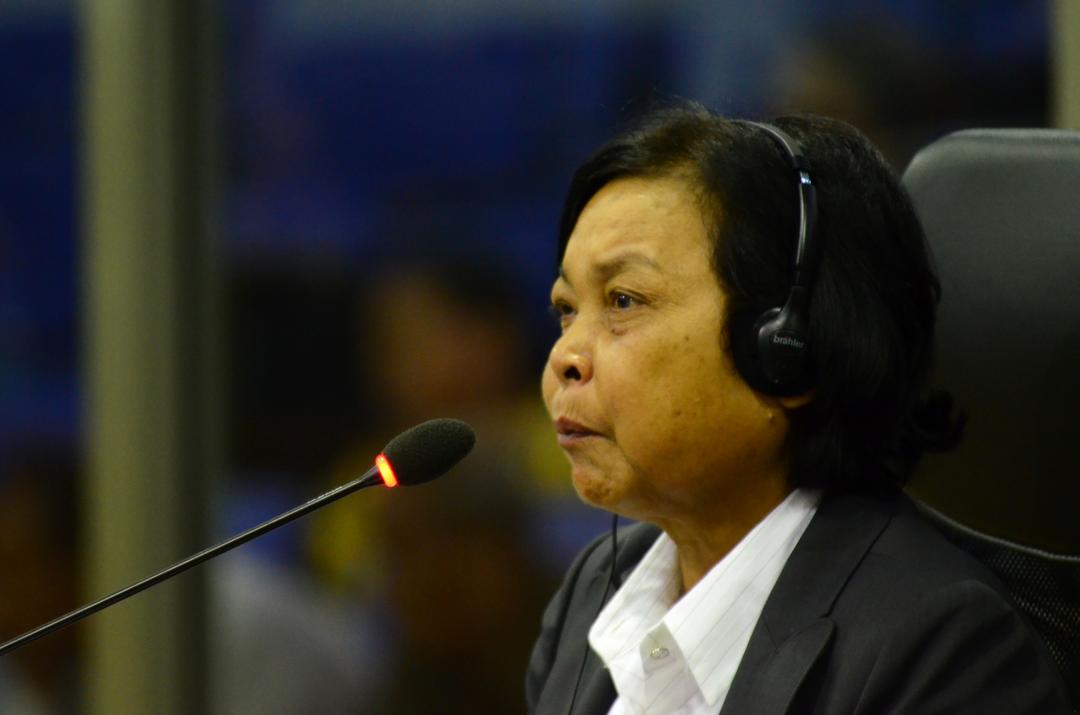
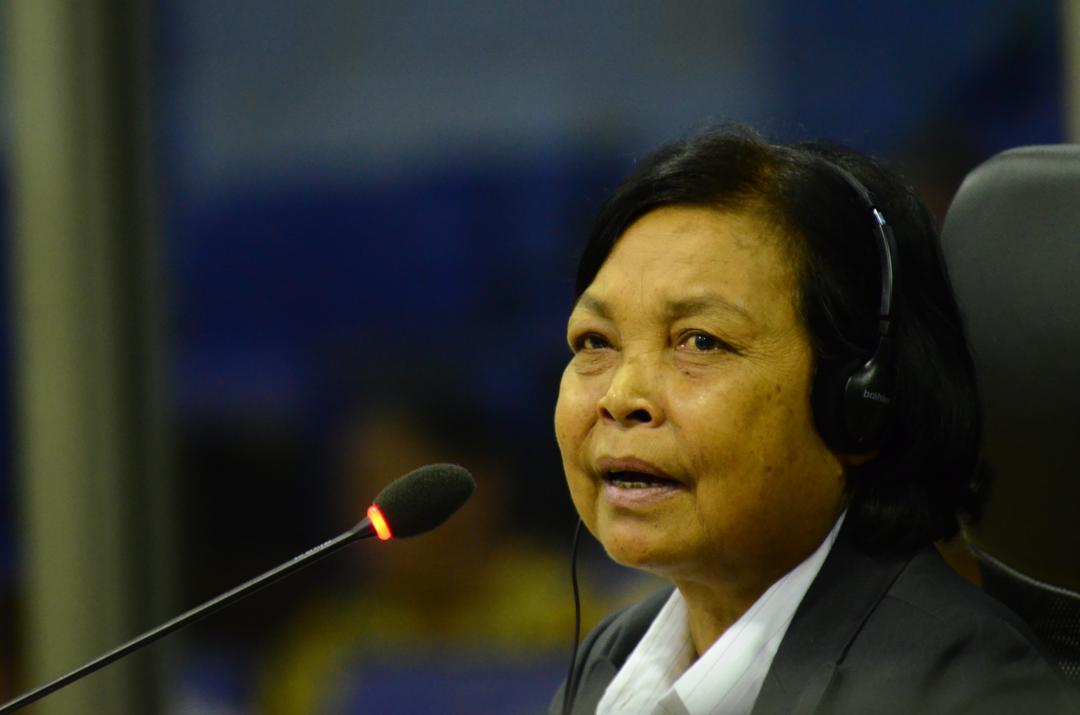
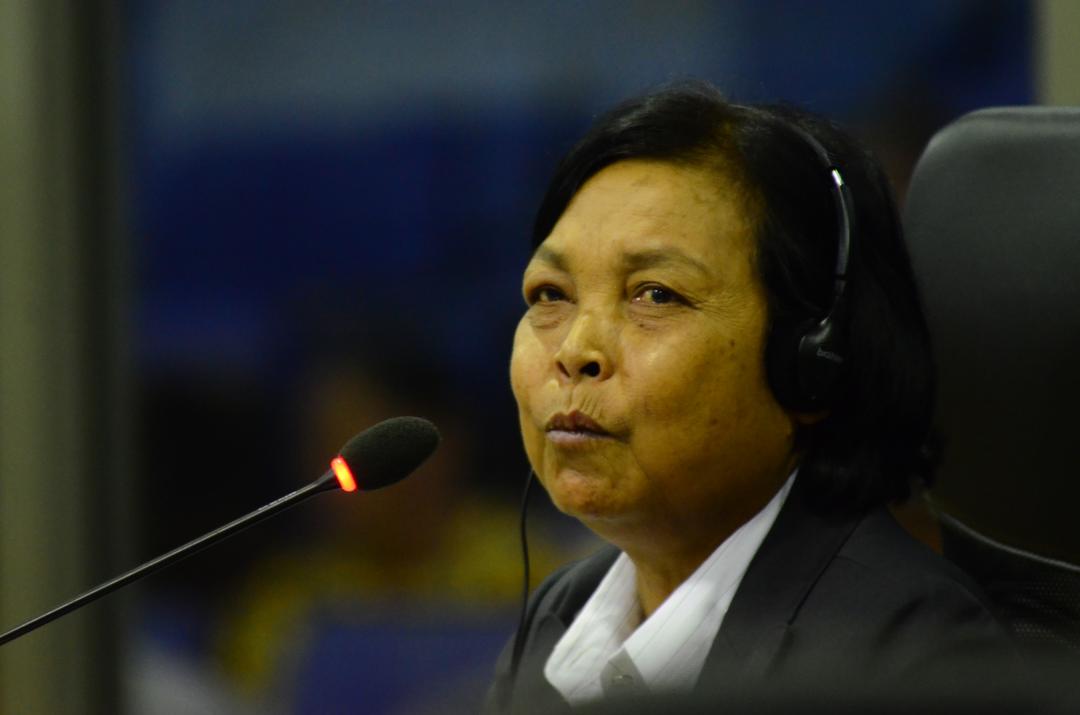
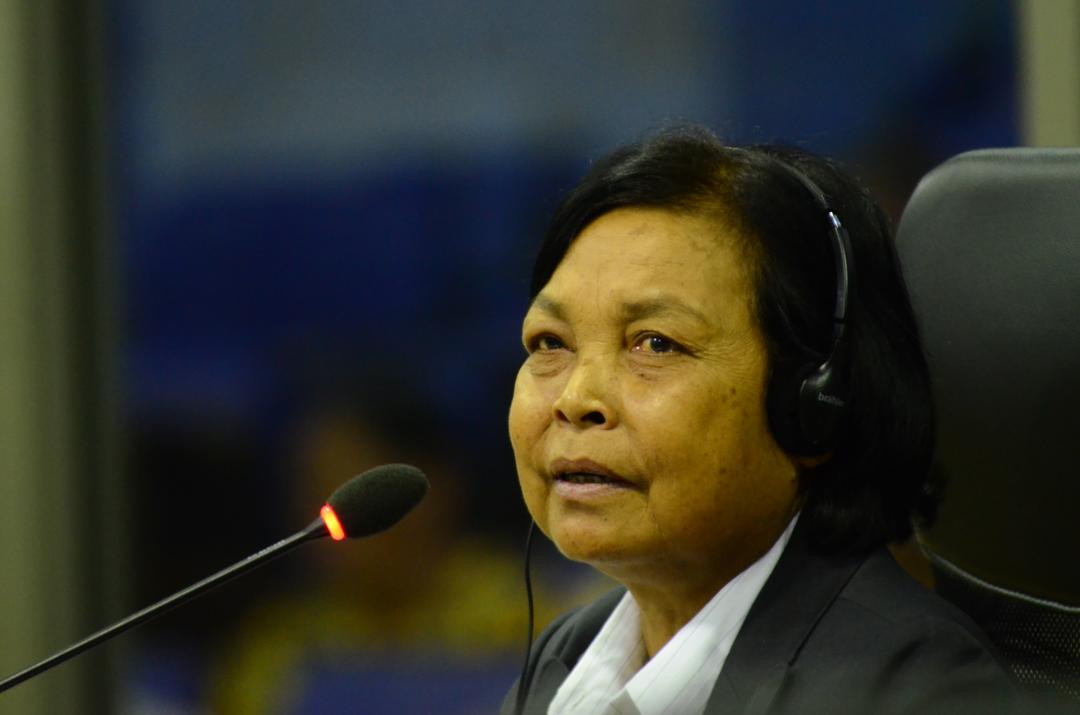
CHEA Deap
Pseudonym: 2-TCCP-286
Cases: Case 002/02
Category: Civil Party
Background and role
Chea Deap joined the revolution in 1974 in Kampong Cham province as a combatant in a military transport mobile unit.
1
On 17 April 1975, she and her company entered Phnom Penh and were in charge of transporting the “war spoils” seized from other people’s houses.
2
She got married in Phnom Penh the same year.
3
Chea Deap testified as a Civil Party before the Trial Chamber in Case 002/02 on meetings with Khieu Samphan, moral offences, and forced marriages.
Meetings with Khieu Samphan
Chea Deap met with Khieu Samphan for the first time in 1975 when he came to open a study session for youths at Ounalom Pagoda,
4
during which he instructed that older male and female youths should be arranged to get married to produce children for Angkar to have more forces to defend Cambodian territory, and advocated the necessity of remaining detached from parents.
5
These points were raised in all study sessions and meetings she attended.
6
Khieu Samphan stated that women between the ages of 19 and 35 should marry.
7
Relying on Chea Deap’s testimony among other evidence, the Trial Chamber found that Khieu Samphan actively instructed on the implementation of the common purpose through various policies,
8
including the regulation of marriage to facilitate the increase of population.
9
The Supreme Court Chamber upheld the findings, dismissing Khieu Samphan’s allegations of inconsistencies in Chea Deap’s evidence and the question of lack of corroboration by other evidence.
10
The second time Chea Deap met Khieu Samphan was in a meeting at Borei Keila during which Hu Nim and Hou Youn were “tried”.
11
Khieu Samphan was “the advisor at that place” and was addressed as “Om” or “Uncle”.
12
On the basis of her testimony, the Trial Chamber found that after Hu Nim’s arrest in April 1977, Khieu Samphan publicly called for his messengers to be interrogated, and knew of his arrest and death at the time.
13
Moral offences
Chea Deap testified that she understood the morality principle to be that people have to respect other by their title and name.
14
During the Democratic Kampuchea period, discipline was very strict, and no one was allowed to engage in any “moral offences”, which could have very different meanings.
15
In some instances, “if a man or a woman fell in love with one another without permission then the persons would be separated. However later on if they observed that they behaved well then the marriage would be organized for them”.
16
Based on Chea Deap’s testimony among other evidence, the Trial Chamber found that male-female relationships outside the context of marriage were considered a form of moral offence.
17
Forced marriages
Chea Deap testified that she was arranged to be married by her supervisor.
18
She said she had no choice because she already refused many times.
19
She was accused of having a fiancé or a boyfriend,
20
so she was sent to work at another location.
21
Chea Deap met her husband for the first time only on their wedding day,
22
as part of a group wedding in which female combatants were to marry disabled soldiers brought in from the North Zone, including her husband.
23
The Trial Chamber cited Chea Deap’s testimony among other evidence in finding that, while certain individuals including disabled soldiers may have been consulted on their marriage, the general practice was that individuals had no choice as to whether or who they would marry.
24
The Supreme Court Chamber upheld the finding, considering that extensive evidence contradicted the official policy of consent to marriage.
25
Chea Deap got married at 19 or 20 years old to her 26 year-old husband.
26
She was informed of the wedding ceremony three days in advance.
27
The ceremony consisted of 12 couples,
28
lasted less than one hour in the morning,
29
and was not conducted according to Khmer tradition.
30
Parents and family were neither consulted,
31
nor present.
32
She was told by senior cadres to follow Angkar’s advice because she was one of Angkar’s children. The Trial Chamber cited her testimony among other evidence to find that parents and family members were usually not present at weddings, and that the number of couples ranged from 1 to 70-80 couples in a single ceremony.
Chea Deap testified that, during the ceremony, couples had to stand and salute the Party flag,
36
and make commitments including producing children for Angkar.
37
She stated that authorities advised that couples had to love each other and live together.
38
The Supreme Court Chamber upheld the Trial Chamber’s findings on the population increase policy through the regulation of marriage,
39
rejecting Khieu Samphan’s argument that the Trial Chamber erred in ignoring Chea Deap’s evidence on the advice given to love each other and live happily together as a couple.
40
According to Chea Deap, after the wedding, each couple was sent to stay in a room together for three days before being separated to their respective workplaces.
41
Chea Deap was told by her husband to get along well together for fear of being mistreated,
42
and she was told by others to be careful because they would be monitored at night.
43
On the first night, she heard footsteps outside the door,
44
and did not consummate the marriage since she was afraid of her husband and militiamen.
45
If the militiamen found out that a couple did not agree to stay together, they would be called for re-education or refashioning.
46
Chea Deap only met her husband once every one or two months.
47
They consummated the marriage at her next visit at her “husband’s choice”.
48
Based on her testimony among other evidence, the Trial Chamber found that: (i) couples were commonly monitored to ensure that they had consummated their marriages;
49
(ii) genuine consent to the consummation was not possible in an environment where couples had not consented to the marriage, knew that consummation was required, compliance was monitored, and in case of noncompliance, forced;
50
and (iii) once Angkar married couples, it was not possible for them to divorce during the regime.
51
The Supreme Court Chamber upheld the above findings considering that: (i) both men and women were subjected to a coercive environment in which consent was lacking;
52
(ii) couples who did not dare to seek divorce for fear of being reprimanded, being sent for re-education or killed constituted “specific and substantiated examples of sanctions”;
53
and (iii) increasing the population was one of the purposes of the regulation of marriage policy even though couples were often separated after marriage.
54
Chea Deap stated that she wept almost every day:
55
“It was so painful, particularly when I was forced to get married”,
56
and “every time I think of what happened, that I did not like my husband, that I was organized to marry him by Angkar, I feel the pain in my chest.”
57
Based on her testimony among other evidence, the Trial Chamber found that her forced marriage experiences had a long-lasting impact on her and many of the victims were still haunted by this to this day.
58
The Supreme Court Chamber upheld the finding, considering that the Trial Chamber did not err in not to consider that she mentioned her suffering from the loss of her family during her final statement of suffering to find the impact from her forced marriage.
59
It found that “her unequivocal statement” that she did not choose to consummate the marriage was more than sufficient evidence of the harm she experienced.
60
Videos