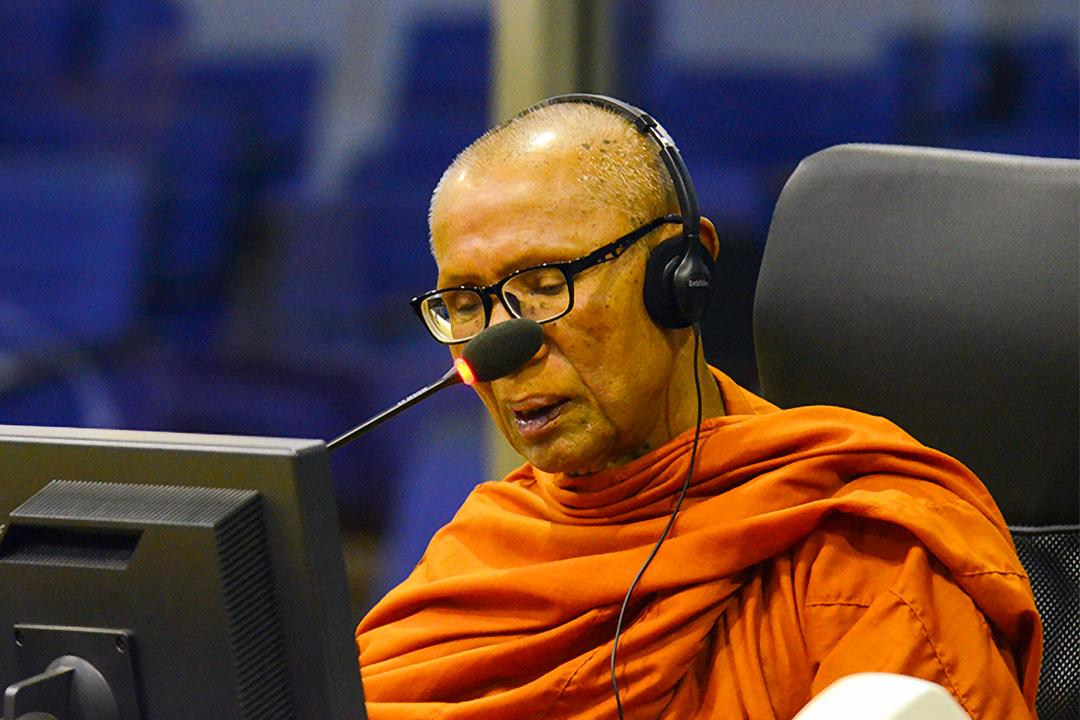
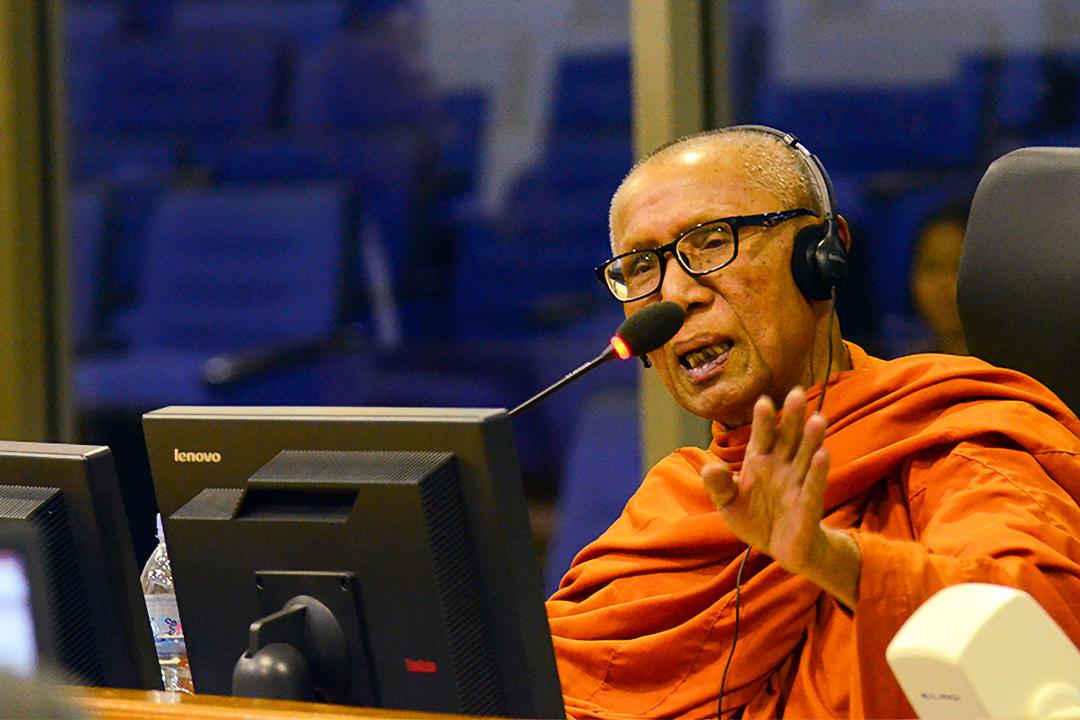
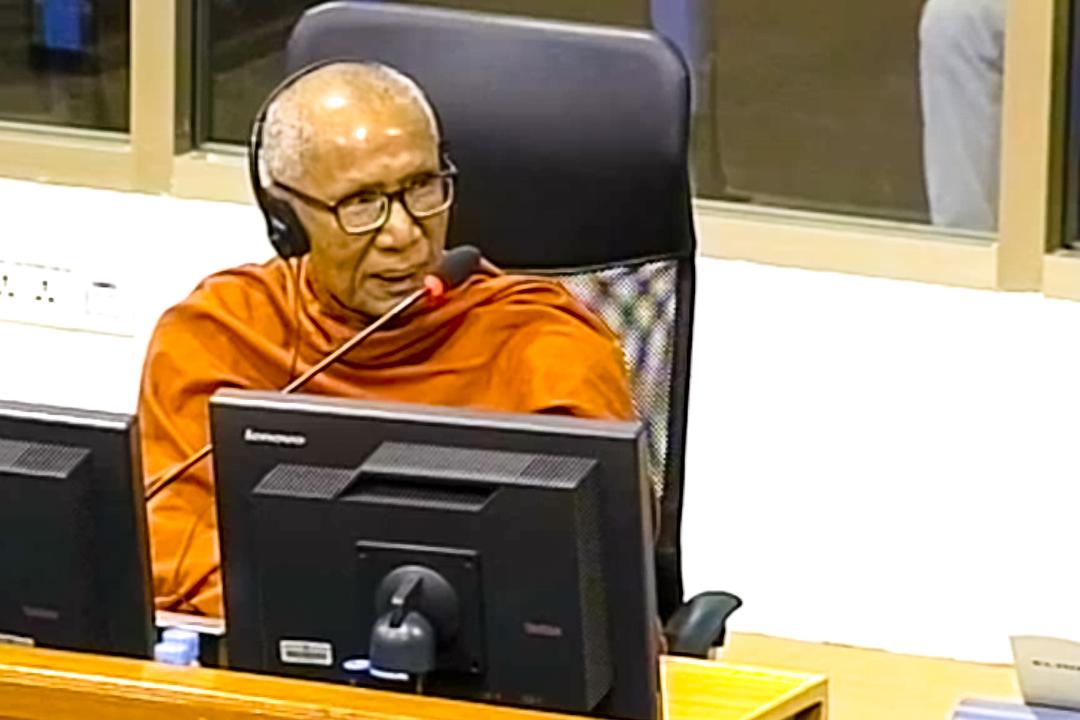
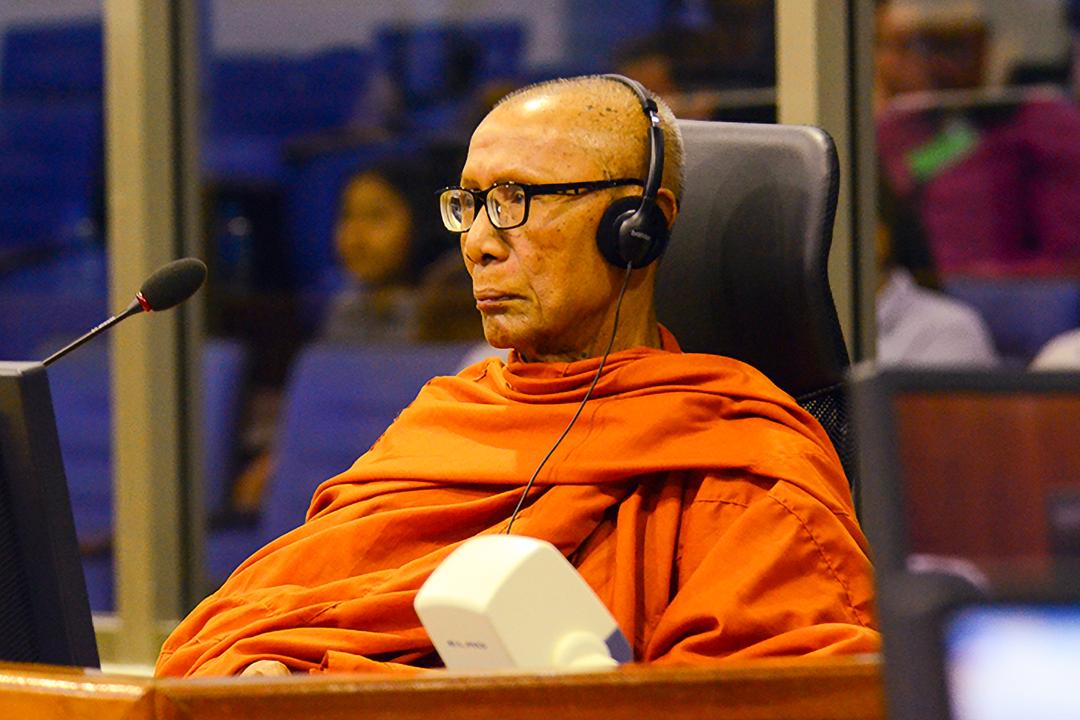
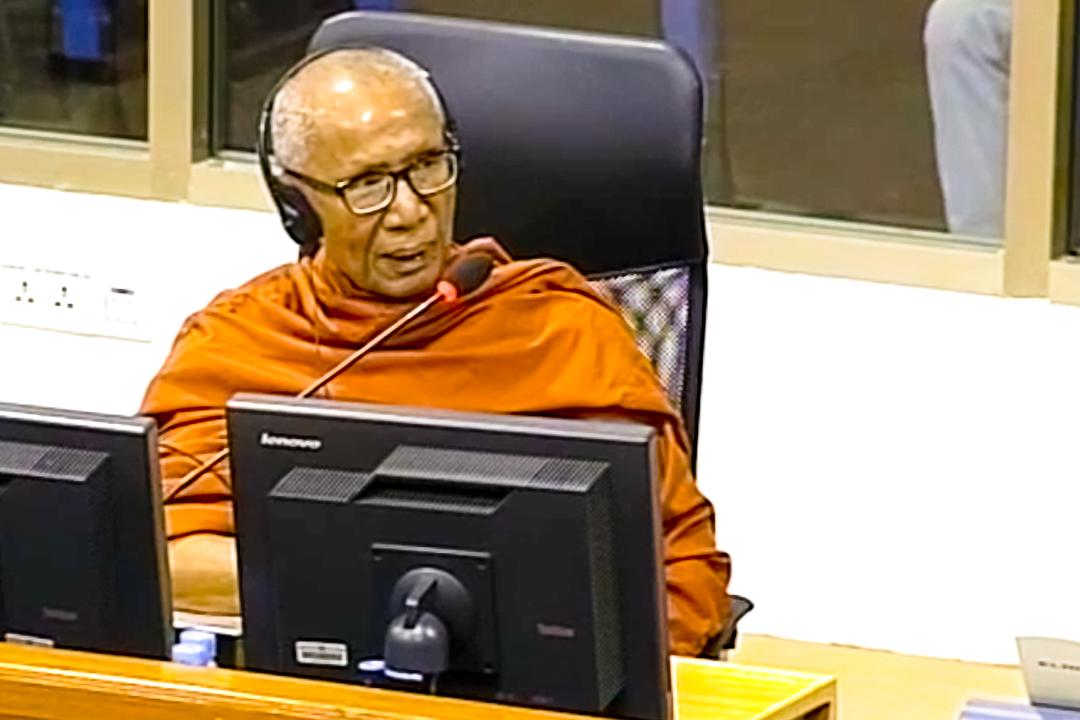
EM Phoeung
Pseudonym: 2-TCW-954
Cases: Case 002/02
Category: Witness
Role and background
Em Phoeung was a monk since his childhood,
1
and at the time of providing his witness testimony held the position of Provincial Monk Chief of Kampot.
2
In 1975 he was evacuated from Phnom Penh and categorized as a 17 April Person (“New People”).
3
In 1976 he was forced to leave the monkhood and was sent to work in a youth group in Tram Kak district.
4
He testified before the Trial Chamber in Case 002/02 on the evacuation from Phnom Penh, being disrobed from the monkhood and the treatment of Buddhists, the practice of forced marriages, and disappearances at Tram Kak.
Evacuation of Phnom Penh in April 1975
Before 1975 monks from remote areas moved to a pagoda in Phnom Penh due to the American bombings,
5
which destroyed some pagodas in those remote areas.
6
On 17 April 1975, Em was told by ‘Angkar’ to leave Phnom Penh for a week and that he could bring with him an umbrella and his clothing.
7
Instead, he travelled for one month on foot with other monks and his students to Angk Roka Pagoda in his hometown in Tram Kak district, Takeo province.
8
While travelling they were not mistreated, but were afraid and suffered from food shortages.
9
Some monks disappeared during the evacuation.
10
He heard that three monks were tortured and killed by Angkar because they opposed CPK instructions.
11
Forced removal from the monkhood
Upon arriving at Angk Roka Pagoda, Em met some of his teachers and other monks.
12
Most of the monks that stayed in this pagoda came from the Takeo province.
13
At first, they were not required to work and had to cook for themselves and collect vegetables,
14
which is against the Buddhist discipline
15
as monks are not allowed to engage in that nature of work.
16
After some time, Angkar ordered them to leave the monkhood and work,
17
whether they were young or old.
18
There was a meeting at Angk Roka Pagoda in which the monks were instructed to perform labour for the regime.
19
They were given no other option.
20
If they refused to leave the monkhood, they would have nothing to eat because they depended on alms.
21
Base People who met with the monks also told them that they need to work for the Regime.
22
The Trial Chamber relied on Em’s testimony to find “that Base People were able to visit the monks at Angk Roka for a period of time after 17 April 1975”.
23
By 1977, all monks in Cambodia were forced to leave monkhood without a ceremony; however, their disrobing was witnessed by fellow-monks in the pagoda.
24
They were given black clothes and shoes.
25
Younger monks left the monkhood first, other monks followed.
26
No one dared to complain or refuse the orders
27
out of fear of the consequences.
28
Relying on Em’s testimony, the Trial Chamber confirmed the process of leaving the monkhood and established that the instructions for doing so came from a member of the commune.
29
It further found that all monks at the Angk Roka Pagoda had no choice but to leave the monkhood.
30
Soy, the chief monk at the Damnak Trayueng Pagoda, refused to join the youth group and was killed.
31
The Khmer Rouge also killed a monk at the Angk Prey Pagoda who was buried near the vicinity of the pagoda compound.
32
Working conditions at Trapeang Dang Tuek dam & Disappearances
After leaving the monkhood, Em went to Samraong cooperative, Banteay Meas district in Kampot
33
to join a mobile youth group.
34
He was part of the mobile unit until the liberation of the country.
35
In his village, people were divided into three groups: the regular force, the ordinary force, and the elderly.
36
Although they were exposed to hard labour, food was scarce until 1978,
37
when they started receiving rice instead of gruel.
38
There were groups of 10-20 monks who dug canals, transplanted cassava, and grew vegetables.
39
At first, they were assigned to first build a canal at Trapeang Dang Tuek and later to construct the canal at Trapeang Dang Tuek.
40
They worked from 6 a.m. to 11 a.m., and from 1 p.m. to 6 p.m,
41
and sometimes had to work longer hours.
42
During the rainy season, they also worked at night.
43
Older monks who could not do heavy labour made baskets for the younger monks to carry the earth.
44
Youth units provided the main force in digging canals and building dams, and engaging in dry season farming.
45
A group of 30 people was needed to complete that dam within a month.
46
At the worksite, the Base People supervised the New People,
47
and he did not witness any mistreatment.
48
Base and New People were usually separated,
49
but shared a communal kitchen.
50
Em performed his duties in order to survive.
51
Former monks kept praying and conducting their sermons in secret.
52
Em noticed disappearances – including of two famous movie stars (Nop Nem and Kim Nova) from Phnom Penh – but no one knew what happened to them because they were sent for re-education.
53
Among those who disappeared were also Lon Nol officials, policemen, teachers, and professors,
54
who were tricked to disclose their true biographies.
55
The Trial Chamber noted Em’s testimony “that former Khmer Republic officials were targeted, and a method was used whereby they were told that Angkar needed them for work which led many to reveal their past; only very few who hid their identity survived”.
56
The elimination of Buddhism between 1975 and 1979
The Trial Chamber noted Em’s testimony that monks were described as “worms” or “leeches” during meetings at villages or commune level.
57
Throughout the regime, the majority of the pagodas were turned into prisons or pig pens.
58
Temples in the pagodas were equipped with metal bars to shackle the prisoners.
59
No one spoke about religion.
60
After 1976 monks could not attend Buddhist rituals for funerals and lay people buried the bodies.
61
Em testified that “[d]uring the DK regime […] everything was destroyed. The Buddhist manuscripts, for example, that were made from palm tree leaves, they tore them – they tore them apart and used them as hats”.
62
The Trial Chamber cited his testimony in support of its finding that “Buddha statues and religious objects were also frequently destroyed”.
63
After being re-ordained at Chum Kriel Pagoda in 1981, he did not see any previous monks from that pagoda or from Angk Roka Pagoda.
64
Forced marriages
Em refused the commune chief’s instruction to marry and he was not mistreated or arrested for refusing because local people who knew him from childhood intervened.
65
Other monks were forced to marry
66
in groups of 10 or 20.
67
The village chief conducted the ceremonies at night.
68
Because he was known to people in the village, Em was invited to give one blessing at a marriage ceremony.
69
The Trial Chamber referred to this evidence in its Judgment, noting that “[w]hile EM Phoeung did give a blessing at the wedding, he did not do so as a Buddhist monk because he had already been defrocked in 1976”.
70
In consideration of his testimony, the Trial Chamber found that there is limited evidence that there were Buddhist blessings at weddings,
71
and “[t]hese instances do not have an impact on the consistent evidence that weddings were not conducted in accordance with Cambodian tradition. The Chamber is satisfied that, in general, wedding ceremonies during the DK period were not conducted according to Cambodian tradition”.
72
The Trial and the Supreme Court Chambers further found that Em’s refusal of arranged marriage was an exception,
73
with the Trial Chamber noting that “[t]he witness himself explained that it was strange that he would suffer no consequence for his refusal and concluded that the local people intervened as they had known him from childhood”.
74
Videos