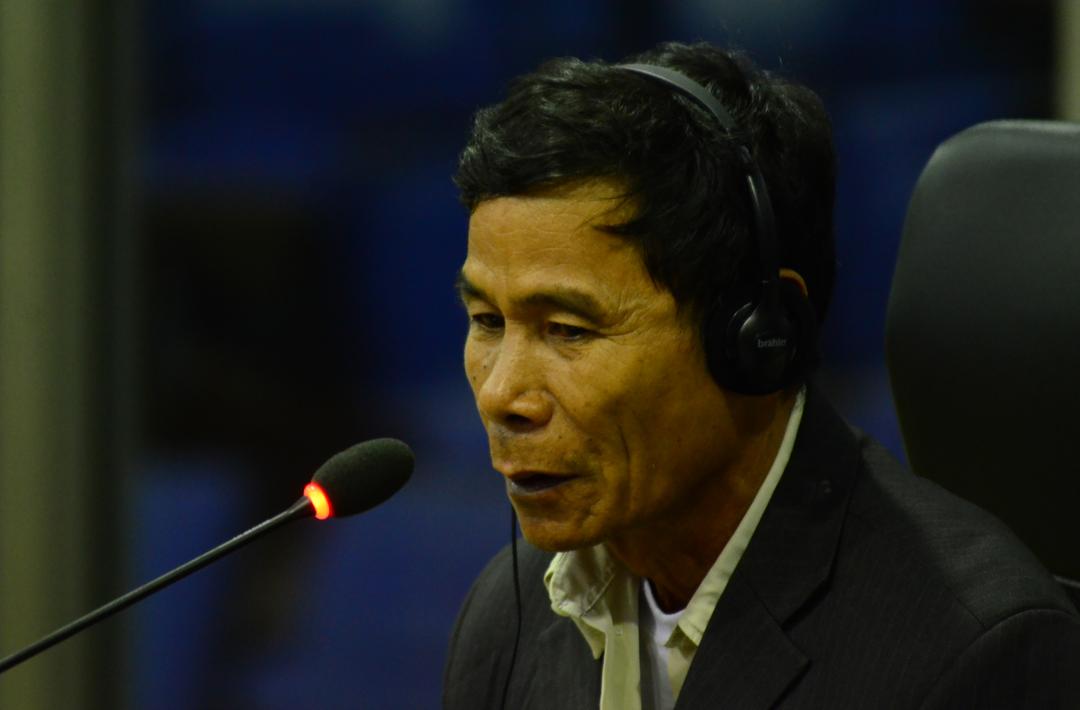
HIM Huy
Pseudonym: 2-TCW-906
Cases: Case 002/02
Category: Witness
Background and role
Him Huy was in the Khmer Rouge military.
1
From 17 April 1975 until 1976, his unit was based in Takhmau, building dykes and working in rice fields.
2
From 1976 until mid-1978, he was assigned by his battalion Commander Hor to work in S-21 Security Center.
3
At S-21, he worked as a guard, in a messenger unit,
4
and later became the head of a “Special Unit” or “outside guard unit” or “arrester unit”.
5
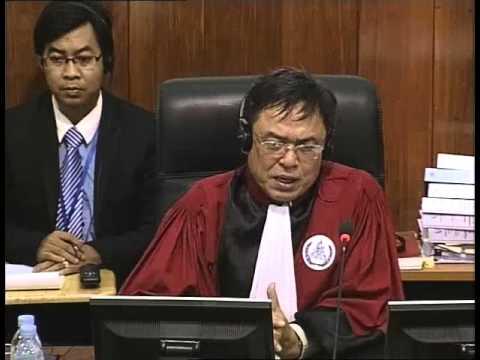
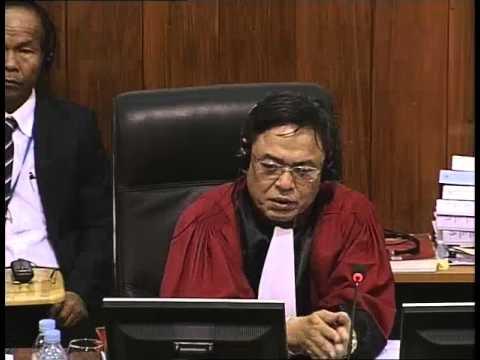
He testified as a witness before the Trial Chamber in Case 002/02 on the S-21 Security Center and on forced marriage. The Trial Chamber considered him as one of the key witnesses on the S-21 Security Center.
6
Location and lay-out of S-21
S-21 was located in the former Tuol Svay Prey High School, which was turned into a prison building during the Khmer Rouge regime.
7
The east side was bordered by a big road, the north with the Chinese hospital; the west with another road; and the south with the area close to Tuol Tumpung Pagoda.
8
The old school buildings within the compound held prisoners; the interrogation facility was to the east of the prison.
9
The burial site was about 100 metres away to the south of the compound.
10
The guard post was outside in the surroundings of the compound.
11
Another satellite of S-21 was located at Prey Sar, and used for the rice farming and re-education.
12
Study sessions for S-21 and Prey Sar staff
All the staff at S-21 and Prey Sar had to attend the study sessions at the political school located to the south of “Duch's” (chief of S-21) house.
13
The political study sessions enabled staff to distinguish between enemies and friends.
14
“Angkar” arrested enemies.
15
Duch instructed that those brought to S-21 would not be allowed to go out, and must be killed after the interrogations concluded.
16
Sometimes training occurred in response to specific disciplinary breaches.
17
In every training session, Duch mentioned Brother One; Brother Two (Nuon Chea);
18
and Office 870.
19
Around 1977, Son Sen convened a meeting at S-21.
20
He had been Duch's superior until he engaged in the battlefields against Vietnam.
21
Him Huy also attended another training session conducted by Son Sen.
22
The topic was the building of the country and agricultural production, military strategies, and sending forces to fight against the Vietnamese and the infiltrated enemies.
23
Structure and Personnel
Nat was the commander of Division 703 and the first chairman of S-21.
24
Duch was the principal chief of S-21, Hor was the deputy, and Huy (Sre) a member.
25
They were all CPK members.
26
Duch’s instructions were relayed to Hor.
27
Hor was responsible for supervising and giving orders to all the S-21 security guards.
28
Huy (Sre) was the chief of Prey Sar until he was arrested.
29
There were around 300 guards, interrogators and logistics people working in/around S-21.
30
The “guard unit” was in charge inside of the compound;
31
under the supervision of Peng, and Phal as his deputy (later the chief of Prey Sar).
32
The youngest guards were about 15 years old.
33
An outside group was stationed on guard at the Beehive radio station,
34
responsible for receiving prisoners and bringing them in, transporting prisoners to Choeung Ek,
35
and making arrests.
36
The Trial Chamber noted that this special unit was also often referred to as “guards”, even though they were not part of the smaller “guard unit”.
37
Him Huy explained that he was selected at first to become an interrogator, but he refused to do it as he did not know how to write.
38
However, based on other evidence, the Trial Chamber considered that he had in fact also been an interrogator at S-21.
39
Prisoners at S-21
People were arrested - from all over the country and including those who just returned from overseas.
40
Guards were given strict instructions not to harm prisoners during their transfer as they needed to arrive safely at S-21 for the interrogations.
41
Sometimes people arrived at S-21 with their children who were detained along with them.
42
Duch gave instructions that “if you dig the grass, you have to dig the root as well”, which meant family members of any suspected traitor were to be arrested.
43
Some members of Division 703 who worked at S-21 were also arrested.
44
After 1977, S-21 staff were prohibited from speaking to each other, and instructed to monitor the activity of one another.
45
Only Duch had the authority to issue orders for staff arrests.
46
Members of his group were successively arrested,
47
and killed within the compound of S-21.
48
Him Huy went to Svay Rieng twice to bring Vietnamese prisoners to S-21.
49
Approximately 40 to 60 Vietnamese soldiers were arrested;
50
tied and handcuffed, and wearing military uniforms with a military cap.
51
Two Americans were detained at S-21;
52
upon completion of their interrogations, Duch instructed them to be burned after execution.
53
Registration and interrogations of prisoners
The vehicles which took prisoners to S-21 were not allowed inside the compound due to secrecy.
54
Prisoners were blindfolded and handcuffed.
55
After their arrival, they were unloaded from the trucks and sent into Him Huy’s house. After receiving any accompanying letters, he forwarded them all to Suos Thy for registration and photos.
56
People accused of having committed mistakes or fraud were not put directly into the compound,
57
but transferred to Prey Sar in order to work in the fields without passing through registration in the compound.
58
The “special prison”
The “special prison” was usually used for detaining important prisoners - the building on the left-hand side of the compound.
59
Those prisoners were driven directly into the compound without passing through registration.
60
Only Hor and Duch had the authority to enter the premises of the special prison.
61
For instance, Koy Thuon, the initial Central (old North) Zone Secretary and former Minister of Commerce under the Khmer Rouge regime, was detained there.
62
Him Huy was involved in his arrest, along with other S-21 staffs at Duch’s house.
63
Executions of prisoners
Upon the conclusion of interrogation, prisoners were killed by Peng’s group to the west of the compound.
64
Duch was the one who designated the burying place.
65
The Trial Chamber found that prisoners were usually taken out of the compound at night for execution; were initially taken out every one or two weeks; and the number of prisoners executed ranged from approximately 50 to 100 on any given day.
66
The execution of prisoners started happening at Choeung Ek from 1977-1978 until the fall of the regime in 1979.
67
The executions began following a discussion between Duch and Hor that killings had to be conducted there for fear of the leak of information about the killings at S-21, and due to the risk of epidemics given the large number of corpses buried there.
68
Him Huy was assigned to transport prisoners to Choeung Ek for the executions and described the process.
69
Prisoners were not told that they were being taken to be killed.
70
While parents were sent to be killed at Choeung Ek, their children (between one to five or six years old)
71
were killed at the location behind the prison.
72
After their interrogations concluded, the Vietnamese were also killed by Peng’s group at the south of the compound.
73
Him Huy said that he was removed from his position at S-21 and assigned to work in the rice field mid-1978 after being implicated in a confession for planning a rebellion at S-21.
74
The Chamber found that the witness was embellishing the details regarding his planned “rebellion” in an effort to minimize his responsibility at S-21 regarding killing prisoners; therefore, it approached Him Huy’s evidence on this issue with caution.
75
The Trial Chamber relied on his testimony to find that while some executions were carried out at S-21 and its immediate surroundings, the majority of them were carried out at Choeung Ek;
76
and, as corroborated by others, children were killed in the vicinity of S-21.
77
Forced marriage
Him Huy recalled that on one occasion, six women were brought in to marry S-21 staff.
78
It was a ceremony for many couples, followed by a reception.
79
The marriage was arranged by Duch; the couples did not know each other before.
80
The Trial Chamber found that even though some male cadres were allowed to choose their wives, their spouses were forced to marry without being asked.
81
Videos