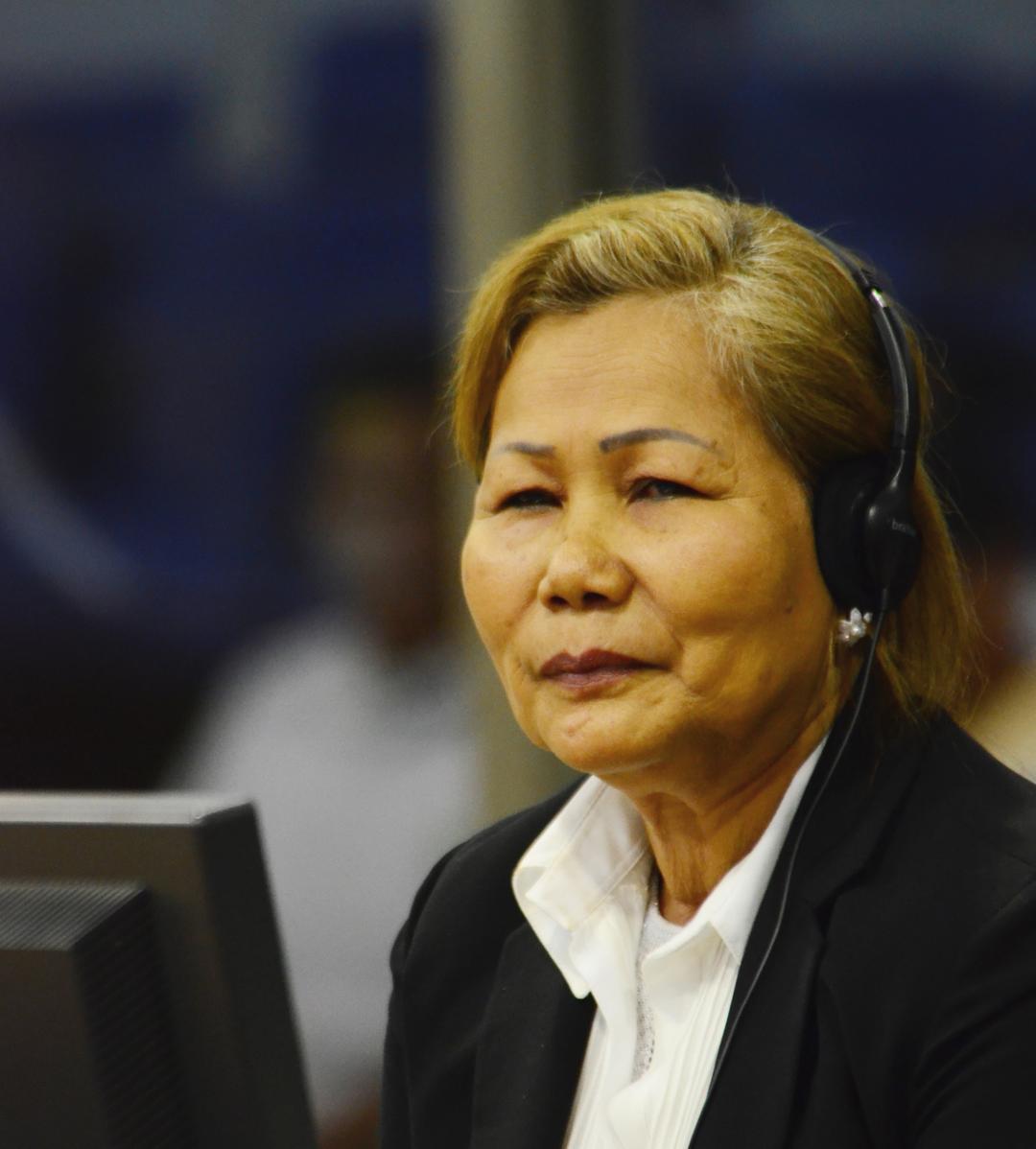

HUN Sethany
Pseudonym: 2-TCCP-255
Cases: Case 002/02
Category: Civil Party
Background and Role
Hun Sethany worked at the 1st January Dam (the “Dam”) from December 1976 until around June 1977.
1
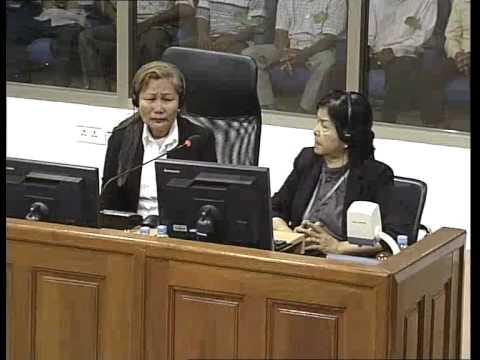
She testified as a civil party in Case 002/02 on the working and living conditions at the Dam.
2
The Trial Chamber relied on her testimony in findings on the Dam, including that: (i) tens of thousands of people were forced to work under difficult conditions;
3
(ii) the living conditions were extremely poor;
4
(iii) former Khmer Republic soldiers and officials were arrested and sent to the Dam;
5
and (iv) inadequate food was provided to the workers.
6
Working Conditions
According to Hun Sethany, there were tens of thousands of workers at the Dam, though the number was not static.
7
The Dam was a “hot battlefield”
8
with long and strict working hours
9
and daily work quotas that had to be met.
10
She recalled being overworked and sometimes fainting while working, only to be supported by other workers who would massage her or pull her hair to wake her up.
11
People were killed for failing to meet their work quotas
12
and a man she knew from her village died from overwork two weeks after returning from the worksite.
13
There was a landslide caused by competition amongst villagers to complete work more quickly that resulted in deaths.
14
When explosives were used, the workers normally were not told in advance and would be injured as a result.
15
Unit chiefs, by contrast, did not work hard and at times would disappear somewhere to rest.
16
They ate pork and beef every tenth day and suffered from diarrhoea due to the richness of the food.
17
The Trial Chamber relied on Hun Sethany’s testimony in finding that: (i) the number of workers at the Dam was in the tens of thousands, ranging between 20,000 and 40,000 during peak construction periods;
18
(ii) the Dam had a strict timetable and deadlines had to be respected;
19
(iii) there were multiple landslides at the Dam resulting from an atmosphere of intense, forced competition that injured or killed several workers;
20
(iv) the working hours for workers were long and arduous
21
and the conditions were difficult,
22
and workers were motivated by fear to meet work quotas;
23
(v) workers were usually granted a day of rest every 10 days;
24
and (vi) working conditions for supervisors and technicians were not as difficult.
25
Hun Sethany also recalled that children were forced to work at the Dam.
26
However, the Trial Chamber found that the only evidence of children being forced to work at the Dam came from Hun Sethany and although there were clearly individual instances of children working there, it did not amount to a general practice.
27
Living Conditions
Hun Sethany described how Khmer Rouge guards watched over the workers at the Dam to prevent them from escaping.
28
Guards threatened to arrest them if they were discovered speaking and two siblings who were talking to one another were forced to separate.
29
Regarding general hygiene, no effort was put into eliminating flies, such as spraying pesticides, which resulted in many cases of dysentery since their food was full of flies.
30
Moreover, workers only had one or two sets of clothes.
31
Rabbit drop pills were provided by medics irrespective of the illness.
32
The Trial Chamber relied on Hun Sethany’s testimony in finding that: (i) the harshness of the living conditions at the Dam was exacerbated by the presence of sometimes-armed soldiers and militiamen watching over the workers in order to ensure they kept working as much as possible;
33
(ii) the hygiene conditions were extremely poor and inadequate to sustain the workers in the assignments they had to undertake, and the bare minimum of clothing with no means to wash led to disease and exacerbated the suffering of workers at the Dam;
34
and (iii) proper medical care was not provided to workers.
35
Former Khmer Republic Soldiers and Officials at the Dam
According to Hun Sethany, her father was a teacher during the Lon Nol regime, who was later arrested, sent to work at the Dam, and never seen again (she was told that her father was killed at Baray Choan Dek pagoda).
36
The Trial Chamber relied on Hun Sethany’s testimony in finding that after workers from the Dam were sent to Baray Choan Dek pagoda, they were killed.
37
The Supreme Court Chamber also referred to Hun Sethany’s testimony in dismissing Khieu Samphan’s argument that her testimony regarding the arrest of her father on political grounds was hearsay and insufficient to find a policy targeting all former Khmer Republic soldiers and officials at the Dam,
38
and recalled that the Trial Chamber may properly rely on hearsay to establish by inference the elements of criminal conduct, including the inference that the arrest of former Khmer Republic soldiers and officials formed a general practice.
39
Food and Clean Water Shortages
According to Hun Sethany, workers at the Dam had a lack of food
40
and clean drinking water,
41
and most women from her village did not have a menstrual cycle due to hunger.
42
In the rainy season of 1977, there was a food shortage in her village and they ate only gruel with soup.
43
Food supplies were being given to militiamen and soldiers on the front line and rice was transported to the commune warehouse, even when there was a food shortage.
44
The Trial Chamber cited Hun Sethany’s testimony in finding that: (i) the amount and quality of food was inadequate with the result that workers at the Dam grew malnourished and emaciated;
45
(ii) workers had to drink unboiled water;
46
and (iii) although the primary purpose of the Dam was to provide agricultural irrigation to nearby rice fields, much of the rice was shipped outside of the workers’ communes even when there was a shortage of food.
47
Statement of Harm
“The injury which was inflicted upon me was that I used to live in a happy life with my family. When the regime came into power, we lost everything. We lost what we had in the previous time. I lost my house, belongings and property; I lost my parents, siblings. I live alone. I lost everything as I said. I underwent sufferings. I am so lonely, and for those who are so lonely as me, they understand my situation. Some people who do not understand my situation, they may say: what's the point of giving your statement? The bad experience seems to be news to me when I think of what happened. I have learned all the bad experience and sufferings in my life. Why I had to go through this bad experience? How those people control and lead their countries? Are they pity on Khmer people? Do you know the difficulty they have experienced? We used to have our own property and belongings to use, but now we -- some of us lost almost everything. You can imagine how difficult our life is at the moment. I am so terrified. I have PTSD and trauma. I lived my life with no freedom and rights in that period. I would like to tell the Court that I do not want the reoccurrence of this regime again. I have suffered much in my life. Nothing can compare. I am trying my best to live my life at the moment. The innocent who were working very hard were killed. They were killed because of words came out of their mouth. If they committed wrongdoings, they would be taken away. Persecutions happened on them. What was the point of living their lives? They were persecuted. People experienced separation from families. Parents were separated from children. What was the society in that period? If you realise what happened in that period, please do not let such things happen again in the society.”
48
Videos