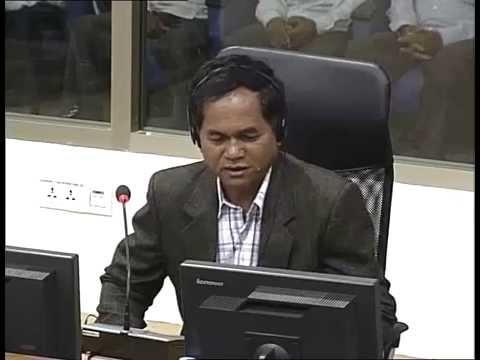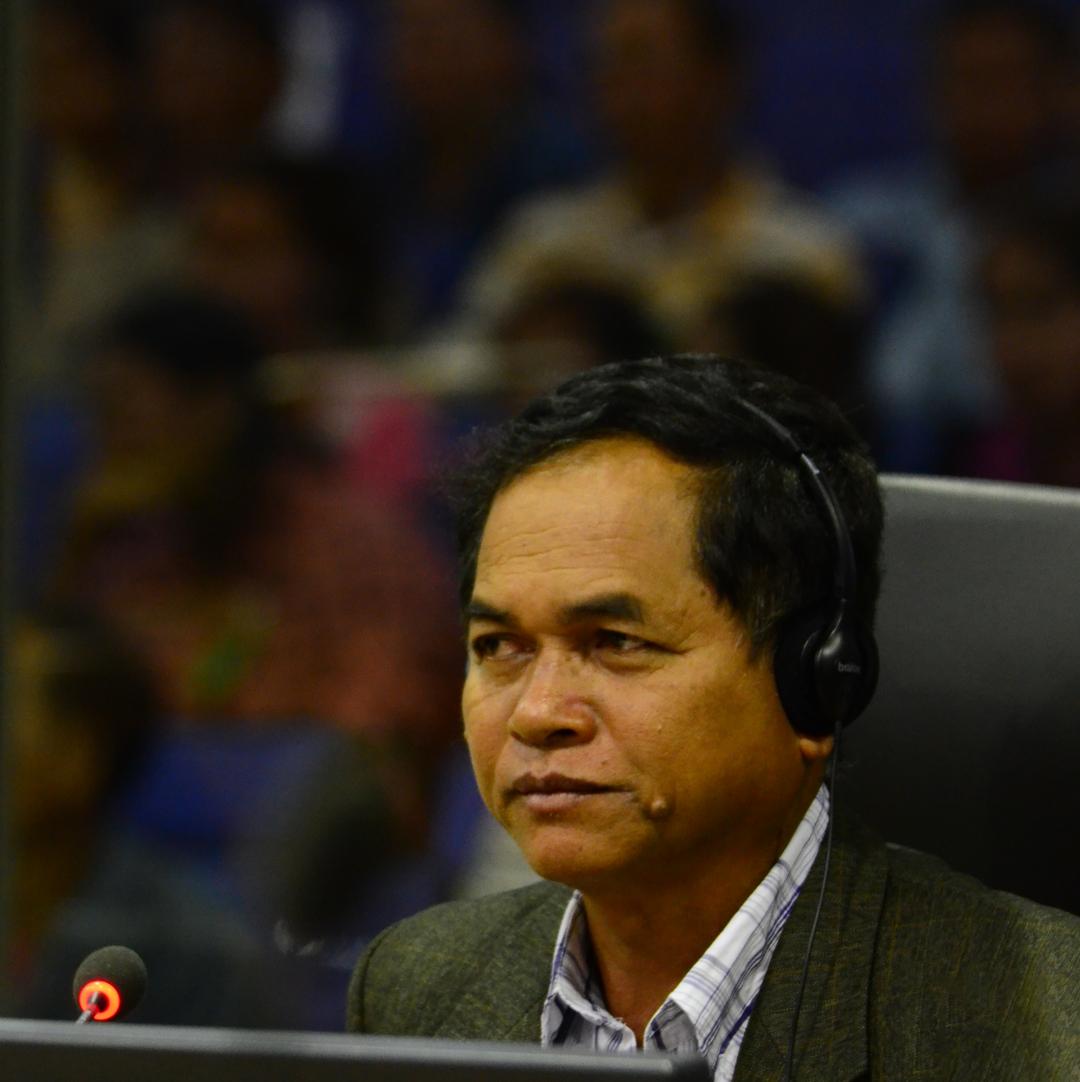
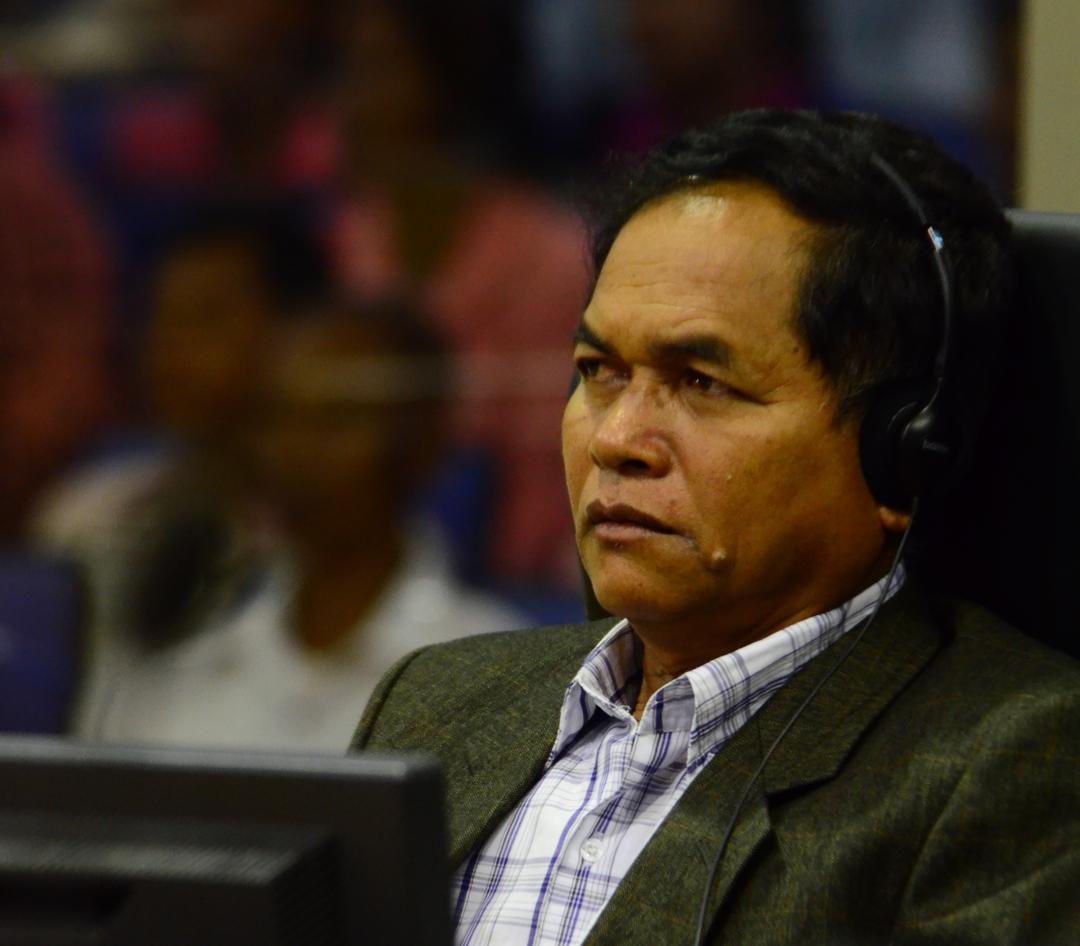
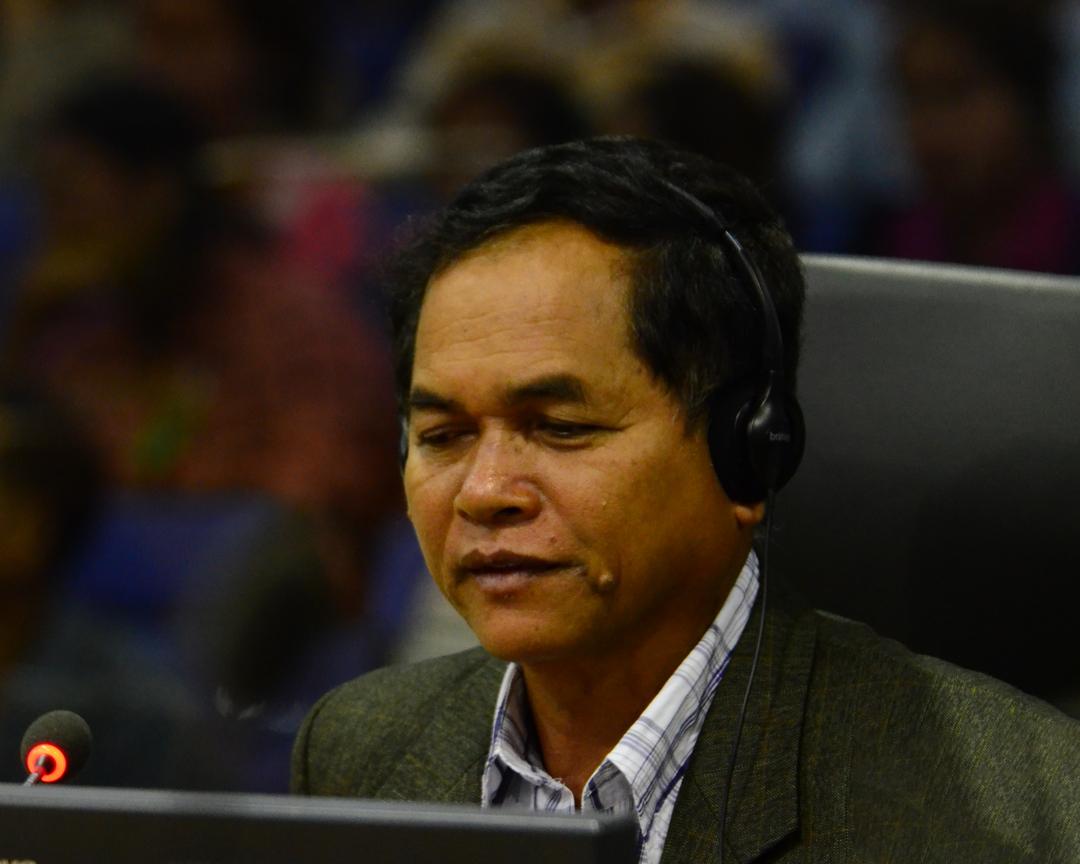
KEO Kin
Pseudonym: 2-TCW-910
Cases: Case 002/02
Category: Witness
Role and background
Keo Kin was a Khmer Rouge soldier from 1972
1
and became Ta Lvey’s messenger and bodyguard in 1974.
2
In 1975 he was asked to guard the gates and clear the grass at the Pochentong airfield.
3
In 1976, he was sent to Kampong Chhnang airport worksite to do hard labor until 1979,
4
because the Khmer Rouge found out that his father was a former deputy of a village in the Lon Nol regime.
5
Before 1975
Between 1972-74, discipline became stricter.
6
He attended military training sessions before 1975 and was told to obey the Party, not to move freely around,
7
and that anyone who opposed the regime, committed moral offenses,
8
or worked for the CIA or KGB, would be killed.
9
Kampong Chhnang airport worksite (1976-1979)
Kampong Chhnang airport worksite was secretive: no unauthorized person or civilian could enter the worksite.
10
Upon his arrival, Keo Kin was asked to uproot trees and dig the soil.
11
There were 10-20 soldiers working at the site
12
and about 10 Chinese technical advisors on land surveying and working in various other sections.
13
In 1976 and 1977 the number of workers increased to thousands,
14
all of whom were Khmer Rouge soldiers.
15
Soldiers at the worksite were not armed
16
and wore black clothes with a cap.
17
They were supervised by armed guards.
18
There were a number of women, mostly working as drivers of trucks carrying earth.
19
Most workers came from Division 502 or from the East Zone,
20
and were soldiers sent for refashioning.
21
East Zone soldiers were considered as prisoners of war
22
and were the target group for the arrests,
23
accused of betraying Angkar and being KGB or CIA agents.
24
People would be called into the office, arrested, blindfolded, and placed onto trucks.
25
Ordinary soldiers were arrested together with their unit chief.
26
“Once a person was accused, the person would not be spared”.
27
If someone was affiliated with the former regime, he or she would be purged.
28
Keo Kin was later moved to the garage unit.
29
His unit constructed wooden garages to park vehicles.
30
It took his unit six to seven days to complete one garage.
31
After he completed the work on the garages, he was assigned to do other construction and grow vegetables, which he did until 1979.
32
The work was difficult and sometimes his unit could not finish it on time – in such cases they would be reprimanded.
33
He worked from 5.00 a.m. until 10.00-11.00 a.m.,
34
and after that he rested; in the afternoon he resumed growing vegetables until 5.00 p.m.; and at night, he worked from 7.00 p.m. until 10.00 p.m.
35
In the morning, he assisted those working in the rice field nearby the airfield, which happened on a daily basis,
36
before beginning his work at the airfield.
37
When he was not building the garage he had to go and transplant rice seedlings.
38
He slept in a building where vehicles were parked, without a proper bed or a mosquito net.
39
After 1977, workers were instructed to work much harder.
40
They had no weekends
41
or breaks.
42
Keo Kin could rest only when he was told to do so.
43
Workers were not allowed to walk freely or take a bath,
44
and were urged to finish their work as soon as possible.
45
They were also under constant surveillance.
46
He testified that food was insufficient.
47
The ratio was given to the group as a whole and not to an individual soldier and they cooked and ate communally together in the group.
48
People fell sick due to insufficient food or from over-work or malaria
49
and were sent to the Kampong Chhnang hospital.
50
There were no medical doctors or medicine onsite
51
and sick people were rarely given medicine.
52
Workers hit by rock fragments from explosions died on the spot.
53
No one within his group discussed or talked to each other out of fear.
54
There was no mingling with other groups.
55
He only attended technical meetings on repairing vehicles and working in the garage,
56
but did not attend the self-criticism meetings of the cadres.
57
He testified that, if a worker, after being criticized, did not “deter”, he or she would disappear and that the Airfield authorities told the other workers “not to follow the steps of the individual that disappear[ed]”.
58
When Vietnamese troops were about to arrive in the country in 1979, workers were put in trucks that went eastward.
59
He heard about a supposed massacre of Eastern Zone soldiers at the beginning of 1979, among those who had worked at the Kampong Chhnang airfield construction site.
60
The Trial Chamber confirmed that workers at the airfield were soldiers from different divisions,
61
and that those from “Divisions 310, 450 and from the East Zone were brought to work at the Kampong Chhnang Airfield to be tempered because they were the subordinates of arrested division leaders, and they were thus perceived as having affiliations with the enemy”.
62
The Trial Chamber also found that some workers worked at night, including those using trucks and other machinery,
63
and that “[n]umerous workers disappeared and were never seen again at the worksite by their fellow workers”.
64
His suffering
Keo Kin’s freedom was very limited while working at the airfield.
65
He did not see his parents throughout the period of Democratic Kampuchea, because he was not allowed to move freely.
66
His family was evacuated to Battambang province,
67
because they were considered as having tendencies with the former regime.
68
If he did not comply with the Khmer Rouge’s instructions, he would be accused of being a traitor; thus, he did whatever they instructed him to do.
69
“We didn’t dare to speak truly to anyone, despite how close we were to that person, as we were afraid that later on, we would face negative consequences from what we had spoken earlier to that person, and that would expose ourselves to being arrested”.
70
Videos