

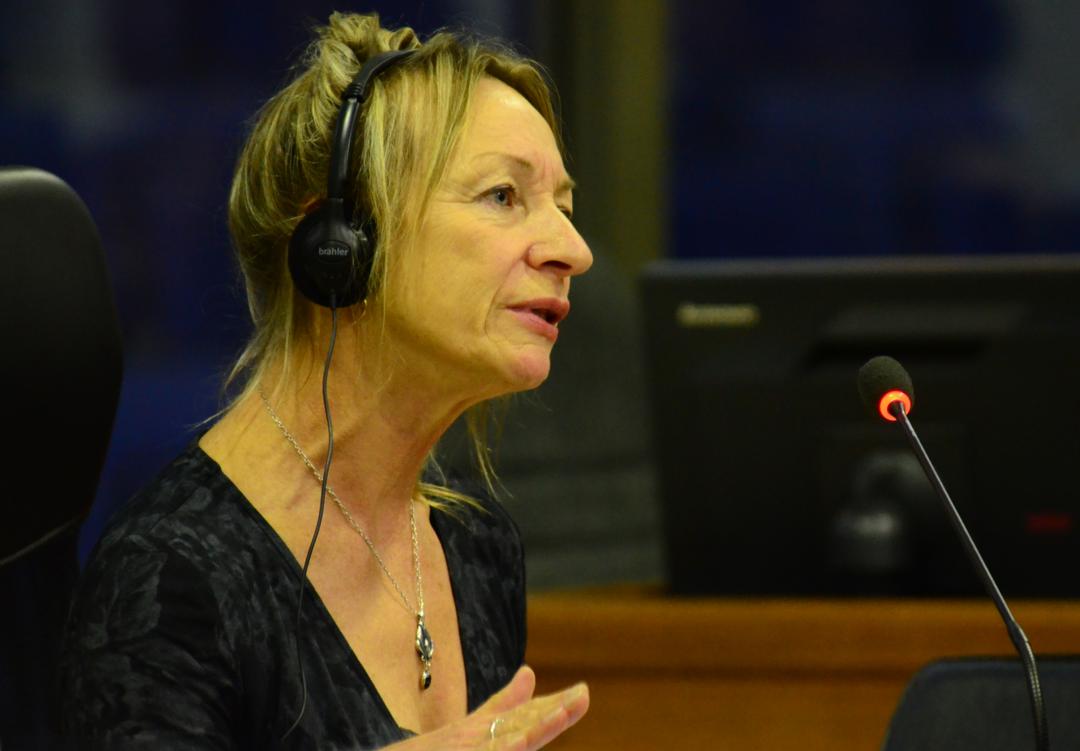
LEVINE Peggy
Pseudonym: 2-TCE-81
Cases: Case 002/02
Category: Expert
Background and role
Peg Levine received her bachelor of science in sociology in 1994, her master’s degree in psychology in 1996, her doctorate in psychology with a focus on trauma studies in 1984, and a doctorate of philosophy in medical anthropology in 2007.
1
She became interested in Cambodia and Democratic Kampuchea (DK) in 1980 when she worked in a mental health center.
2
This was when she first heard about weddings in Cambodia, and commenced her formal research in 1997.
3
Subsequently she met with colleagues who were married to each other during the DK period and had not been forced to marry.
4
This challenged her perception that people who married under the Khmer Rouge regime were forced to do so.
5
She pursued a PhD degree to be able to have sufficient time and resources to conduct independent research.
6
Her formal academic research in relation to marriages under the DK regime was conducted in the context of her second doctorate, which was later published as a book.
7
The research involved 192 respondents, including 11 couples and a random selection of 170 persons, from 18 different regions in Cambodia.
8
Peg Levine testified before the Trial Chamber in Case 002/02 as an expert witness about weddings, consummation of marriage and the impact on victims caused by the loss of traditional rituals during the DK period.
9
Peg Levine’s evidence on practices of marriage during the Khmer Rouge regime
While numerous witnesses and civil parties testified to having forced to marry under the threat of death from the Khmer Rouge,
10
Peg Levine said that marriage during the DK period was not forced.
11
She characterized it as “conscription” rather than being “forced”.
12
She explained that the conscription in the context of marriage entailed being called up by Angkar to be married as part of one’s national duty or service.
13
At the same time, she refused to define “forced marriage”, reasoning that it was not part of her findings.
14
She also declined to say, when asked by the Civil Party Lead Co-Lawyers, whether the “conscription” was a state policy.
15
Peg Levine’s view of marriage was drawn from the evidence of respondents to her study. Many of her respondents described their weddings as providing a service to the future of the country and showing their loyalty to Angkar.
16
“Firstly, in the methods that I used, it was important that I only represent the perceptions, beliefs, opinions, experiences of the respondents in my study. And in doing that, no one in my study told me that their weddings were forced […] The crux of how I came to determine that word “conscripted” is related to […] the role of Angkar in people’s lives and the loyalty that people gave to Angkar when they were being asked to marry someone that being selected for them or arranged for them […],” Peg Levine stated. According to her, there was no policy on weddings at the beginning of the regime, although the structure of a policy in relation to wedding ceremonies and proceedings had developed by 1978.
18
It was chaotic at the beginning of the Khmer Rouge regime particularly in 1975 and 1976 because people still had access to traditional weddings.
19
It was not until 1977 when Khmer Rouge influenced weddings appeared to be more consistent throughout Cambodia.
20
Peg Levine also argued that the concept of the omnipresent “Angkar” became a cultural phenomenon outside the control of the regime, rather than a tool at its disposal.
21
People attributed transforming powers to Angkar, so if individuals were asked to marry by Angkar, “it was essential that they comply”. Most people believed that Angkar was an “animist force”. Men usually considered “Angkar to be a person who was associated with the Khmer Rouge”, whereas women considered Angkar as being “transformational forces”. “But this is a cultural artefact […] that the Khmer Rouge did not and could not […] have accounted for [.],” she stated. The Nuon Chea Defence submitted that Peg Levine’s study on weddings under the Khmer Rouge followed strict methodology
26
and the Khieu Samphan Defence submitted that her testimony contained important information about the DK period.
27
The Prosecution, however, submitted that the witness’s view on whether couples felt their marriages were forced was not complete because, by her own admission, she did not ask her interviewees this question and that despite confusion in her approach, information provided by the respondents in her study confirmed that people were coerced into marrying against their will.
28
Peg Levine responded to the Prosecution’s query about why she did not ask the respondents whether they consented to marriage.
29
Peg Levine defended her stance, reiterating that “forced marriages” did not happen to her subjects.
30
“Firstly, my conclusion was about the whole of my study and my analysis. I do want to say again up front. And secondly, because I didn’t ask a question directly did not mean that I did not have that content to analyze because the way I set up my questions was without an interrogation, without leading the respondent.”
31
Noting that the material available to Peg Levine was far more limited than the totality of evidence before it, the Trial Chamber considered that it was not bound by any opinion provided by Peg Levine with regard to the nature of marriage during the Khmer Rouge period.
32
The Trial Chamber stated that it would discard her evidence as erroneous where it was based on reasoning which contradicted the preponderance of the evidence before the Trial Chamber, especially the contemporaneous documents concerning the Communist Party of Kampuchea’s regulation of marriages and the statements made in court by those who experienced marriage during the DK era.
33
Defence for Khieu Samphân challenged these findings on appeal. While Khieu Samphan disagreed with the Trial Chamber’s approach regarding the evidence by Peg Levine, however, he failed to demonstrate any error on appeal to support his argument, which was therefore dismissed by the Supreme Court Chamber.
34
Expected consummation of marriage
While many witnesses and civil parties who experienced marriages during the DK period told the Trial Chamber that they had been forced to consummate their marriages,
35
Peg Levine expressed the view that consummation of marriage during the Khmer Rouge regime was not forced.
36
“Yes, some people reported that there were people listening to them during that time in the night, but nobody in my sample said that the next day someone asked them did they have sex or not. No-one in my sample were threatened with death if they did not comply to the request. So, I can only speak from my sample.”
37
She explained that among the weddings that took place in Kandal province, 0.8% of the people went to what she described as the “honeymoon huts or wedding huts”, and 35% went home. If people had parents living nearby, they would return home and people who went to the huts were the ones who did not have families they could return to.
38
According to Peg Levine, consummation of marriage is something that generally occurs in marriages.
39
Even internationally, consummation is expected implicitly or explicitly.
40
“Of course, I’m not wanting to make the implication that the way in which this happened under DK was tasteful, but consummation of marriage, typically in the Western world when we talk about the honeymoon period, is expected”.
41
While Peg Levine stated that no one in her individual research sample was threatened with death, she also gave evidence that 76 out of 192 respondents in her study reported that sexual intercourse was “prescribed”.
42
The Supreme Court Chamber found that the evidence clearly supported the existence of coercive circumstances.
43
Impact of the absence of traditional rituals
Peg Levine looked at the sequence of rituals under the Khmer Rouge regime; what was dropped, what was added, what was the dynamic and what the rituals of weddings and courtship were.
44
What she noticed was a “dramatic change in the ritual structure” in the access people had to rituals formally.
45
Many sought rituals secretly during the Khmer Rouge regime, sometimes feeling very afraid.
46
People experienced anxiety by not having a particular kind of protection that was embedded for centuries in the culture in pre-Khmer Rouge Cambodia.
47
The level of trauma that was exacerbated by the lack of access to ritual was excruciating” and people were afraid on a daily basis.
48
The traditional rituals were missing at the wedding ceremonies during the DK regime, resulting in a “grave violation” which Peg Levine considered a “crime against culture”.
49
The Trial Chamber cited Peg Levine’s testimony, among other evidence, in finding that victims regretted the fact that their wedding ceremonies during the DK period were not conducted according to Cambodian tradition.
50
Videos