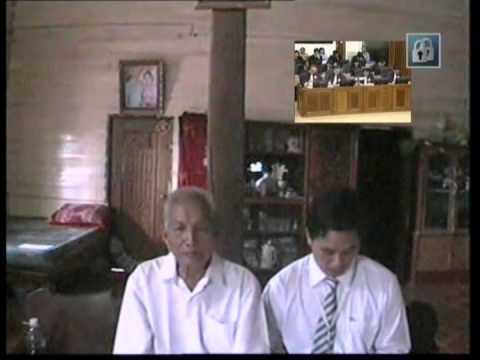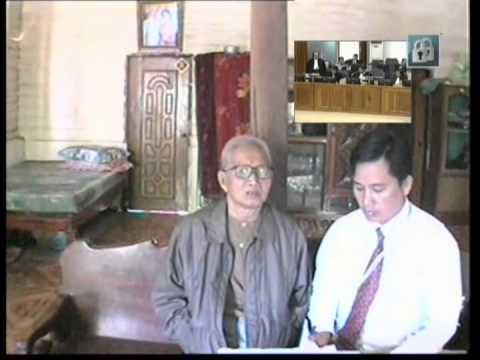
LONG Norin
Pseudonym: TCW-395
Cases: Case 002/01
Category: Witness
Background and role
Long Norin alias “Rith” was a student who studied gymnastics in Prague in Czechoslovakia from 1960-1961 until 1971.
1
The witness recalled that in 1971, following an appeal from the former King Norodom Sihanouk (in Peking) for the Cambodian people to enter the Maquis Jungle after Lon Nol’s coup d’Etat, he decided to join the revolution, and return to Cambodia via China.
2
Upon arrival in China, he worked in Peking for a while where the FUNK (National United Front of Kampuchea) and GRUNK (Royal Government of National Union of Kampuchea), created and headed by Norodom Sihanouk, were in exile.
3
He recalled working for the Ministry of Foreign Affairs in Peking where his main responsibility was to prepare letters, including diplomatic letters which established links from FUNK/GRUNK in Peking to the movement inside Cambodia and around the world.
4
Upon leaving Peking in around 1972-1973, Rith went to Hanoi where he stayed for about six months,
5
and worked for the radio station established by the FUNK (see below).
6
His tasks were to translate documents into Latin and prepare and broadcast educational programs for the Khmer in Hanoi.
7
After Hanoi, in 1973, he went to Cambodia through the Ho Chi Minh Trail.
8
He stayed at Stung Treng – Kampong Cham for about six months, dealing with farming, before moving to Preah Vihear province for a short period.
9
After the liberation in 1975, he moved to Phnom Penh and worked for the Ministry of Foreign Affairs under the supervision of Ieng Sary.
10
He worked as a typist in the Ministry of Foreign Affairs, and occasionally prepared houses to receive guests.
11
Around early 1976, for about 6 months, he was temporarily assigned to provide protection for Norodom Sihanouk, who was then President of the State Presidium, in the Royal Palace.
12
He worked with a person named Chhorn Hay.
13
He recalled accompanying Norodom Sihanouk on his travels to the provinces and abroad.
14
Means of communication prior to April 1975
Rith testified that prior to the Democratic Kampuchea regime, a radio station was established in Hanoi by the FUNK, under the direction of Ieng Thirith.
15
News articles were prepared in Cambodia, sent to radio station in Hanoi and broadcast back to Cambodia.
16
He explained that instructions from Cambodia were sent through telegrams and transferred all the way to the radio station.
17
He added that while he was in Preah Vihear province, a telegram was sent to the village chief telling his group to go back to Phnom Penh.
18
On the basis of this witness’s evidence (among others), the Trial Chamber found the radio station based in Hanoi was used to broadcast the resistance movement,
19
and that telegrams were used in order to communicate within Cambodia, and externally in order to make contact with the FUNK and GRUNK representatives in Vietnam.
20
Contacts with the senior leaders
The witness testified that he knew Ieng Sary when he worked for the Ministry of Foreign Affairs in Peking. At that time, he was the special envoy of the GRUNK in charge of Foreign Affairs and a special envoy representing the domestic resistance force while Sarin Chhak was in charge of the Ministry.
21
Rith recalled that during the regime, Ieng Sary was the chief of the Ministry of Foreign Affairs, and was in the Central Committee and the Standing Committee with Pol Pot, Nuon Chea and others.
22
, Khieu Samphan was the President of Presidium d’Etat. He sometimes accompanied Ieng Sary to greet visitors at the Ministry of Foreign Affairs.
23
Sometimes the witness saw Khieu Samphan and Vorn Vet entering the Ministry when Ieng Sary was absent overseas, but they did not make any decision at the Ministry.
24
Rith recalled that during his stay at Stung Treng, he met Khieu Samphan and Nuon Chea for the first time, and they asked him to go to Preah Vihear to meet people and understand their needs.
25
However, while being interrogated about the precise roles of these persons, he said he only knew about their public roles as “leaders”.
26
Rith recalled attending some party congresses during the Democratic Kampuchea regime with members or staff at the Ministry of foreign affairs and other Ministries, which would be held at the Olympic Stadium. The subjects were mainly political themes.
27
He testified that during these congresses, Nuon Chea was on the stage with Pol Pot in the seats arranged for the dignitaries.
28
Videos