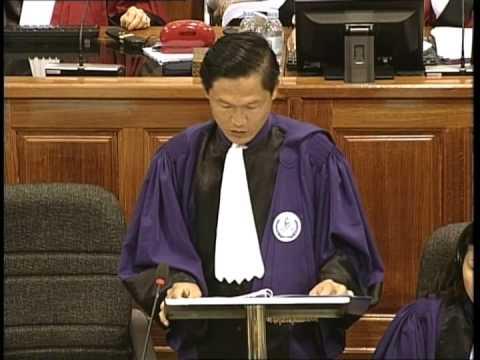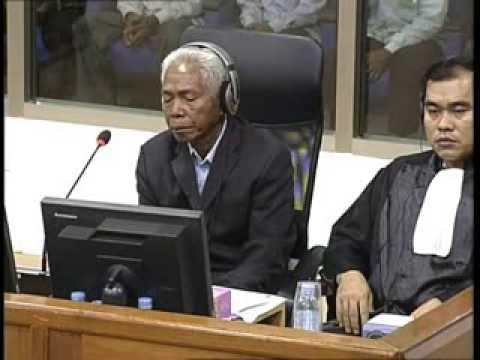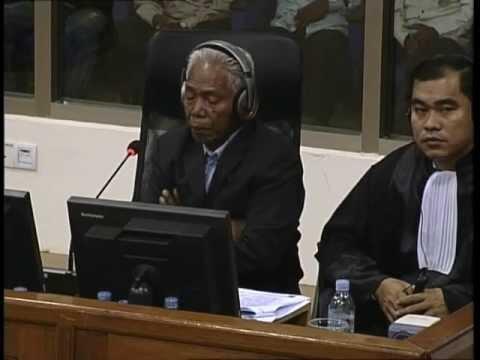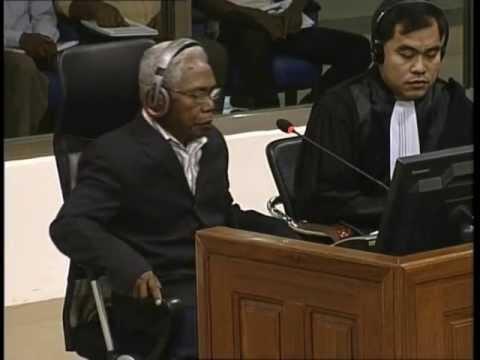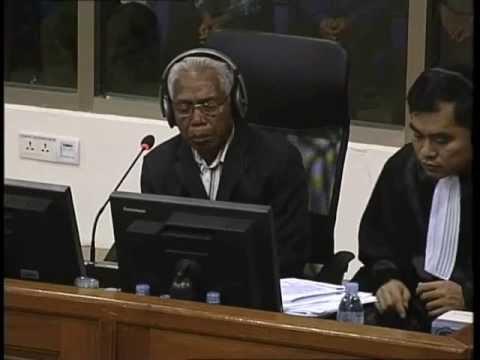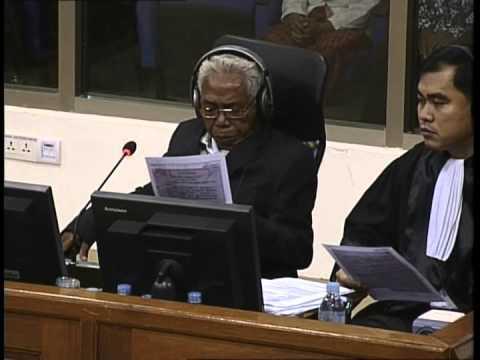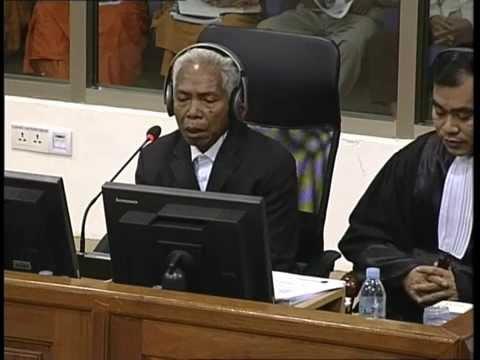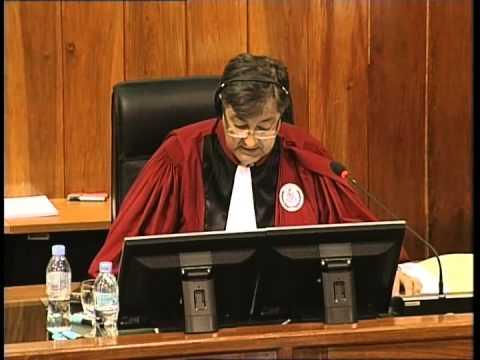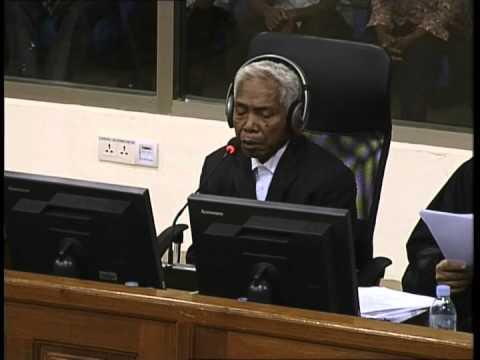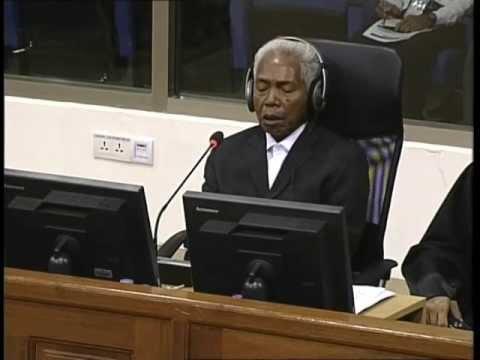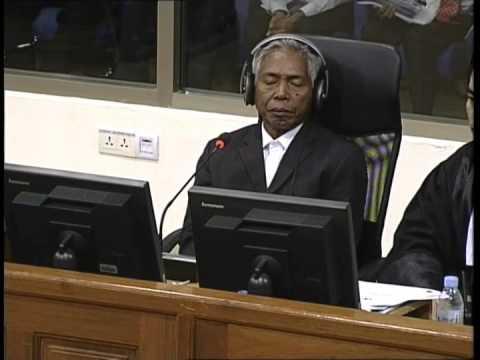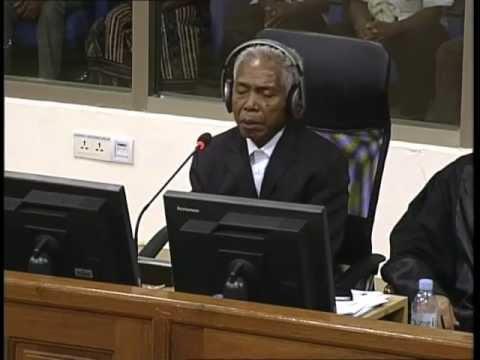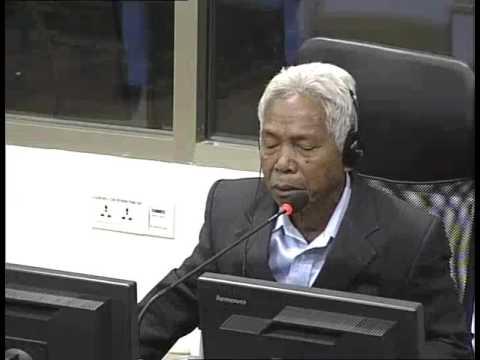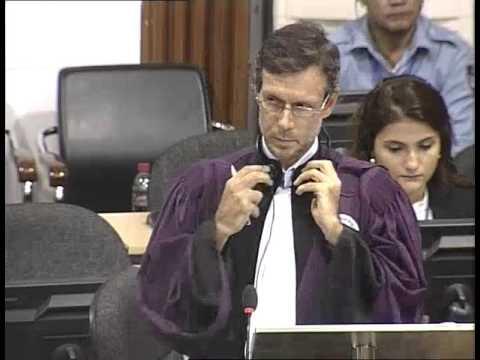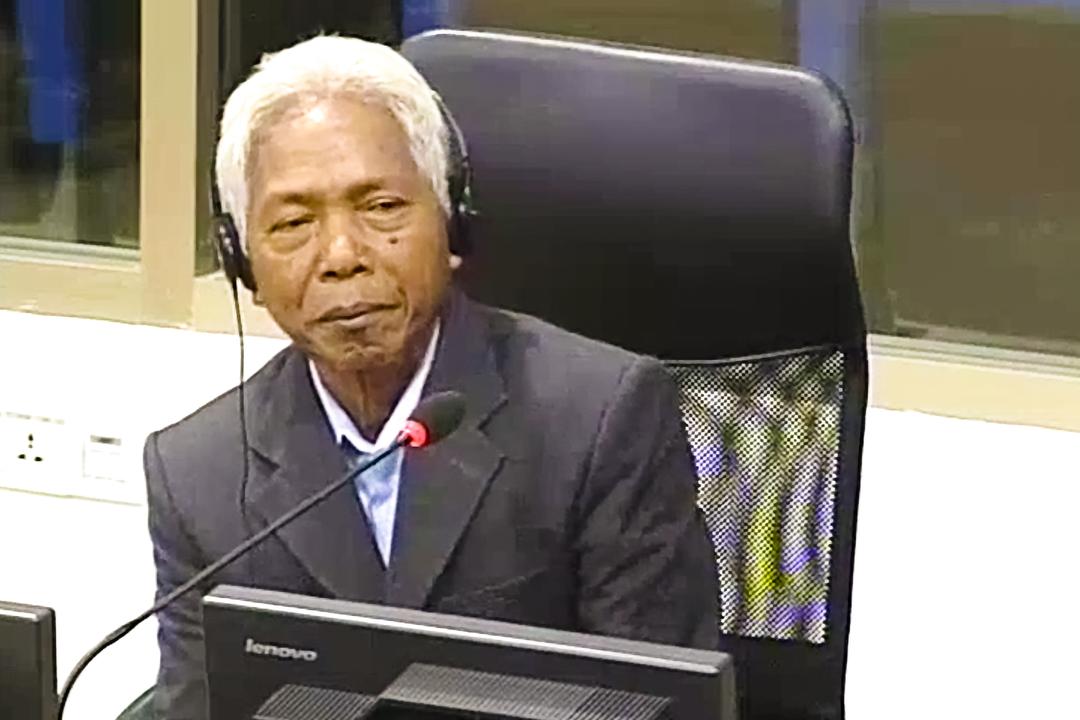
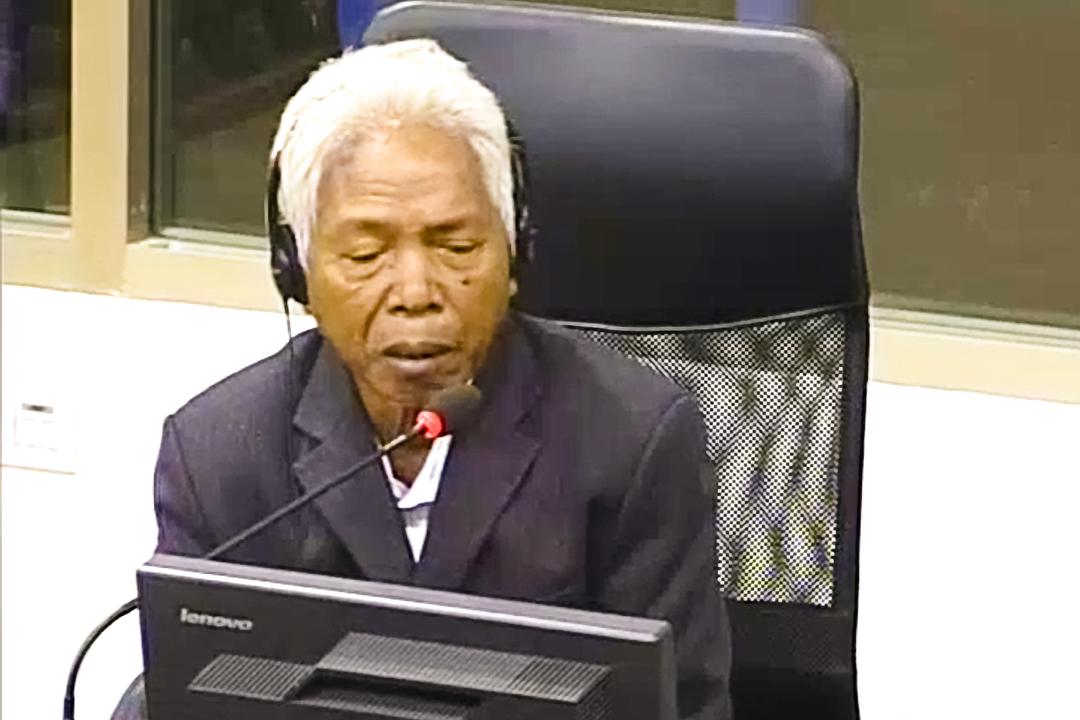
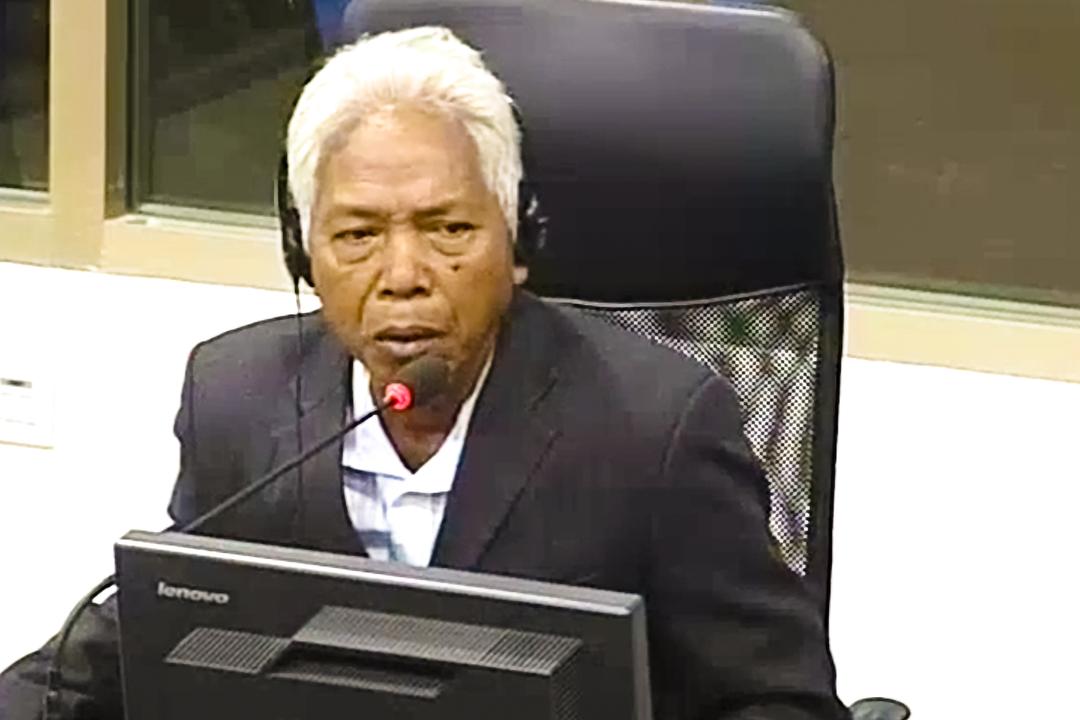
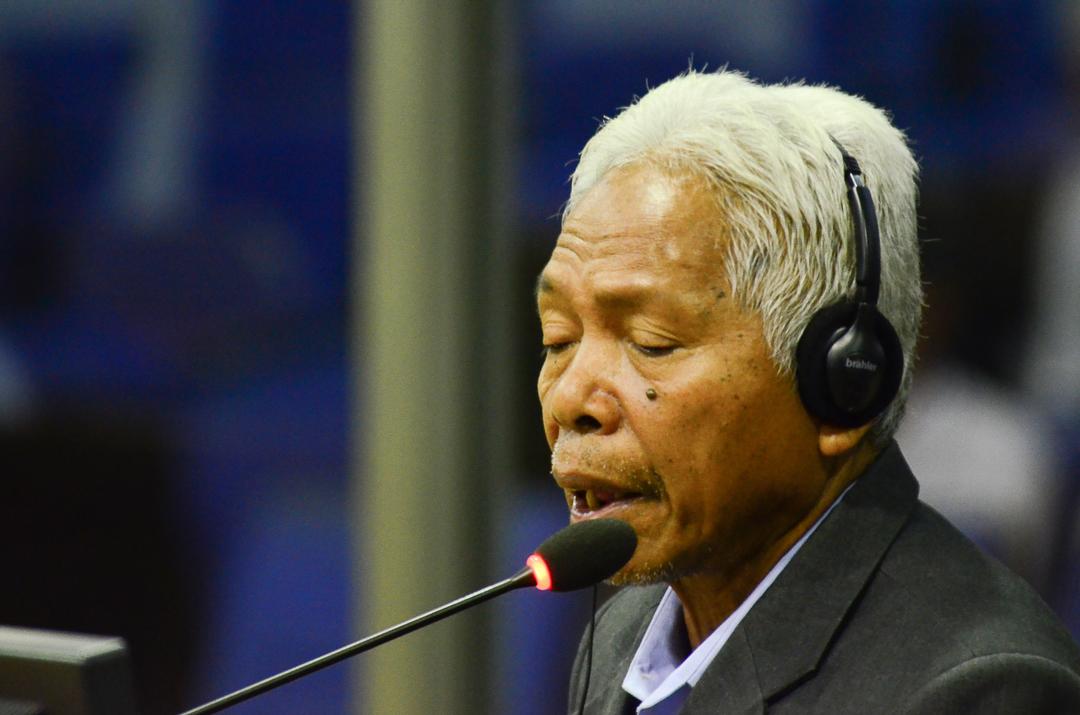
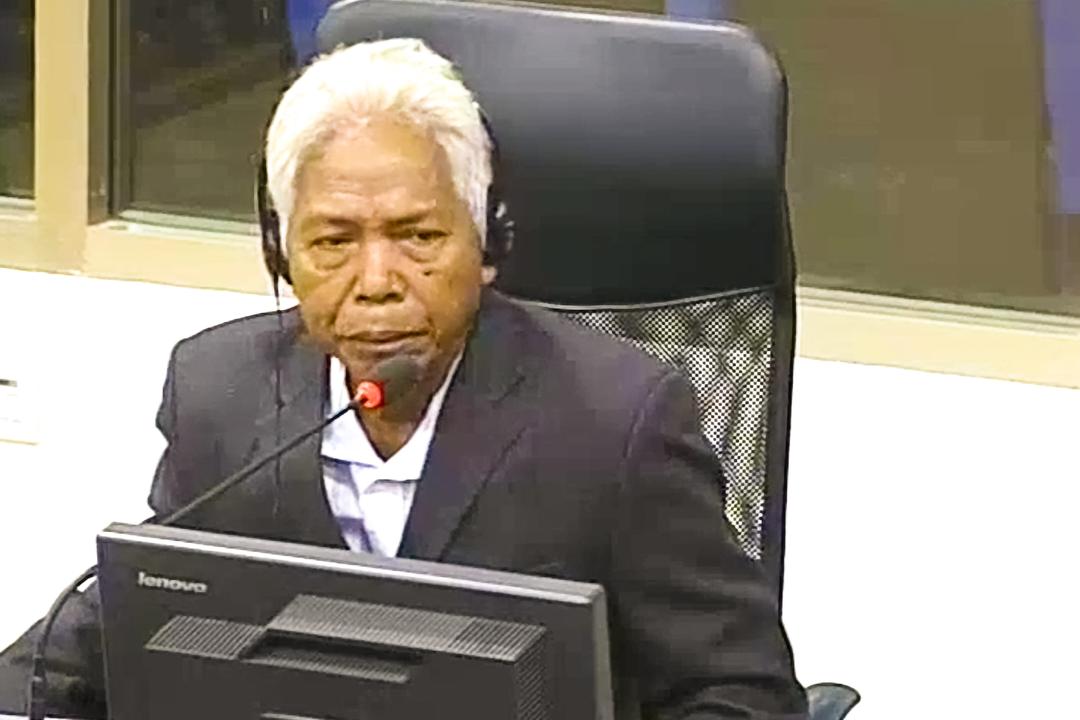
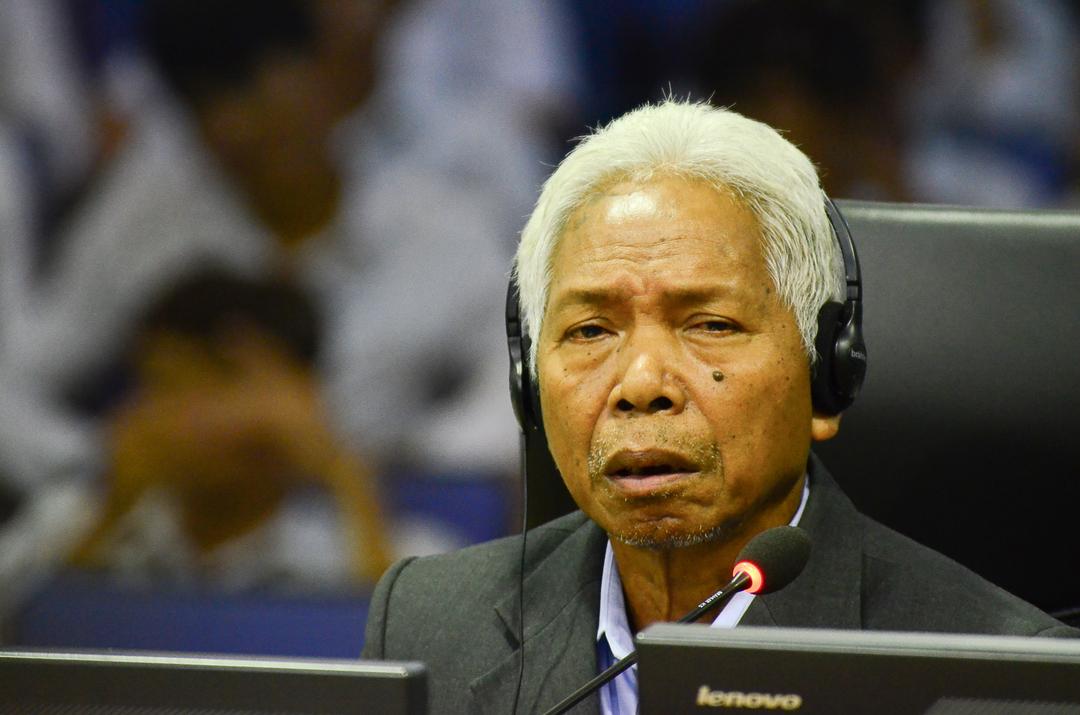
MEAS Voeun, alias Sway Voeun
Pseudonym: 2-TCW-1008–TCW-428
Cases: Case 002/01, Case 002/02
Category: Witness
Meas Voeun, alias Svay Voeun,
1
testified as a witness in Case 002/01 over four days,
2
and in Case 002/02 over two days.
3
He was a soldier and discussed, among other topics, military structure and reporting, the evacuation of Phnom Penh, the capture of Thai and Vietnamese at sea, and reporting to Khieu Samphan about his family members and the living situation in Preah Vihear. Meas Voeun was born in 1944 and joined the revolution as a youth representative.
4
In 1968, he was recruited by Ta Mok to work as a bodyguard for 30-40 people including Vorn Vet, Hu Nim, Hou Yuon, and Khieu Samphan.
5
They stayed in various locations in the forest and moved to avoid enemies, with Ta Mok deciding their movements.
6
By 1970, the witness became a soldier.
7
Military Structure
The General Staff, composed of Son Sen, Nuon Chea, and Ta Mok, had overall command of the military.
8
Ta Mok was the commander-in-chief, and was more powerful than Son Sen.
9
He could decide on the removal of leaders or soldiers.
10
In meetings, the division would receive orders from the General Staff, then the division commander would circulate this information down the military chain of command.
11
In a zone, there was zone military, sector military, and district military.
12
Zone military protected the outer border, while sector military protected the sector and district military protected each district.
13
Zone military was divided into units from group to division.
14
A group had 12 people; a platoon had three groups; a company had three platoons; a battalion had three companies; a regiment had three battalions; a brigade had three regiments, plus a special battalion; and three brigades made a division.
15
The Southwest Zone was led by Ta Mok, with Chou Chet alias Ta Si (“Si”) below him.
16
Division 1, headed by Soeung, was under the authority of the Southwest Zone prior to the capture of Phnom Penh, and was the only Division in that Zone at the time.
17
Ta Mok issued orders to Soeung, who issued them to the regiment or brigade.
18
Soeung promoted Meas Voeun to commander of Regiment 16, which had 300-400 soldiers, in 1975.
19
Capture of Phnom Penh and Evacuation
About a week before 17 April 1975, Soeung informed the witness that he met with the General Staff about plans to attack Phnom Penh, but did not discuss its evacuation.
20
The plan was to capture Phnom Penh on 18 April 1975, but they captured it a day earlier.
21
The witness commanded one regiment of 600 troops attacking Phnom Penh from Pochentong while two other regiments attacked from Stueng Meanchey and Boeng Prayap.
22
The witness’s unit entered Phnom Penh later than the other zones,
23
and did not arrest any soldiers.
24
When they entered, there was no fighting; apartments and houses hung white flags, and they were told not to harm anyone who raised the white flag.
25
People stayed in their homes.
26
They lacked food and medicine.
27
After one day, the witness withdrew to Stueng Meanchey.
28
A few days later, he saw people being evacuated along National Roads 3 and 4.
29
Some carried luggage, some pushed carts or cars or motorbikes that had run out of gas.
30
People did not want to leave their belongings and were unhappy to be leaving without food.
31
They told him Angkar instructed them to leave.
32
The witness did not receive any orders about the evacuation, but heard that people were required to leave the city and he let them leave.
33
His division commander said that city people would be evacuated for a week or so and would return once Phnom Penh was organized and the situation returned to normal.
34
Transfer to Koh Kong
Ta Mok ordered the removal of the witness’s forces from Phnom Penh.
35
After leaving Phnom Penh, they moved to a couple of areas briefly before being transferred to Koh Kong.
36
In September or October 1975, the Southwest and West Zones were separated.
37
The witness’s regiment was transferred to the West Zone and joined its military structure.
38
The West Zone had three sectors: Sector 31, Kampong Chhnang province, Sector 32, Kampot province, and Sector 37, Koh Kong province.
39
After being stationed in Koh Kong for about a year, the witness was promoted by Soeung and West Zone Secretary Si to be deputy commander of Division 1, in charge of 2,700 soldiers.
40
The rest of the Division 1 soldiers were stationed at the Division headquarters in Longveaek.
41
The witness’s soldiers were in charge of border, not internal, security.
42
There were no mobile units working in Koh Kong; it was a purely military force.
43
The witness was in charge of Koh Kong and other islands near the Thai border. Division 3, commanded by Meas Muth, was in charge of the other islands.
44
Meas Muth never communicated directly with the witness, but his regiment or battalion commanders communicated every three days so they could avoid conflicts.
45
Division 1 did not have ships, which were under Division 3 only, but helped guard the ships docked at the islands and did have a few motorboats.
46
If the witness saw a ship, he would report this to Soeung and to the people under Division 3, who would report to their superiors.
47
The witness communicated with Soeung by radio and telegram, and this would occur on a daily basis if there were problems at the Thai border.
48
The division used telegrams or vehicles to communicate with the General Staff.
49
Occasionally, they found Khmer people who tried to flee to Thailand and reported this to the Division.
50
These people were sent to the sector, which would take measures against them.
51
Capturing Vietnamese and Thai
Thai fishing boats were usually accompanied by warships and as time went on, they encroached deeper into Cambodian waters. This was reported to the division which said to attack ships encroaching deeply, and must have done so on the General Staff’s orders.
52
,They approached the Thai ships and were fired on and fired back; in another encounter they used planes to shoot, which led to a land and sea border conflict with Thailand lasting a week, until the witness’s unit withdrew.
53
They did not capture any Thai soldiers.
54
After that, Thai fishing boat encroachments reduced drastically.
55
The witness’s unit captured some Thai fishing boats on Cambodian territory, as the Division ordered.
56
They would keep the boat and send the people to the division headquarters in Kampong Som.
57
In its Judgment, the Trial Chamber referred to Meas Voeun’s testimony that “when a boat with Vietnamese refugees approached the waters where Division 1 was situated at the coast of Koh Kong province, his division would capture it and send the captured Vietnamese to ‘the upper echelon’; the Division 164 headquarters in Kampong Som. The order to do so was issued by Ta Soeung, the commander of West Zone Division 1, who would then forward the report up the line of command. MEAS Voeun claimed not to know what happened to Vietnamese refugees once they were sent to the upper level: ‘when they were captured by my unit I would send them to my upper leadership level and whatever decision they made that was theirs’.”
58
Division 1 also arrested hundreds of Vietnamese refugees.
59
They sent them to Kampong Som and reported by telegram to the division.
60
Thai and Vietnamese people would then be returned to their respective countries.
61
Security Centre and Arrests
Security centres could be under the command of the zone or division.
62
Meas Voeun heard there was a security centre in Prey Nob district at Kaoh Khyang, and that Soeung went there occasionally.
63
Some soldiers from Division 1 were sent there. There was a special force in the division tasked with conducting investigations and examining the biographies of each combatant to see if they were linked to the previous regime; it would arrest people and bring them to Soeung.
64
On Soeung’s order, the special regiment took some of his combatants with family connections to the previous regime to tempering places.
65
Soeung instructed the witness to keep a record of biographies, keep track of the soldiers’ performance, and find out about their previous activities before a decision was made to remove them.
66
People were removed from Division 1 for being CIA or associated with the CIA.
67
West Zone Congresses
The witness attended two West Zone congresses where he saw Pol Pot, but not Nuon Chea, although Soeung said Nuon Chea attended.
68
As noted by the Trial Chamber in its Judgment, Meas Voeun testified that the purpose of the 1977 West Zone congress at Kampong Speu was to instil consciousness of Yuon ‘tricks’: “they wanted to search out the infiltrated enemies that were within the army or cooperatives. That was their purpose.”
69
Preah Vihear
The witness left Koh Kong in August 1978.
70
He and Soeung met Pol Pot in Phnom Penh at Wat Ounalom along with commanders of other divisions, about 12 people in total.
64
Pol Pot spoke about the border situation with the Vietnamese, then tasked Soeung to investigate the imprisonment of some people in Siem Reap and tasked the witness to investigate many arrests and lack of goods in Preah Vihear.
72
There was no official pronouncement, but the witness understood that Ta Mok nominated Soeung to be in charge of the New North Zone.
73
Sector 103 encompassed Siem Reap and Preah Vihear and was an autonomous sector under direct supervision of the Centre, that reported to Khieu Samphan.
74
Meas Voeun’s predecessor in charge of Preah Vihear was arrested.
75
In Preah Vihear, the witness had an office that could send and receive telegrams.
76
Khieu Samphan asked the witness by telegram to check on his relatives and send them to Phnom Penh if they were facing hardship.
77
He found Khieu Samphan’s mother-in-law and father-in-law, who were at their home but were afraid of being arrested or killed, and took them to Soeung in Siem Reap. He does not know what happened to them after.
78
Soeung investigated and learned that Khieu Samphan’s sister-in-law was detained in the Siem Reap security centre and he and Meas Voeun went there to have her released.
79
Meas Voeun reported once to Khieu Samphan, telling him about his relatives’ situation, and the poor living conditions of the people, including that 500 people had been arrested and detained in Rovieng and lacked sufficient food.
80
He does not know whether Khieu Samphan received the telegram and thinks he did not, as the telegram could not link with the one in Phnom Penh much after August 1978 and he did not receive a response from Khieu Samphan.
81
As Khieu Samphan admitted learning of his relatives’ situation in Preah Vihear,
82
however, the Trial Chamber considered that Meas Voeun’s testimony and the telegram to Khieu Samphan (in evidence) “not only debunks KHIEU Samphan’s assertions that he was unaware of the arrest and detention of civilians or indeed the conditions faced by the population across the country, but also demonstrates the degree of influence and authority his position carried to intervene in Party affairs.”
83
The witness saw that the missing commodities from Phnom Penh were in a warehouse but had been destroyed, so people had great difficulties.
84
The witness did not report to Pol Pot about the situation but considers that Soeung likely did.
85
The witness remained in Preah Vihear until after the Vietnamese entered Phnom Penh on 6 January 1979.
86
Marriage
Although the witness stated that marriage was not forced but based on consent and people who wanted to marry would inform the witness, who drew up lists of soldiers who wished to get married,
87
the Trial Chamber considered that genuine consent was not possible.
88
Males had to be at least 20 and females at least 18.
89
Soeung organized marriages and brought some women from a women’s unit attached to the division for those who intended to get married.
90
The drive to have troops marry was to increase Cambodia’s population.
91
Vietnamese in Cambodia
Between 1975-79, the witness heard of a plan to eliminate Vietnamese living in Cambodia.
92
The witness was somewhat equivocal as to whether there was a plan to “smash” these Vietnamese or simply remove them from Cambodia.
93
Everyone heard during the DK period that the Vietnamese were hereditary enemies.
94
But not all Vietnamese were considered the enemy, which was why he sent captured Vietnamese to the upper level rather than smashing them at sea.
95
Vietnamese living in Cambodia could be differentiated from Khmer because they spoke with an accent and through their neighbours, one could learn how long they had lived in the area.
96
Videos