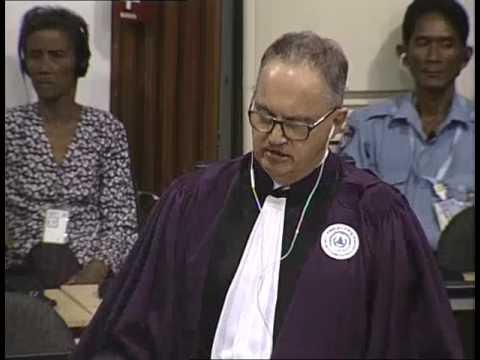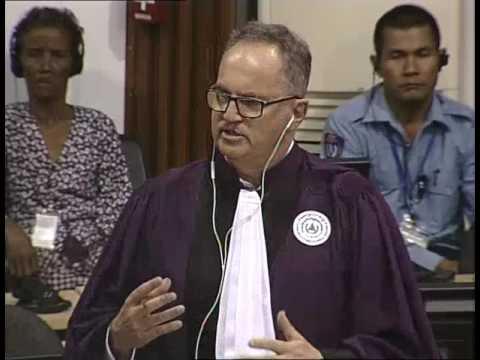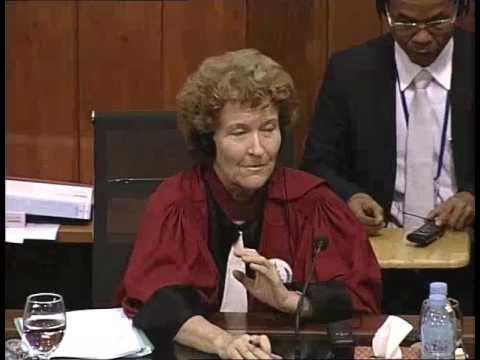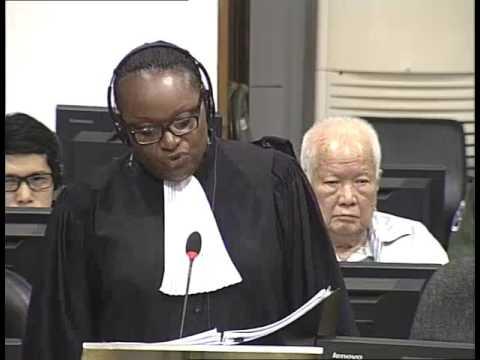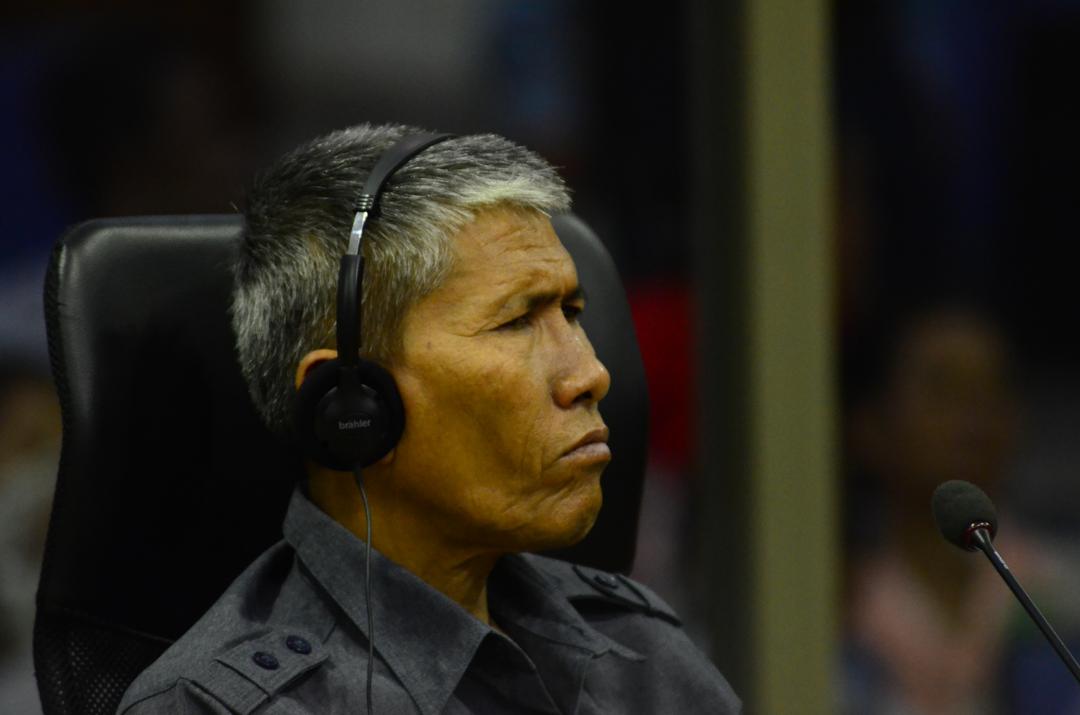
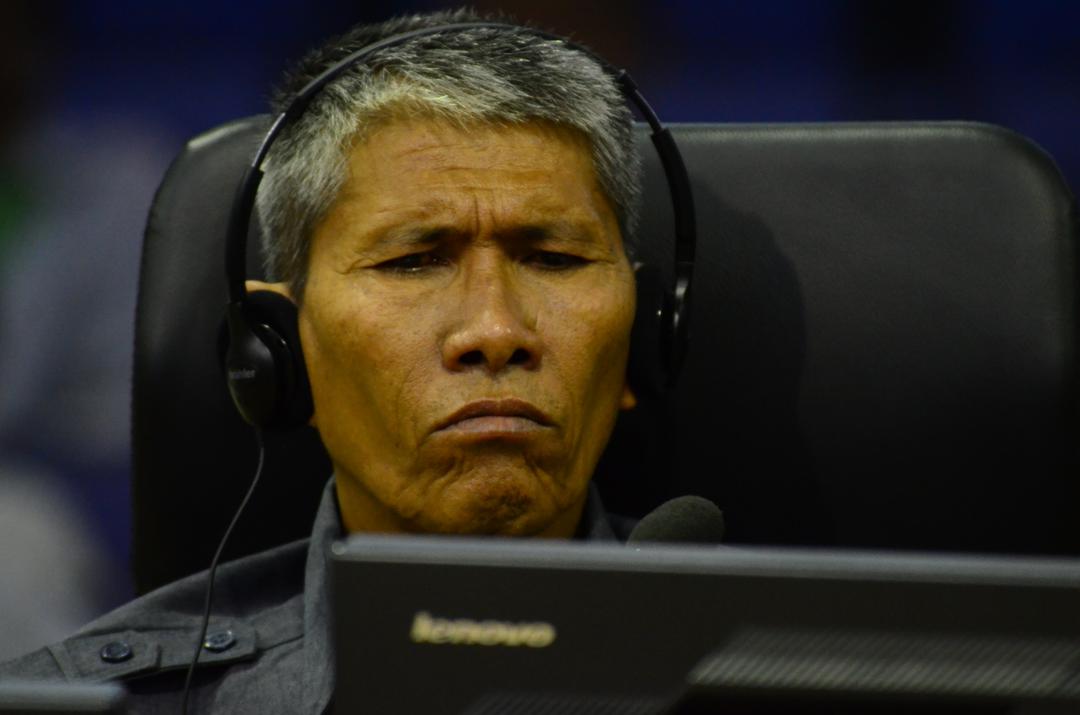
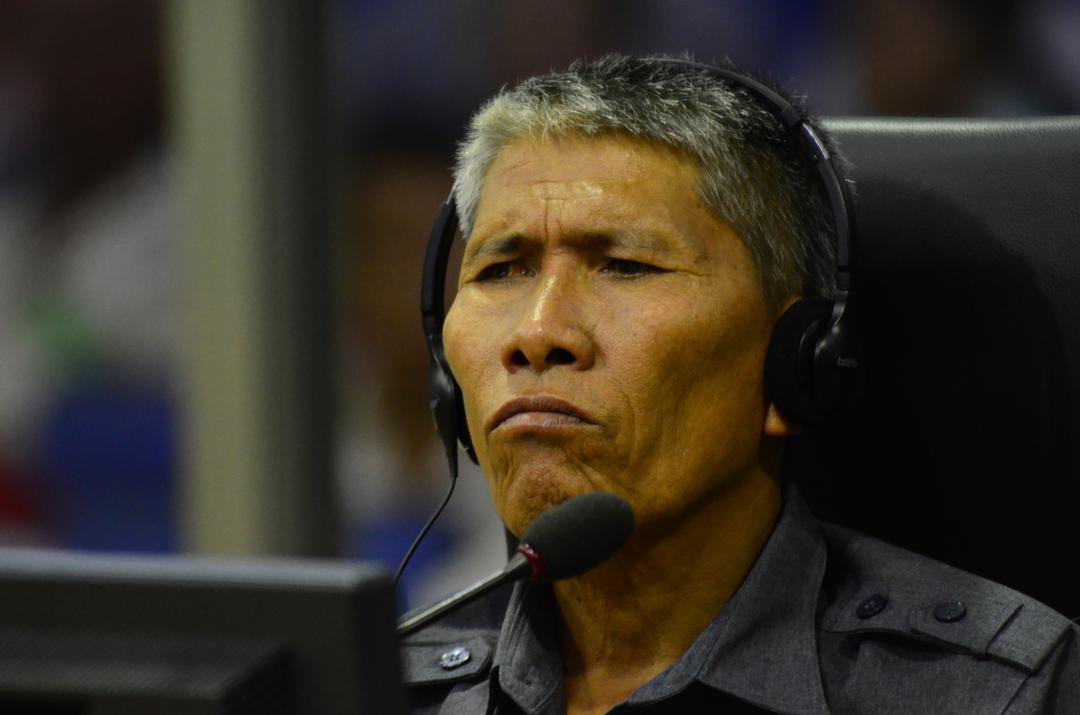
MOENG Vet
Pseudonym: 2-TCW-1005
Cases: Case 002/02
Category: Witness
Background and role
Moeng Vet worked in Office 160 – Sector 13’s messenger office – in Takeo province’s Angkor Chey district, Southwest Zone, until September 1975 after being relocated from the province’s Tram Kak district.
1
He then worked in another messenger unit in Kirivong district before being transferred in March 1977 to Kratie province’s Sector 505,
2
where he was the deputy chief of the Division 117 Office.
3
He testified before the Trial Chamber as a witness in Case 002/02 about the internal purges of Khmer Rouge cadres in Southwest Zone’s Sector 13 and in Kratie Autonomous Sector 505 between 1977 and 1978.
4
Purges and arrests in Sector 13
Ta Mok was in charge of everyone in the Southwest Zone.
5
He had the power to reshuffle cadres and order arrests and killings of people perceived as enemies of Angkar.
6
People at the lower level did not dare to take any action without permission from senior cadres.
7
They did not even dare to speak to one another as they were afraid of being accused of colluding.
8
The Southwest Zone under the leadership of Ta Mok (known as Ta 15) was comprised of four sectors: Sector 13, Sector 25, Sector 33, and Sector 35.
9
Sector 13 consisted of many districts including District 55 in Prey Kabbas, District 56 in Samrong, District 105 in Tram Kak, District 106 in Angkor Chey, District 107 in Treang, District 108 in Kaoh Andaet, and District 109 in Kirivong.
10
A series of arrests occurred in Sector 13 in 1977.
11
Moeng Vet recalled Yeay Yuth’s husband being arrested and sent to Kampot province to be executed for being a former intellectual and connected to the KGB.
12
Ta Saom, a former journalist, became the secretary of Sector 13 in 1975 after Meas Muth, Ta Mok’s son-in-law, was moved to be in charge of Division 3 and then Division 164.
13
Ta Saom felt sick and was later released from his position and transferred to the Ministry of Foreign Affairs in Phnom Penh for his alleged links with “suspicious activities.”
14
Angkar arrested Ta Saom’s deputies – Ta Keav, who was Ta Mok’s son-in-law, Ta Ngoy, and Ta Khem – following Ta Saom’s transfer to Phnom Penh for the same reason.
15
Moeng Vet recalled attending a meeting when he was a messenger in Sector 13, during which Angkar told participants to eliminate its two enemies, the KGB and CIA, affiliated with Vietnam and the United States respectively.
16
Following the meeting, arrests happened one after another.
17
Saom Choeun, who replaced Ta Saom as secretary of Sector 13 for a short period of time in 1977, was arrested and sent to Toul Sleng prison (known as S-21) for execution in December 1978 for his alleged links with KGB networks.
18
Ta Tom, secretary of Kirivong district, was arrested in 1978 after being implicated with the KGB.
19
Ta Sieng, secretary of Kaoh Andaet district, was also arrested at the same time with Ta Tom.
20
Ta Nam, commander of Sector 31, was later on removed because he was affiliated with those coming from Hanoi and replaced by Phorn.
21
Following the major purges in June 1978, Ta Mok ordered the reshuffles of cadres between the Southwest Zone and the Northwest Zone to replace cadres who were purged.
22
Im Chaem, who was district secretary of Kaoh Andaet after Ta Sieng’s arrest, was sent to Northwest Zone to deal with the issue of traitors.
23
While noting that a number of witnesses, including Moeng Vet, testified that Ta Keav was arrested,
24
the Trial Chamber found that their knowledge of the arrest was insufficiently clear to establish a finding.
25
Purges in Kratie and Sector 505
Moeng Vet was transferred from Kirivong district to Kratie province’s Sector 505 in March 1977 to fight the Vietnamese.
26
Ammunition shipped from Phnom Penh was stored at the warehouse in the Division 117 Office,
27
where he was responsible for radio operation and telegram communication when the divisional level cadres went to the battlefront.
28
Moeng Vet also elaborated on the Sector 505 leadership before testifying about their purges.
29
Born Nan alias Yi was Secretary of Sector 505 from 1971 to 1976.
30
Meas Keth alias Moeun was the secretary of Sector 505 from 1976 to 1978. Rom, Leang, and Nim were commissioner, commander, and member respectively of Division 117. Yeng was the secretary of Kratie district after leaving Division 117. Chum Chen alias Phoan was the secretary of Snuol district.
After the Vietnamese army took over the entire Snuol district in 1978, Division 117 came under suspicion for not fighting the Vietnamese hard enough.
35
Meas Muth travelled from Kompong Som to Kratie province to examine the border conflict with Vietnam and to replace Sector 505 and the division leadership.
36
A “sweeping clean” operation of cadres in the sector had begun.
37
Moeng Vet saw a letter from Office 870, the central office of the Communist Party of Kampuchea (CPK), ordering 11 cadres in Sector 505 to come to Phnom Penh by airplane for a meeting.
38
Division 117 Commissioner Khun Rum alias Rom, Sector 505 Secretary Meas Keth alias Moeun, and Snuol District Secretary Chum Sen alias Phoan were among the 11 cadres.
After his return from Stung Treng province, Moeng Vet learned that all his chiefs were arrested after being considered traitors.
40
Yi was arrested in March 1978.
41
Rom and Moeun were sent to S-21 in December 1978 for execution.
42
Others among the 11 cadres were sent to Kampong Chhnang Airfield worksite to break rock.
43
The Trial Chamber cited Moeng Vet’s testimony in finding that: (i) Sector 505 was initially under the control of the Northeast Zone before becoming an autonomous sector;
44
(ii) Division 117 reported directly to the General Staff;
45
(iii) Meas Muth came to Sector 505 from Kampong Som to replace the sector and division leadership after Snuol district was seized by the Vietnamese army in 1978;
46
(iv) Yi was arrested in March 1978;
47
and (v) Rom and Moeun were executed at S-21 in 1978.
48
Marriage regulation
Concerning marriages during the Khmer Rouge period, Moeng Vet testified that everything was based on individuals’ backgrounds.
49
Base People and 17 April People were classified differently, although Moeng Vet did not think that this rule was written down.
50
17 April or New People might be affiliated with the KGB or CIA.
51
Khmer Rouge cadres and Base People who married New People would risk being implicated as enemies of Angkar.
52
The CPK instructed people to choose a spouse carefully.
53
A request to marry someone according to their own feelings would be granted only if it was found consistent with the collective interests, especially with regard to the respective biographies of the future spouses.
54
The Trial Chamber relied on Moeng Vet’s testimony, among other evidence, in finding that: (i) biographies of individuals were screened before matching them to get married;
55
and (ii) wedding ceremonies took place in various locations throughout Cambodia during the Democratic Kampuchea regime including in the Southwest Takeo.
56
Videos