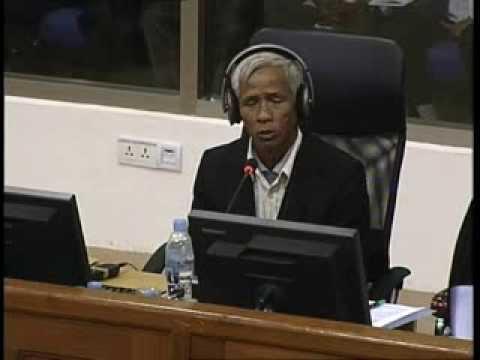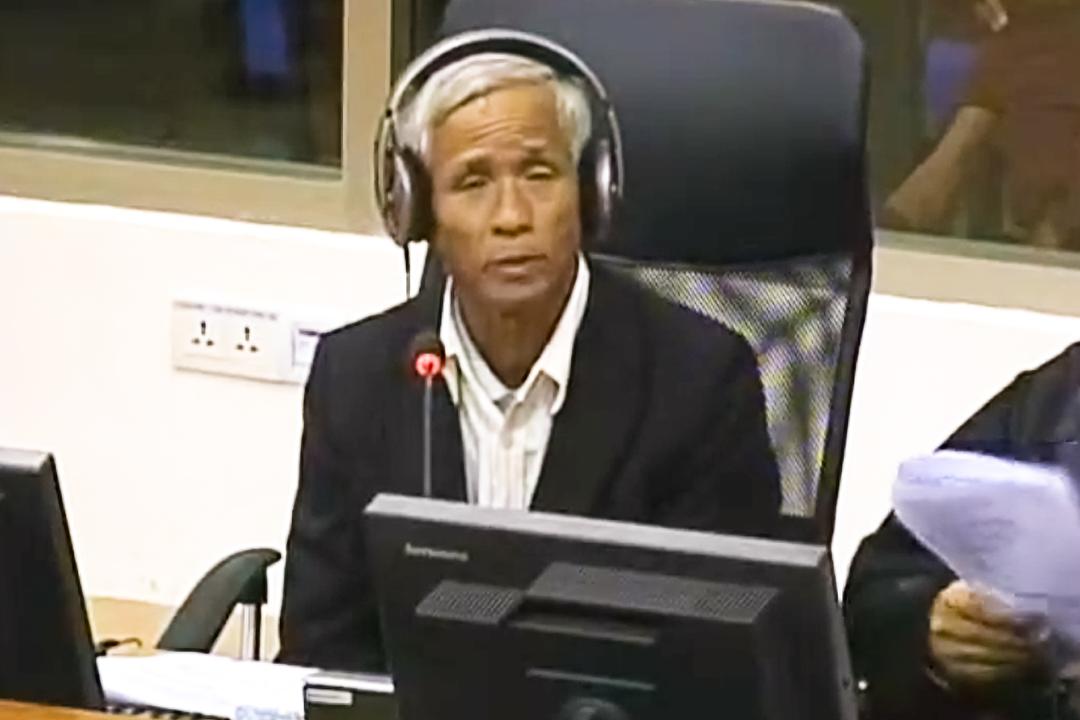
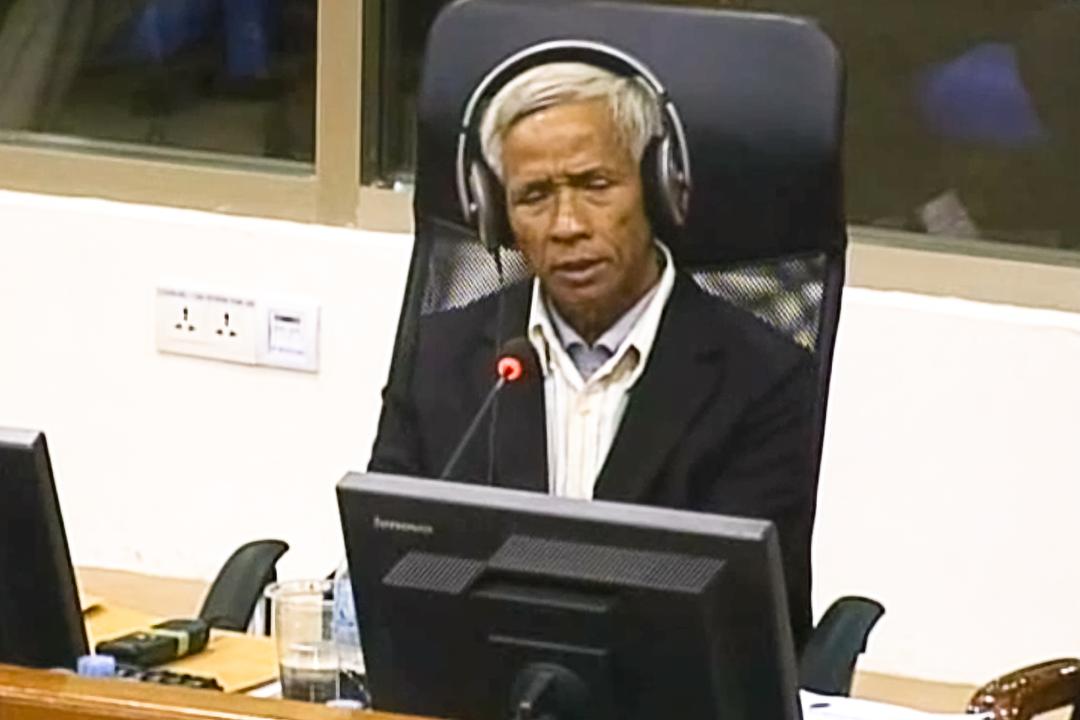
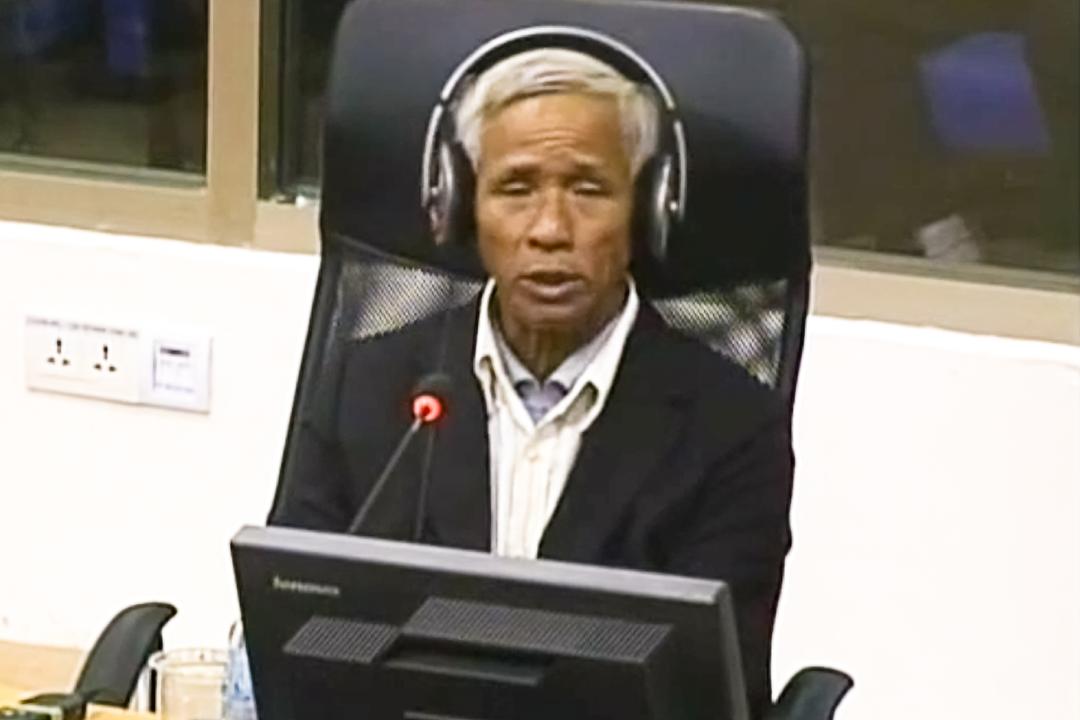
OEUN Tan
Pseudonym: TCW-488
Cases: Case 002/01
Category: Witness
Background, role, and knowledge of Khmer Rouge leaders
Witness Mr Oeun Tan (‘OEUN’) aka Chou Tan,
1
69 years old at the time of his testimony,
2
joined the Khmer Rouge revolution on 2 March 1968 in Andoung Meas district, Rattanakkiri province.
3
He was recruited by Kang Deng, the district Secretary.
4
Like others, OEUN joined the revolution not knowing the purposes behind it,
5
though he heard that the peasant class ought to be liberated from the ‘oppressive class’.
6
He had not heard anything about the Lon Nol regime.
7
OEUN was a messenger for the Communist Party of Kampuchea (‘CPK’) in Andoung Meas district,
8
and a bodyguard.
9
He delivered letters,
10
whose content was unknown to him because he was illiterate at the time.
11
He did not know, therefore, that some of the letters concerned arrests,
12
though he also claimed not to have delivered letters concerning marriages of disabled people.
13
The recipients were also unknown; the letters were handed over to somebody else who would then deliver them to the intended recipient.
14
In 1970, OEUN was assigned by CHIMM Sam Aok alias “Pang”
15
as a bodyguard for Pol Pot.
16
Pang supervised the Northeast Zone messengers.
17
While OEUN knew that Pol Pot, Nuon Chea, Khieu Samphan, and Ieng Sary were leaders,
18
OEUN was neither aware of their roles
19
and responsibilities,
20
nor of the content of their meetings as all bodyguards stood twenty meters away from them.
21
Relying inter alia on OEUN’s testimony that the meetings held in Kampong Cham were chaired by Pol Pot
22
, the Trial Chamber (‘TC’) found that the CPK leaders regularly met from October 1970 until 1975 concerning the ongoing revolution.
23
OEUN had not heard anything about Offices 100, 102, B-5, or S-71
24
OEUN arrived in Phnom Penh two weeks after POL Pot did,
26
who had gone fifteen days after 17 April 1975.
27
OEUN learned of the Khmer Rouge forces’ victory that day through radio broadcasts in Trapeang Thum village, Kampong Cham province.
28
OEUN did not know of the evacuation plan until he arrived in Phnom Penh.
29
The city was largely empty and quiet as its inhabitants, including civilians and soldiers,
30
had already left
31
- a fact accepted by the TC.
32
OEUN’s evidence on the distance from the leaders’ meetings all bodyguards were bound to observe, served the Khieu Samphan’s Defence to impeach the credibility of witness Rochoem Ton alias ‘Phy Phuon’ (‘Phy’), whose testimony ran counter to OEUN’s testimony.
33
By finding that Phy’s evidence was credible,
34
the TC implicitly suggested the opposite regarding this part of OEUN’s evidence. Although the Supreme Court Chamber acknowledged that the TC had not entertained the purported inconsistency in the bodyguards’ evidence,
35
it nonetheless found that it was reasonable for the TC to mostly rely on Phy’s more detailed evidence to find that the forcible transfer of Phnom Penh’s population was planned.
36
From 1975 to 1979, OEUN lived and worked at K-1,
37
a compound in Phnom Penh where Pol Pot’s house was located
38
-a fact accepted by the TC
39
- and where the leaders also worked.
40
Based, inter alia, on OEUN’s testimony, the TC found that Nuon Chea frequently visited Pol Pot’s house at K-1, where important meetings of the ‘Party Centre’
41
were held.
42
In Pol Pot’s absence, Nuon Chea chaired those meetings,
43
which were also attended by officials of the Sector, Zone, and District committees
44
on the invitation sent by letters.
45
OEUN received the letters from Pang at K-1, which he delivered at K-7; other messengers would then collect them and take them to other locations.
46
Sometimes, OEUN delivered letters to Pol Pot from K-7.
47
Relying, inter alia, on OEUN’s evidence, the TC found that the CPK leaders communicated with each other by letter,
48
as well as the various organs within the administrative structure of the Democratic Kampuchea (‘DK’).
49
The content of those meetings was unknown to OEUN; Pang only informed him on what the leaders addressed in particular meetings.
50
Based, inter alia, on OEUN’s evidence, the TC inferred that Khieu Samphan continued to attend the Standing Committee meetings after 1976.
51
Within the same period, 1975-1979, OEUN escorted Pol Pot during his visits to the canals and rice paddies,
52
but could not hear Pol Pot’s discussions.
53
Based, inter alia, on OEUN’s evidence, the TC found that Pol Pot and Nuon Chea, amongst other party leaders, travelled throughout Cambodia disseminating the policy concerning population movements.
54
Telegrams were also used at K-1.
55
OEUN received telegrams from other messengers which he delivered to Pol Pot.
56
After he read them, OEUN delivered them to Nuon Chea
57
at K-3
58
. The TC found that Nuon Chea saw most telegrams sent to Pol Pot.
59
Although OEUN had not referred to decrypted messages, the TC, relying inter alia on OEUN’S evidence, found that the final recipients received decrypted telegrams.
60
Pang took charge of Office 870,
61
whose competence was unknown to OEUN.
62
Self-criticism sessions were regularly conducted in Office 870, where people were exhorted to refrain from engaging in ‘immoral conduct, not to hurt people or not to do bad things to people’.
63
By ‘moral misconduct’, OEUN understood that it referred to actions detrimental to people’s property or the livestock of the village.
64
The wrongdoers were called for ‘re-education’
65
namely, to be advised as to how to do better in life, as opposed to being sent away.
66
While OEUN did not hear of any ‘moral or immoral conduct’ attributed to women,
67
he heard of the existence of marriages during the DK regime.
68
Although there were not security breaches in K-1, OEUN learned that Pang had disappeared,
69
wondering as to his whereabouts.
70
However, drawing inter alia on OEUN’s evidence, the TC found that Pang was arrested and taken to S-21.
71
Although OEUN claimed not to have heard of S-71,
72
the TC relying, inter alia, on his evidence, found that Khan Lin alias “Ken” took charge of S-71, after Pang’s arrest in 1978.
73
OEUN managed his fears of his own eventual disappearance by continuing to work.
74
He was not aware of other disappearances.
75
Videos