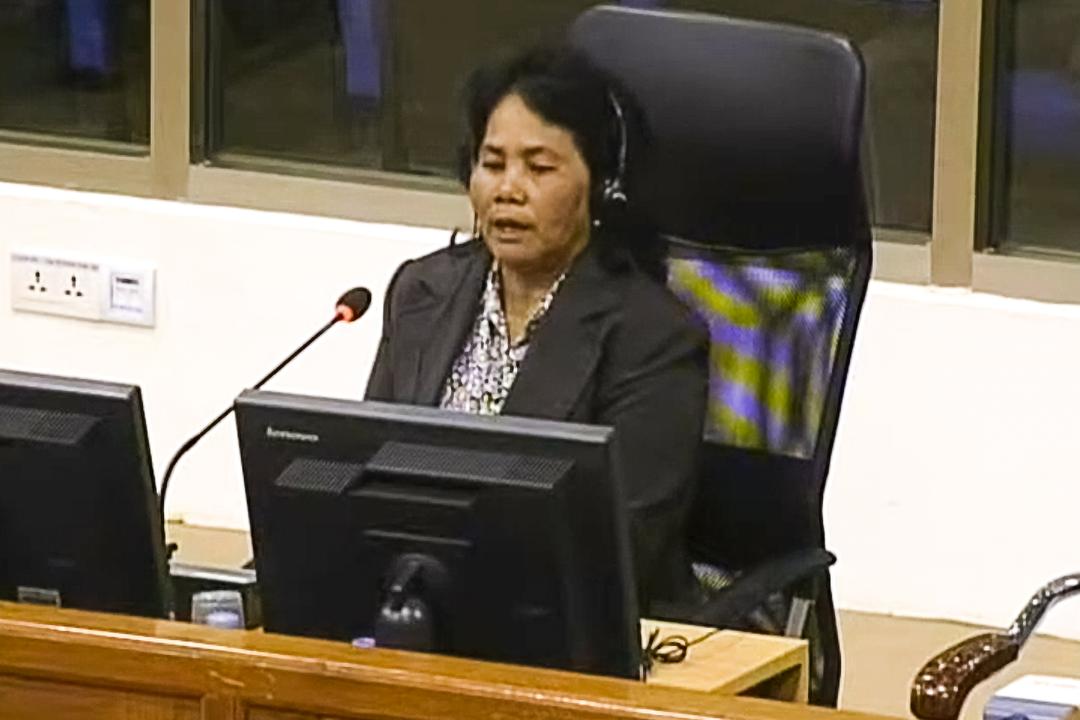
OR RY
Pseudonym: TCCP-105
Cases: Case 002/01
Category: Civil Party
Background
During Lon Nol regime, Or Ry and her 11 family members lived in Phnom Penh.
1
When the Khmer Rouge arrived in Phnom Penh in April 1975 they were forcibly evacuated from the city and returned to their native village called Tboung Damrei Village in Kampong Chamlang Commune.
2
They were subsequently forced to board a boat to Battambang as part of the CPK’s forced movement of the population phase 2.
Evacuation of Phnom Penh
When Khmer Rouge took control of Phnom Penh, soldiers instructed Or Ry and her family to leave the city, telling them that they could return in a few days.
3
The soldiers told them to leave because they had to “cleanse the city”
4
, which was noted by the Trial Chamber in its Judgment: “Yet other residents were told the evacuation was for their public safety as Angkar needed to ‘sweep’ or ‘clean’ the remaining enemies from the city”.
5
The soldiers threatened to kill those who refused to leave.
6
The Trial Chamber cited her testimony when finding that “Khmer Rouge soldiers also threatened to kill those who refused to follow their instructions and leave”.
7
Or Ry described the chaotic evacuation, explaining that “many people [were] leaving together” and that it was “crowded”.
8
The Trial Chamber considered this testimony when observing that “[t]he exodus of thousands of people from Phnom Penh was described as crowded, chaotic, confusing and difficult, as evacuees struggled with little children and elderly family members”.
9
People went in different directions and some went back to their native villages whilst her family went to Preaek Lieb.
10
They brought a little money, which could not be exchanged for food.
11
Her family were hungry.
12
At that time, her mother had just delivered a baby and her other siblings were not well.
13
The Khmer Rouge soldiers did not provide them any food, accommodation, transportation, or medicine.
14
The Trial Chamber noted her testimony when finding that “numerous witnesses and civil parties recounted how the Khmer Rouge soldiers along the way did not provide them with any food, water, medicine or even transport, not even to assist the evacuees who were weak, elderly or injured”.
15
They slept wherever they got tired, such as sleeping on the ground near lakes and in the open space.
16
After travelling for one day and a night, her family arrived in their native village in Tboung Damrei Village, Kampong Chamlang Commune.
17
Treatment of New People and Forced Movement Phase 2
When her family arrived at their native village, they were instructed to live in another house.
18
They were labelled as ‘New People” from Phnom Penh
19
and were not allowed to mix with ‘Base People’.
20
The Trial Chamber cited her testimony when recalling that “many other evacuees recounted how they were labelled ‘17 April people’ or ‘new people’ to distinguish them from the local population (known as ‘old people’ or ‘base people’), viewed with suspicion as capitalists or feudalists, and shunned and told to move on”.
21
They ate and stayed there for a few days, and thereafter were ordered to leave because of their status as New People.
22
They travelled on foot
23
until they reached Preaek Ta Meak.
24
When they arrived at the riverbank, they were instructed to board a boat travelling to Preaek Pnov with 4 armed guards onboard.
25
When they arrived, they were forced to board a truck heading to Pursat and Battambang.
26
The trucks were guarded and driven by armed Khmer Rouge soldiers.
27
Or Ry explained that “There were Khmer Rouge soldiers and unit chiefs; the former was armed and all wore black clothes and sandals.
28
Videos