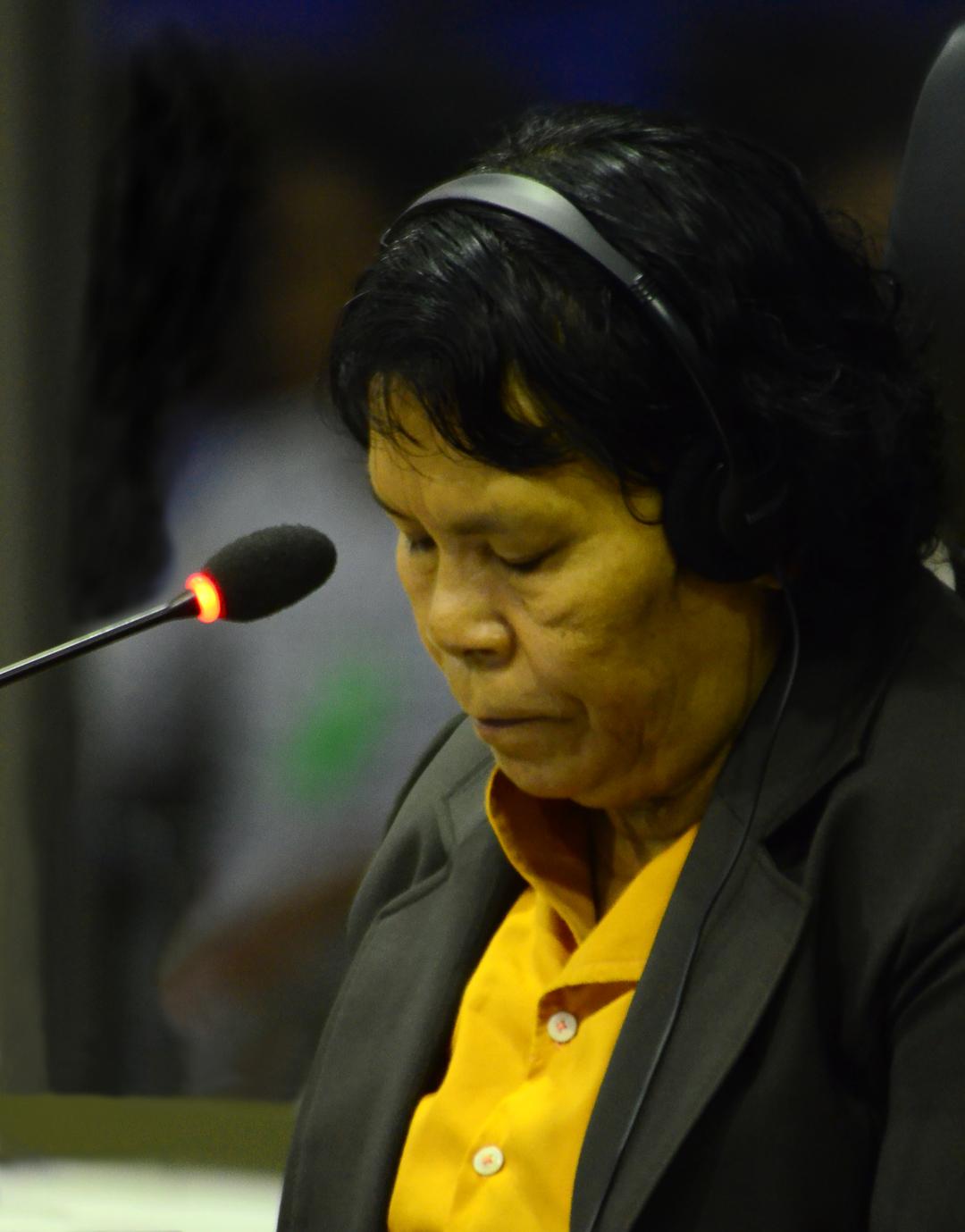
PHAN Him alias Thy (Thi)
Pseudonym: 2-TCW-914
Cases: Case 002/02
Category: Witness
Background and role
Phan Him was born in Cheung Prey district in Kampong Cham province.
1
She joined the revolution in September 1973, working in Cheung Prey district commerce office.
2
In early 1975, she was assigned to Battalion 306 to carry wounded soldiers from the battlefield in the battle against Lon Nol soldiers.
3
From May 1975, she went to Phnom Penh to work in different parts of the Commerce Ministry.
4
From 1977 she worked at “the by-product selection unit” for exporting goods overseas, located near Tuol Tumpung pagoda.
5
In November 1978, she married her husband and moved to live with him at the Ministry of Finance until January 1979.
6
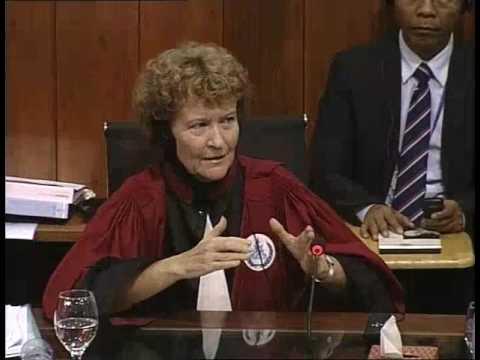
She testified as a witness before the Case 002/02 Trial Chamber on the Commerce Ministry, marriage under the Khmer Rouge, and her study session with Nuon Chea.
Life at the Commerce Ministry
In the Commerce Ministry, Ta Rith was in charge of internal and external affairs.
7
He was above Ta Hong who was his deputy and in charge of the domestic commerce.
8
In May 1975, Phan Him was assigned responsibility for the warehouse at Phsar Thmei, supplying food to the workers, and liaising with other departments in the Commerce Ministry.
9
In 1977, she was sent to a tempering site near Pochentong where she worked day and night digging canals and building dykes, without enough food.
10
Later in 1977 she came back to Phsar Thmei and attended a study session presided over by Ta Hong.
11
During the session, the North Zone traitors were denounced,
12
including Koy Thuon, Chhoeun, Nhem and others.
13
A few days later, she saw a vehicle arrive at night; people with weapons got off to make arrests, put people back onto the vehicle and left.
14
The next morning, she heard that two cadres, named Phy and Doeun, had disappeared.
15
At Tuol Tumpung, Phan Him’s task was to review certain products - including sesame seeds, and tiger and elephant bones - to ensure that good quality for export through Kampong Som.
16
She only saw Ta Hong and Ta Rith - who came to do inspections at Tuol Tumpung - briefly.
17
Arranged marriages under the Khmer Rouge
In 1974, a marriage was arranged between Phan Him and a handicapped soldier from Prey Chhor district, as part of a bigger group of marriages for handicapped soldiers. The marriages did not take place because some soldiers refused to marry.
18
Subsequently, she refused other proposals to marry.
19
In November 1978, Phan Him received a proposal to marry her current husband.
20
She refused, but was told by a female chief to respect and agree with Angkar, and adhere to the principles or direction set by Angkar. Phan Him said that “if I violated the discipline, then I had to be careful with myself.” The next morning, she was given a set of clothes, and the wedding ceremony was organized in the afternoon. Unlike her own case, all of the other people in her group had got engaged one or two month before the marriage. The marriage happened when there was a proposal from a man to marry the woman; the female agreed to the proposal; and there was no prior relationship between them.
The wedding ceremony was organized for 21 couples,
26
in a hall that was used for staff study sessions for Commerce staff every 10th and 20th days of the month.
27
It was presided over by Ta Rith, Ta Hong and the supervisors.
28
Parents or relatives were not present or aware of the wedding.
29
Women were instructed to sit in a row separately from men, and then each pair was called out to hold hands and be announced husband and wife.
30
Ta Rith instructed them to live together as husband and wife, love one another, and strive to work hard for the Party and the people.
31
After the marriage, some couples moved to live at the Finance Ministry while some others remained around Tuol Tumpung pagoda.
32
The newlyweds didn’t receive any instructions about consummating the marriages; Phan Him didn’t consummate her own for two weeks to a month, when she started to have sympathy for her husband.
33
Following the marriage, her husband came to visit her once per week.
34
They continued to live together after the fall of the regime.
35
Other couples who were living at Tuol Tumpung lived happily together and then ran away together when the Vietnamese were advancing into Cambodia.
36
The Trial Chamber relied on her testimony in addition to others in finding that: (i) wedding ceremonies took place in various locations throughout Cambodia during the regime including in Phnom Penh;
37
(ii) in general the parents and family members of the couples were not involved and/or present at the weddings;
38
(iii) with the exception of some favored individuals those who were matched to be married, couples were usually not consulted about the marriage and received little to no notice that they were to be married;
39
(iv) the number of couples married in a single wedding ceremony ranged from one couple to 70-80 couples;
40
and (v) with the exception of Phan Him herself, other women were forced to consummate their marriages, either because they feared for their lives or physical security, and therefore did not genuinely consent, or because they were physically forced to engage in sexual intercourse with their husbands.
41
On appeal, the Supreme Court Chamber considered that her evidence confirmed the Trial Chamber’s finding that women did not have true freedom to marry;
42
finding that it would have been preferable for the Trial Chamber to more fully address the question of Phan Him’s ability to freely consent to sexual intercourse with her husband.
43
Study session with Nuon Chea
In late 1978, Phan Him attended a one-day study session at Borei Keila taught by Nuon Chea.
44
The topic was respect for the Party and the Party's disciplines and working hard to produce good products to achieve three tons of rice yields per hectare.
45
Many people from the import and export sections attended the session.
46
Videos