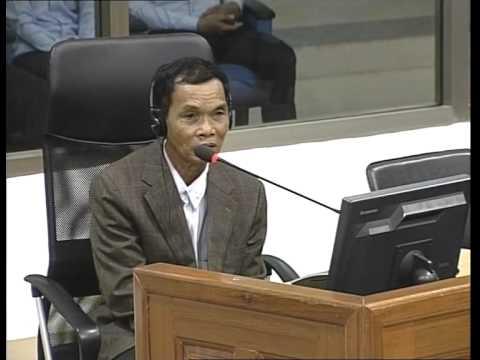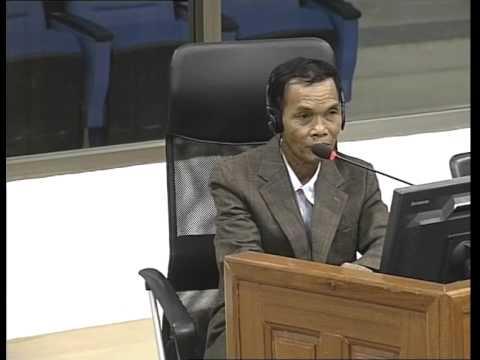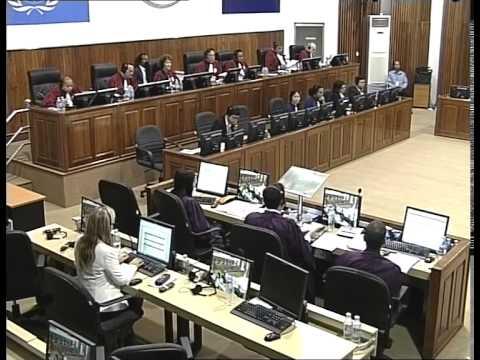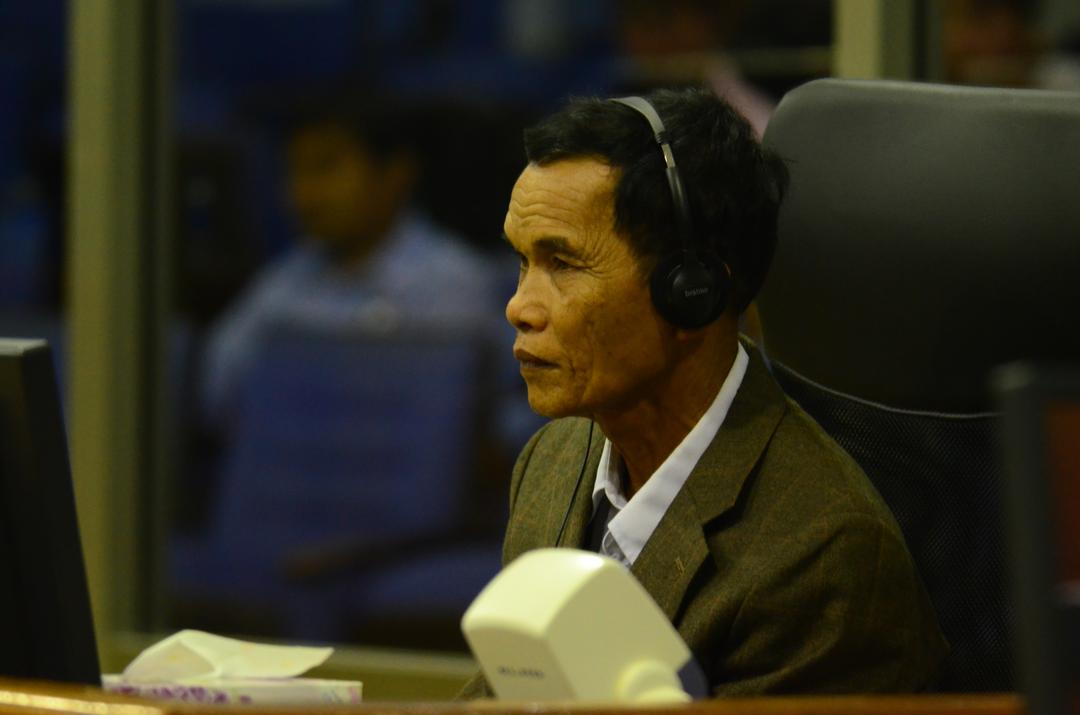
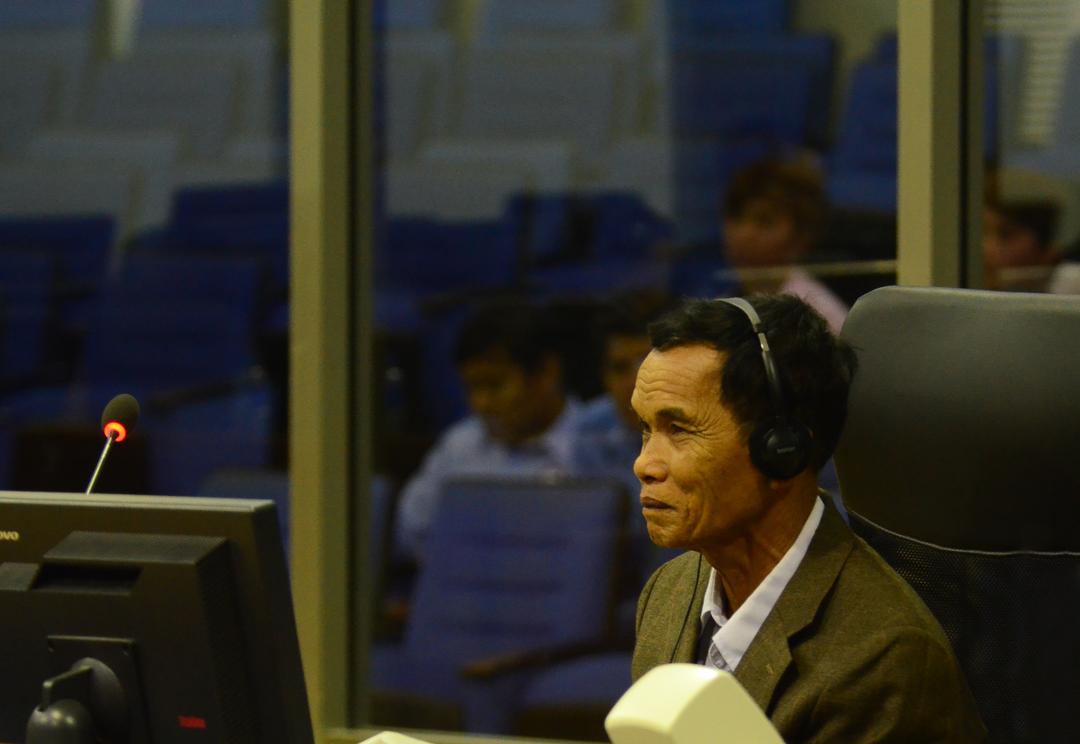
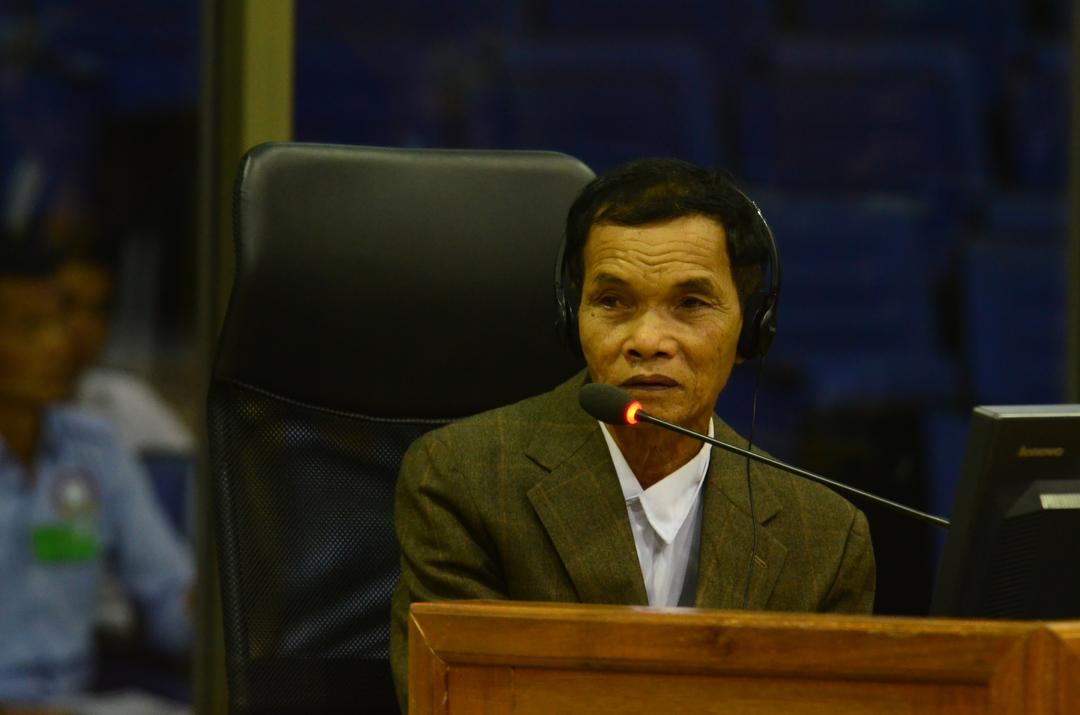
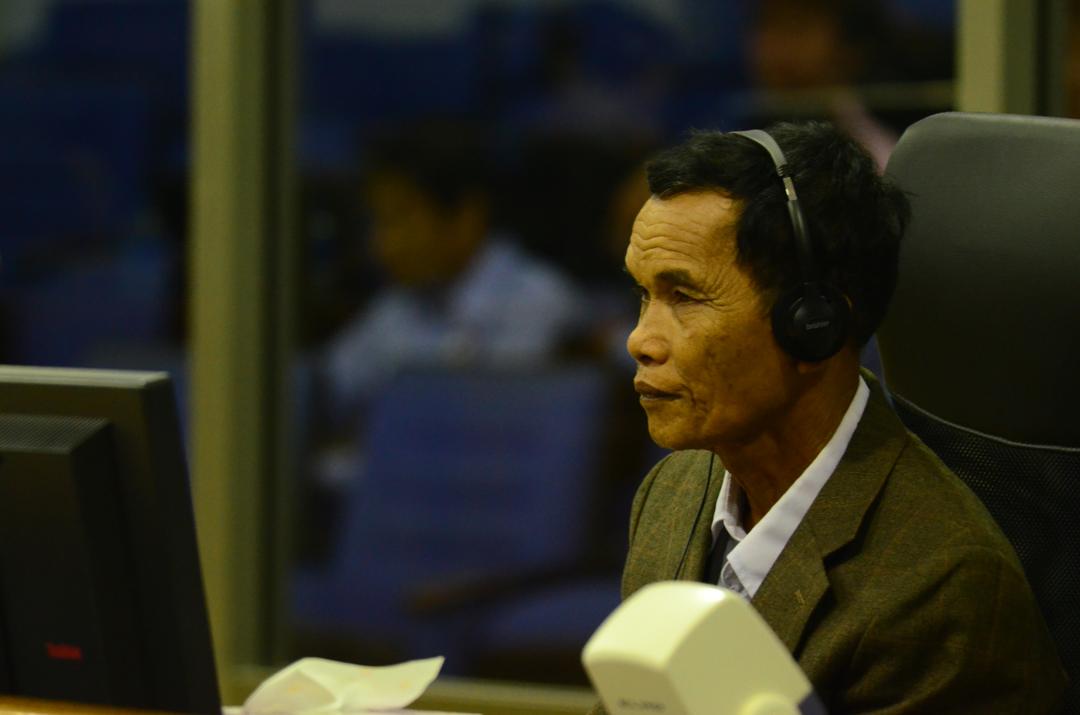
PHNEOU Yav
Pseudonym: 2-TCW-934
Cases: Case 002/02
Category: Witness
Role and background
Phneou (or Phneu) Yav
1
was a monk before he joined the 1970 revolutionary movement.
2
After 17 April 1975, he was a Base Person living in Samrong commune in Tram Kak district.
3
He first worked in Unit 2 in Paen Meas,
4
before being transferred to Unit 1 in the south, where he transported rocks for bridge building.
5
In late 1976, he began teaching children in Unit 1 at Ang Ponnareay.
6
Phneou Yav testified as a witness in the Case 002/02 trial proceedings on the living and working conditions in Samraoung commune, disappearances, the practice of forced marriages, and the elimination of Buddhism.
Living and working conditions in Paen Meas cooperative
In the Samraong commune, Phneou Yav ploughed the field, carried earth, and grew vegetables.
7
Women transplanted rice, men carried earth, elder women looked after the children, and elder men grew vegetables.
8
New People, who arrived from Phnom Penh or Takeo, were instructed to build a dam.
9
There were no Khmers from Kampuchea Krom, Cham, or Chinese living in his commune.
10
In 1976, the commune leadership created three working units: Unit 1 (Base People), Unit 2 (Candidate People), and Unit 3 (New People).
11
Each unit had to be self-sufficient
12
and ate separately.
13
Unit 1 was composed of strong individuals who can work fast; other units’ members were not as strong.
14
Unit 1 did more work and finished earlier than other units.
15
Base People who were considered wealthy were included in Unit 2,
16
and the rest were sent to Paen Meas village.
17
Only Base People could become cooperative chief.
18
Unit 1 was considered the purest, Unit 2 the purer, and Unit 3 was the lowest category.
19
There were exchanges of individuals between Units 1 and 2 but never exchanges with Unit 3.
20
While at the Samraong commune, Phneou Yav belonged to Unit 2. In 1978, Unit 1 and Unit 2 merged.
21
Phneou Yav worked from 6 a.m. until 11:30 a.m., and resumed at 2 p.m. until 5 p.m;
22
some were assigned to evening labour.
23
They had no time to relax or leave; they rested every 10th day when they were allowed to visit their families.
24
If workers were sick, they were allowed to be hospitalized.
25
Communal eating started after 17 April 1975 and it continued until 1978.
26
Food was insufficient; a group of 10 would receive three cans of gruel, and later on each received a half can of rice.
27
He had fish almost every morning, and every 10 days beef.
28
Rice from the paddies was for the consumption of all units and the surplus was sent to the upper echelon.
29
Unit 1 received more food than Units 2 and 3.
30
The Trial Chamber found that components of CPK policy in Tram Kak Cooperatives “included the collectivization of all property, the categorisation of people and their assignment to various units, political education, and communal eating in dining halls”.
31
Based on his testimony, the Trial Chamber confirmed that the Paen Meas and the Angk Ponnareay cooperatives were for Base People.
32
Living and working conditions in Ang Ponnareay cooperative
In 1976, Phneou Yav was transferred to Ang Ponnareay, where he taught Base People’s children.
33
The children were allowed to visit their parents every 10th day.
34
He worked in Children’s Unit 1
35
looking after 100 boys.
36
Girls were taught in another location.
37
After teaching them the alphabet for three hours, the children were sent to tend the cows and collect cow dung until 5 p.m., when they returned to have meal.
38
Children had the same meal as those who were in the mobile units – a pot of cooked rice for a group of 8-10 children. They would catch their own fish.
39
If children of New People stole food, they were threatened that they would be taken for execution.
40
Phneou Yav rarely attended self-criticism meetings, but those from other units held self-criticism meetings frequently.
41
Disappearances
People were afraid of making mistakes because they would be taken away and killed – this did not happen so much for the Base People as it did for others.
42
Disappearances happened in the south of the village, but not to the north.
43
Phneou Yav testified of the disappearance of Ta Vin, a member of the cart unit, who was taken to Kraing Ta Chan Security Centre in 1976 because he was complaining about not having enough to eat.
44
There was no reason given for Ta Vin’s arrest, except that he would be taken for re-education.
45
Children who stole food and couples who did not consummate their marriage would not be sent to Kraing Ta Chan.
46
Forced marriages
Phneou Yav witnessed the marriage of 30 couples in Unit 1.
47
People in Unit 1 could be married to people in Unit 2, but not with people in Unit 3.
48
Some couples knew each other, others did not.
49
The ceremonies, organised by the commune and village chiefs,
50
were mostly held at night.
51
After the marriage, each spouse returned to their respective units and could meet every 10 days.
52
If two people liked each other, they could ask the upper echelon to arrange the marriage.
53
If the couple did not have sexual intercourse, they would be in trouble.
54
Militiamen eavesdropped at the newlywed’s houses to determine whether the couple consummated the marriage.
55
If they did not, militiamen reported them to the upper echelon and they were threatened with being taken to Kraing Ta Chan Security Centre.
56
There were no family-building instructions for the couple, other than to love each other and to live together.
57
The Trial Chamber confirmed that the wedding ceremonies were held at night, after people finished working.
58
The Supreme Court Chamber confirmed the Trial Chamber’s finding that sanctions were imposed against couples who did not get along and would seek divorce.
59
It upheld the finding that “the regulation of marriage had a purpose, which was … part of the common purpose”,
60
and that the Trial Chamber’s conclusion that couples lacked meaningful consent to their marriages, was reasonable.
61
Buddhism
Phneou Yav testified that after 17 April 1975
62
monks were ordered to disrobe and pagodas were transformed into fertilizer warehouses or meeting places.
63
Buddha statues were removed from temples and thrown into ponds.
64
There were no monks or religious funerals after 1975,
65
as was the custom prior to 1975.
66
His suffering
Videos