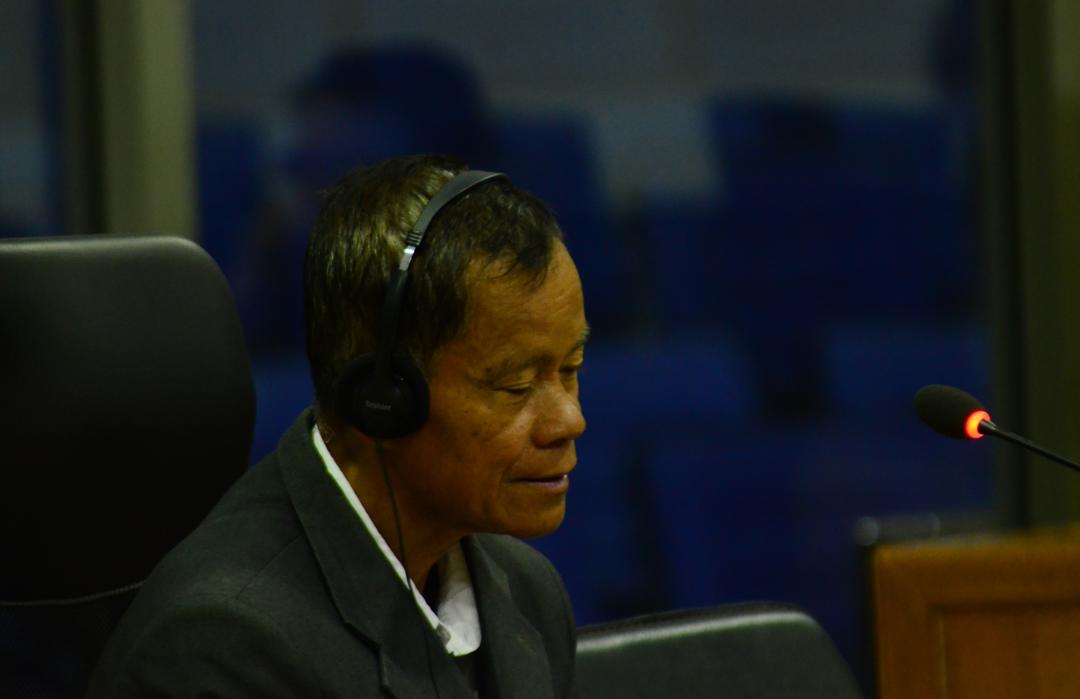
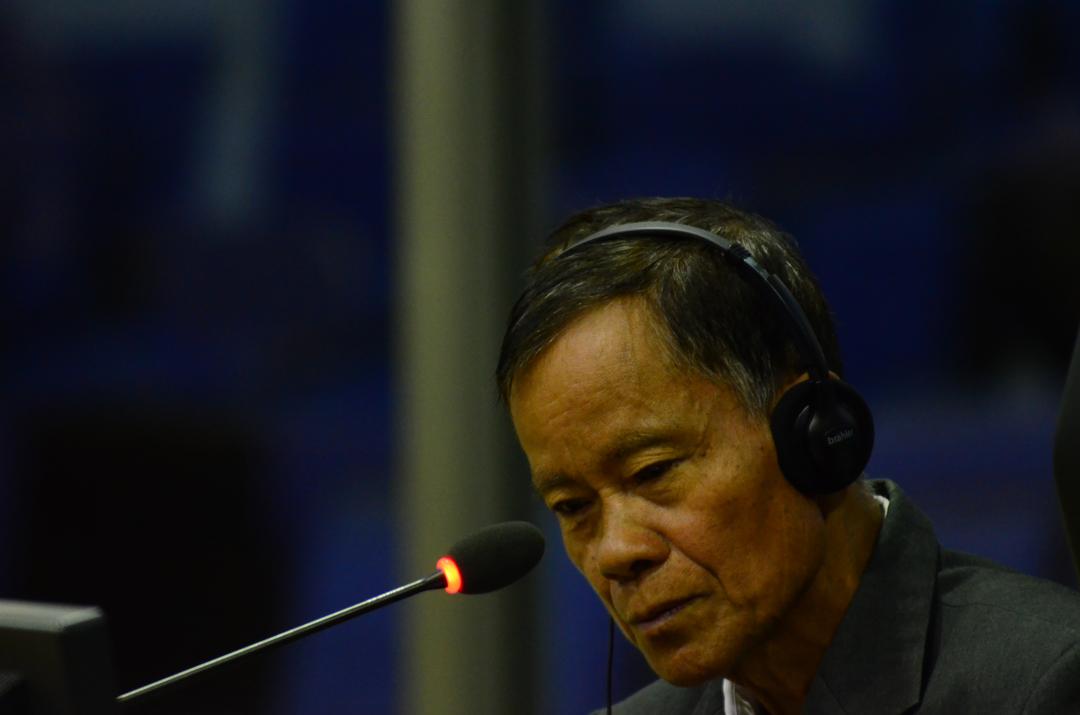
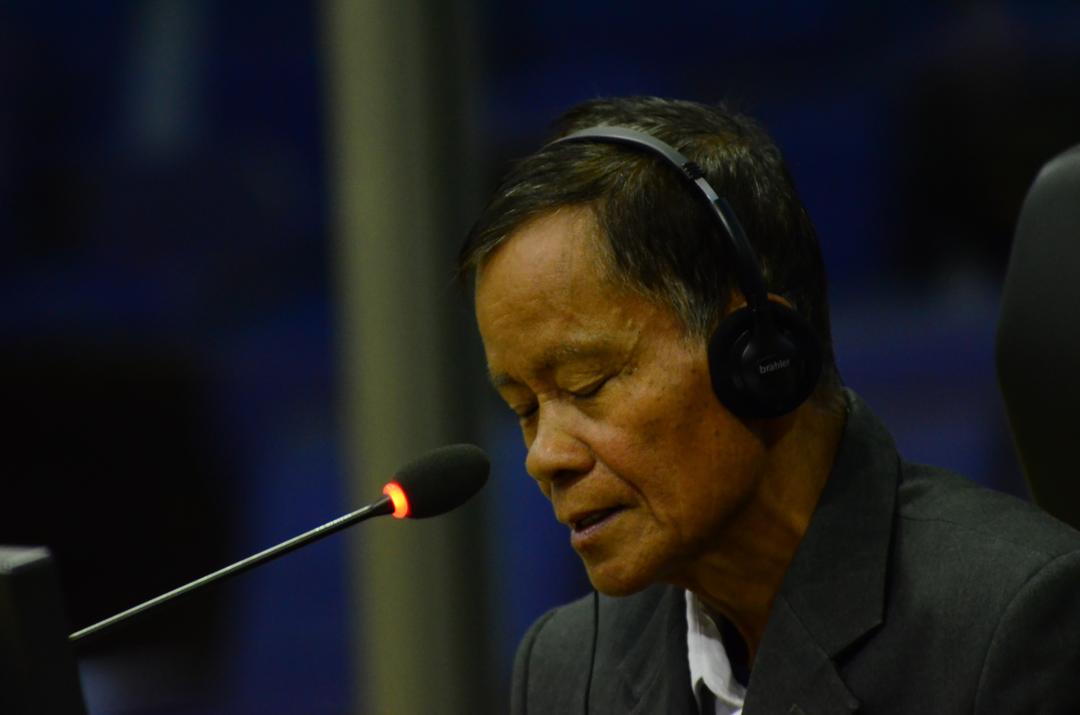

SANN Lorn
Pseudonym: 2-TCW-1007
Cases: Case 002/02
Category: Witness
Background and role
Sann Lorn, alias Maunh,
1
is the brother-in-law of Ta Mok who worked as a messenger during Democratic Kampuchea.
2
He was born in Tram Kak district in Takeo province, where he also went to school.
3
From 1971 to 1972, he was appointed by the commune to serve as the Chief of Prakeab village while it was under the control of the Khmer Rouge.
4
Between 1975 and 1979, Maunh worked as a messenger in the District Office in Angk Roka, Tram Kak district for District Secretary Yeay Khom and later for District Secretary Pech Chim.
5
In 1977 or 1978, he studied agriculture in Battambang province for one year.
6
Maunh testified as a witness in Case 002/02 about Ta Mok and the transportation of the Vietnamese.
Ta Mok
Maunh is the brother-in-law of Ta Mok and the younger brother of Ta Mok’s wife.
7
He believed Ta Mok to be a top leader and the second-in-line behind Pol Pot, and knew him to have a designated number, “Ta 15”.
8
Ta Mok’s messenger, Touch, would deliver orders from the sector to Maunh.
9
The orders to transport Vietnamese people came after Ta Mok and Ta Tith visited the District Office during the time Pech Chim was district chief.
10
The Trial Chamber cited Maunh’s testimony in finding that: (i) Ta Mok had a long-standing and prominent role in the Communist Party of Kampuchea (CPK) between 1975 and 1979;
11
(ii) CPK leaders from the zone, sector, and district levels regularly travelled throughout Tram Kak district to visit and supervise worksites;
12
and (iii) instructions were issued from at least the district level to round up Vietnamese from various communes.
13
Transporting the Vietnamese
During the dry season in 1975, Maunh was tasked by the District Office with transporting Vietnamese people.
14
Over the course of four days, he collected people from about six communes in a “huge truck” with a cover and transported them to Nhaeng Nhang village in Tram Kak district.
15
The truck fit 50 to 60 people, so he made several trips to communes that had many people, while other communes only required one trip.
16
Usually the commune chief was responsible for gathering the people at the pick-up location, and after dropping them off, the district military chief would receive them along with ten soldiers.
17
The direct orders to transport the Vietnamese came from Phy, alias Thy, who was second-in-line to the district secretary at the District Office.
18
Phy was responsible for the security office on the border of Samraong and Kus communes and the re-education office that was located in Angk Roka,
19
which was not a fixed location, but a mobile one that was sometimes relocated.
20
Maunh recalled that Phy had a limp.
21
Although Maunh did not know what happened after he dropped them off, he heard from the district that the transportation of the Vietnamese was a deportation.
22
However, he could not recall the specific communes,
23
the number of people transported, or if he told a person who worked at the district named Ul Hoeun, alias Ek Hoeun, that he had transported 9,000 people (despite being confronted with Ek Hoeun’s testimony claiming that he had).
24
He also claimed that he did not know a person named Ek or Ul Hoeun,
25
but later claimed he was not sure whether he spoke to him and forgot it.
26
The Trial Chamber cited Maunh’s testimony in finding that: (i) large numbers of Vietnamese were gathered in Tram Kak district from late 1975 into early 1976, with many expelled and/or disappeared; (ii) persons identified as Vietnamese were being targeted and instructions to kill Vietnamese were issued at various times;
27
(iii) the Vietnamese were lawfully present in Tram Kak district at the time;
28
(iv) Phy was involved with security matters for Tram Kak district and was memorable for his limp;
29
and (v) the primary location of the Tram Kak District Office was at Angk Roka, where the District Committee was based.
30
The Trial Chamber accepted that Maunh told Ek Hoeun that the figure was 9,000, but found the statement “improbable” due to Maunh’s evidence that transfers were made by “a single truck holding 50-60 persons at a time” over four days.
31
It reasoned that Maunh appeared to accept that approximately 9,000 Vietnamese were transferred in some instances, while questioning the figure in other instances.
32
It also noted that Maunh claimed not to know a person named Ek or Ul Hoeun, while testifying that he was not sure whether he talked to or discussed numbers with him.
33
On appeal, Khieu Samphan submitted that the Maunh’s testimony, among other testimonies, shed no light on the fate of the Vietnamese who were gathered up, except that some of their evidence indicated that the Vietnamese were sent away from the border.
34
However, the Supreme Court Chamber found that this evidence “support[s] the idea that Vietnamese were gathered up and moved,” and that it may also lend some credence to the inference that some Vietnamese crossed the border.
35
Consequently, it found that the Trial Chamber did not err in concluding that there was intent to force Vietnamese across a national border.
36
Khieu Samphan also argued on appeal that the only instructions and orders mentioned by the Trial Chamber related to killing Vietnamese.
37
However, the Supreme Court Chamber referred to the testimonies of Ek Hoeun and Maunh discussing instructions regarding the transportation of Vietnamese, concluding that it was proper for the Trial Chamber to find that the instructions regarding the transportation of the Vietnamese demonstrated an intent to target the Vietnamese.
38
***
Videos