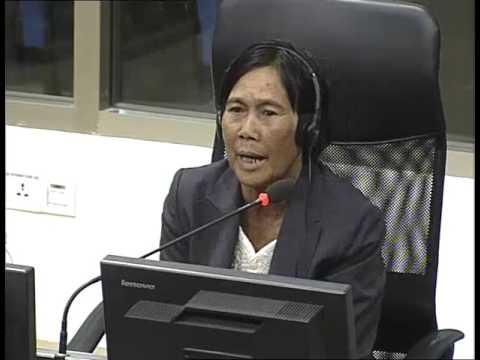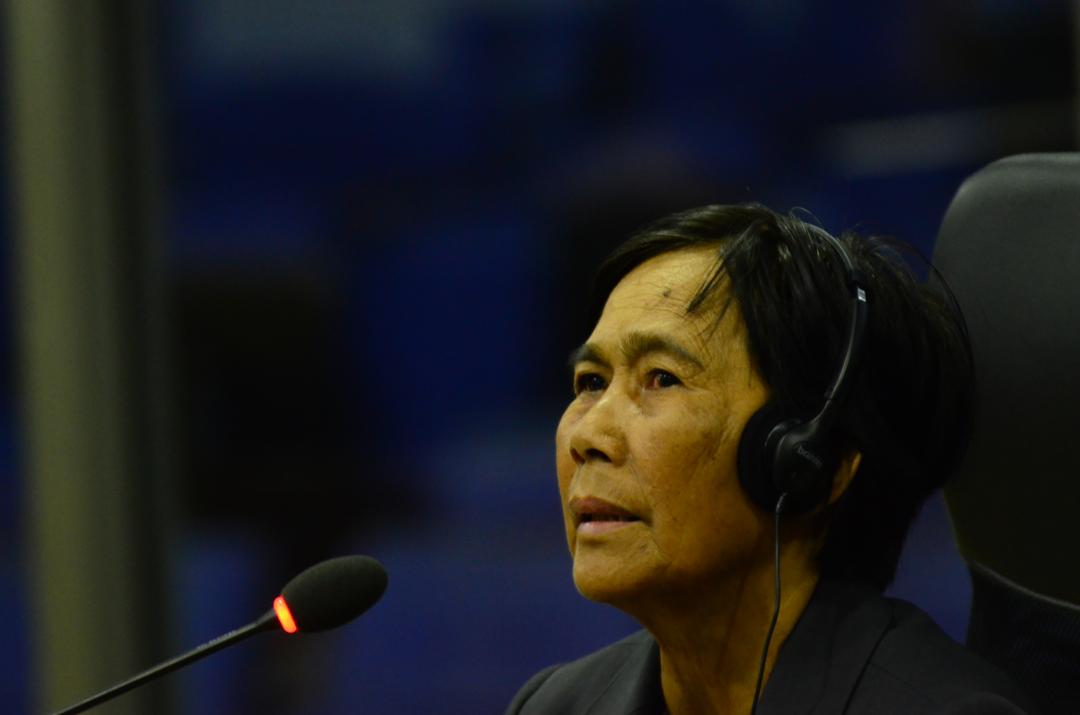
SAO Sak
Pseudonym: 2-TCW-886
Cases: Case 002/02
Category: Witness
Background and role
Sao Sak was born and lived her entire life in Anlong Trea village, Preaek Chrey commune, Kampong Leav district, Sector 24 of the East Zone.
1
She got married in 1969 and had three children in 1975.
2
Her mother was “half-blood Vietnamese”, whereas her father was Khmer.
3
She testified as a witness before the Trial Chamber in Case 002/02 on the treatment of the Vietnamese.
The term “Yuon”
During her testimony, Sao Sak used the term “Yuon” to refer to Vietnam or Vietnamese in general terms.
4
The Trial Chamber relied on her evidence in addition to others to consider any derogatory intent associated with the use of the term “Yuon” or Vietnamese “enemy” on a case-by-case basis, and by taking into account the totality of the evidence and the circumstances in which the term was used.
Vietnamese a distinct group and its identification
Before 1975, Vietnamese were living and mixing up with Khmer people.
6
Later on, the Vietnamese people were sorted out.
7
They could be recognised by their accents since they spoke differently from the Khmer people.
8
Sao Sak recalled that there were a few Vietnamese families living in her area, including: (i) Van Mao – and his father Vietnamese called Thav;
9
and (2) Neang Nat – the daughter of Thaong (Khmer father) and Yeun alias Sak (Vietnamese mother).
10
In her opinion, the village chief did some statistics or made some records about the ethnicity of the villagers, and that is why people in the higher ranks knew something about the ethnicity of the people in the village.
11
They did not discuss the Vietnamese in the meetings Sao Sak attended during the Khmer Rouge regime – only rice productions.
12
The Trial Chamber relied on her testimony in addition to other evidence in finding that: (i) most Vietnamese living in Cambodia spoke Khmer with an accent or not fluently, and constituted an ethnic, national and racial group at the relevant time;
13
(ii) the upper echelons were well aware of which families had members of Vietnamese origin;
14
and (iii) from 1975, the upper echelon ordered the identification of Vietnamese, as a result of which lists and biographies were prepared by the lower echelons and then communicated back to the upper echelons for further action.
15
Mistreatments and disappearances of the Vietnamese families in the Anlong Trea village
During the Khmer Rouge regime, Sao Sak’s mother was assigned to taking care of babies and children with other women in her village.
16
One instance in 1978, she was called to a meeting, and then she brought along Sao Sak’s daughter.
17
Sao Sak learned about the arrest of her mother from a militiaman called Khon.
18
She went to meet her mother while she was detained with a Yeun (mother of Van Mao) at Krasar Pha’eul village
19
and to request to get her daughter back.
20
She took her daughter back, but dared not chit-chat with her mother and felt pain seeing her detained.
21
She did not know what mistake her mother had committed.
22
At the time she was quite old and had no relatives or siblings related to Vietnam or living in Phnom Penh.
23
She explained: “Anyone who was related to Vietnamese origin would be taken away and killed that is what I learnt.”
24
Her mother was taken away together with Yeun and never saw or heard about them again.
25
Some others people in her village with Vietnamese links also disappeared and never returned; and she did not know where they were taken.
26
She learned that Thav (Van Mao’s father) was taken away with another man.
27
Thav’s father (Van Mao’s grandfather), called Hein, had been sent away and killed, though she was told that he was sent to work elsewhere.
28
Hein’s father was ethically Chinese and his mother was Vietnamese.
29
Sao Sak heard that a Khmer named Lang Hel who already passed away had his wife and three children all taken away and killed under the regime.
30
However, she did not know whether his wife was Vietnamese.
31
About five months later after her mother’s arrest, Sao Sak was called to a meeting at the Anlong Trea pagoda and was detained in a temporary detention place in Angkor Ang village with her three children for a period of ten or twelve days, without knowing the reason.
32
There she was asked about the ethnicity and the previous occupation of her father.
33
She said that he was Khmer, a simple villager and did not do anything else.
34
After that, she was instructed to work in the kitchen, to harvest corn and to clean the compound as well as the kitchen hall in that detention place.
35
Based on her observation on those mixed families, when the father was Vietnamese, the children were taken away and killed.
36
The Trial Chamber found that: (i) Sao Sak and her children benefited from an exception to the nationwide policy to kill Vietnamese living in Cambodia at the time;
37
and (ii) though the final fate of the mother remained unknown, it was not established to the requisite standard that she was dead as a consequence of the policy to kill Vietnamese living in Cambodia at the time.
38
Movement of Vietnamese Civilians from Cambodia to Vietnam
After 1975, Sao Sak saw Vietnamese families being gathered and evacuated to the lower part, which meant to Vietnam.
39
She heard from fellow villagers that this was because the Vietnamese were not allowed to live in Cambodia.
40
As for the mixed families, they were gathered up continuously, sent one family at a time, and then disappeared.
41
Videos