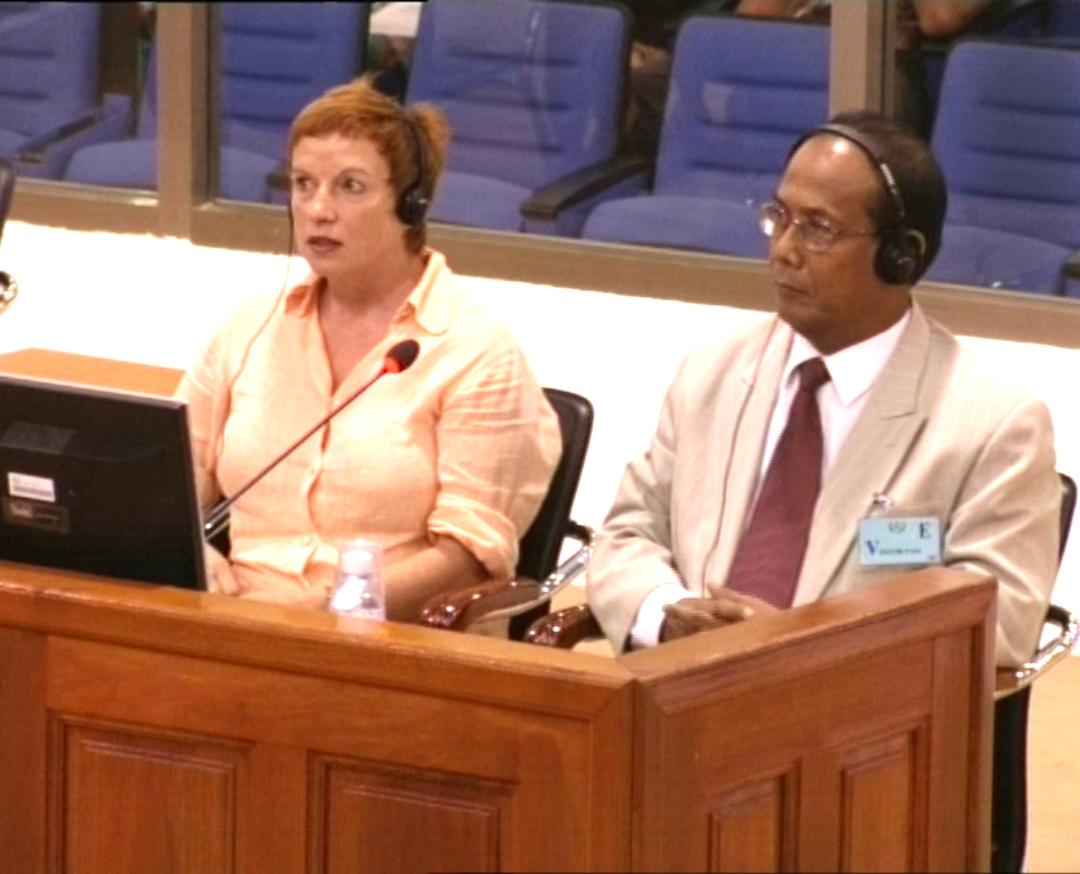
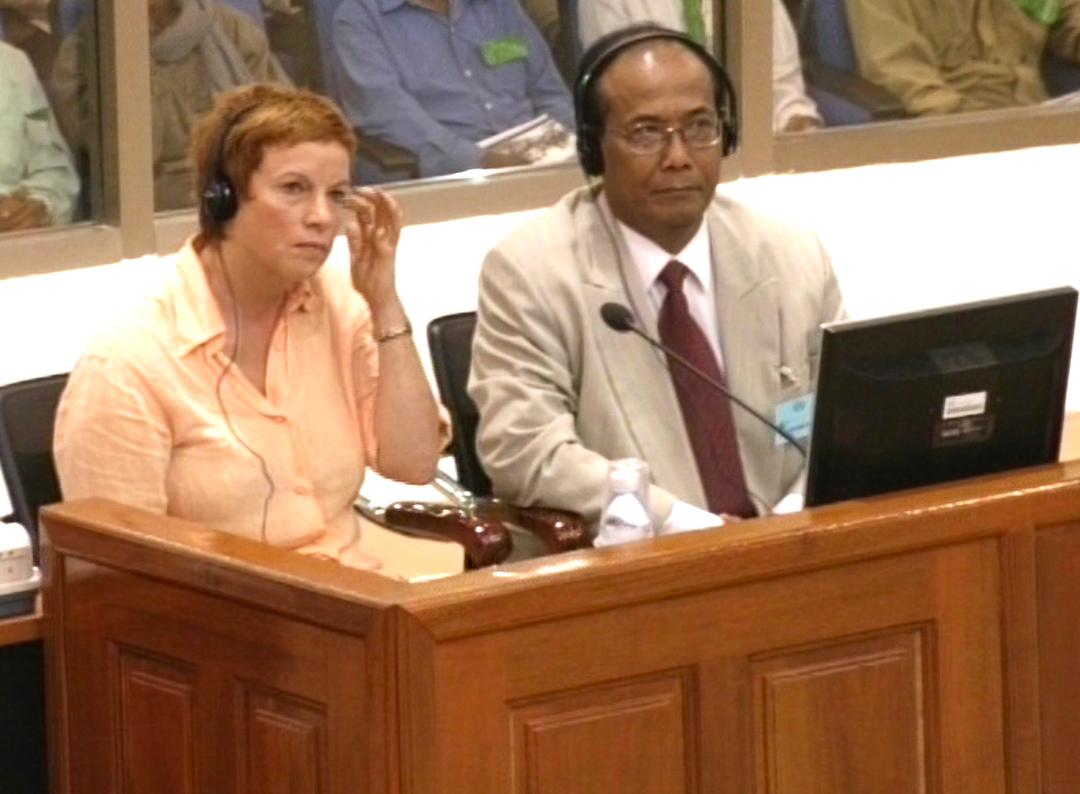
SIRONI-GUILBARD Francoise
Pseudonym: KW-35
Cases: Case 001
Category: Expert
Background and Expertise
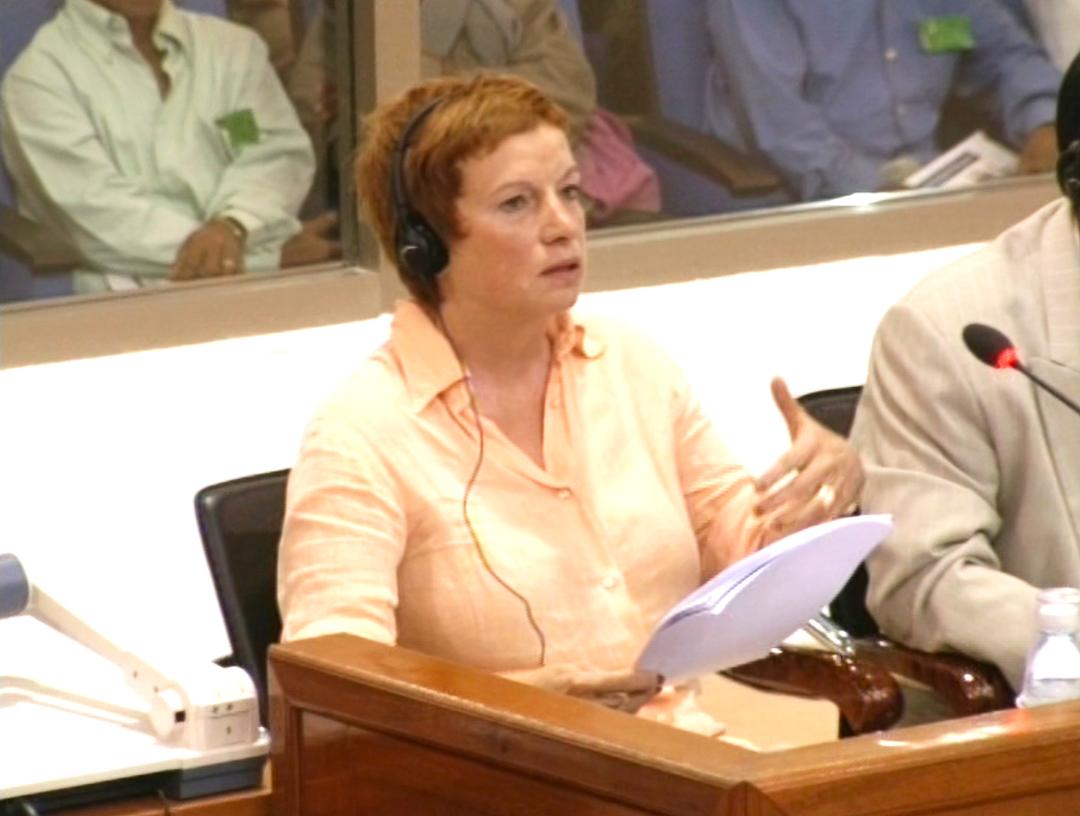
Francoise Sironi-Guilbaud is a psychologist and lecturer at the University of Paris 8,
1
with expertise in the psychological treatment of victims of torture.
2
She was called as an expert to present a psychological assessment of Duch. The report she presented concerned the character of the Accused, his ability to understand, judge and empathise, and his susceptibility to be influenced by others and by psychological factors.
3
She was further instructed to address the question of whether Duch was capable of being reintegrated or rehabilitated into society.
4
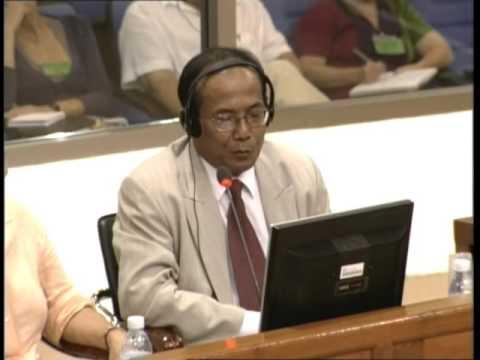
Ms Sironi-Guilbaud presented her report to the Trial Chamber jointly with Professor Ka Sunbaunat of the Phnom Penh University of Health Sciences. She adopted an approach grounded in clinical geopolitical psychology,
5
which as she explained, “reports on the articulation in each of us between collective history and individual history”, taking into account the weight of political, economic, historical and cultural factors on the personality of the subject.
6
The report was based upon 13 interviews held with Duch of an average duration of three hours each, as well as an additional three updated interviews.
7
Ms Sironi-Guilbaud noted that there was a marked difference between the first and second series of interviews; in the first series, Duch would speak from an external point-of-view, as if he were an observer, whereas in the second series he adopted more of an internal view on his life and actions.
8
Duch’s Interest in Communism
Regarding Duch’s childhood, Ms Sironi-Guilbaud testified that he did not experience family violence.
9
She did however believe that Duch experienced a feeling of debasement or inferiority as a child, which led him to work hard and surpass himself.
10
Ms Sironi-Guilbaud described a pivotal turning point in Duch’s life when, at the age of 15, he learnt of the social situation of his family and of his father's enslavement to an usurer of Chinese origin.
11
At the same time, he became fascinated by communism, which to him represented an ideal solution to exploitation and usury.
12
Another turning point was when, in 1964, Duch met his future mentor, Son Sen, while at the Sisowath College.
13
He then discovered stoicism; a doctrine that claims indifference in the face of anything that can influence emotions.
14
She described how three events during his time as a student oriented him towards Marxist theories: a romantic disappointment, the theft of his bicycle which prevented him from attending class, and the arrest of 10 of his friends.
15
A further impacting event was his arbitrary detainment between 1968 and1970.
16
Duch’s Questioning of the Regime
Following the torture and execution of Vorn Vet, his former master at S-21, Duch was confronted with fears and doubts stemming from a perceived absence of legibility of Angkar's intentions.
17
However, in what Ms Sironi-Guilbaud explained as “reactional formation”, he continued to work with even more zeal and extreme allegiance to dispel those doubts.
18
She described how Duch suffered two bouts of depression: the first in 1979 before the arrival of the Vietnamese when he was at S-21, and another between 1981 and 1982.
19
He said that he ruminated because as the eldest child of his parents he did not know how to announce the death due to famine of two of his sisters, of one of his brothers-in-law and of six of his nephews.
20
Duch’s psychological factors
Ms Sironi-Guilbaud testified that she did not detect a mental disorder in Duch.
21
She described him as a “perfectionist” and as “meticulous, conscientious, mindful of detail and of control”.
22
She concluded that Duch was easily influenced,
23
and had a strong need for affiliation to a group and recognition by his superiors.
24
She stated that the need to please his superiors, particularly when Son Sen was his superior, likely led Duch to write out false confessions as a means of preserving his position at S-21.
25
Duch married in 1976 and went on to have four children of his own.
26
His ability to separate his family life from his work at S-21, where children died, was possible, Ms Sironi-Guilbaud explained, through psychological splitting.
27
As Duch stated in his interview, "I did not want to see. I did not want to know”.
28
Alongside psychological splitting, Ms Sironi-Guilbaud stated that Duch had resorted to several defence mechanisms, including rationalisation.
29
He had also transitioned between feelings of denial and denegation, which in psychology involves acknowledging partially one’s participation in acts while simultaneously trying to justify those acts.
30
She further found that Duch suffered from alexithymia, or an inability to feel his emotions concerning his own subjectiveness and the suffering or the pain of others.
31
In its judgment, the Trial Chamber agreed with both Ms Sironi-Guilbaud and Professor Ka Sunbaunat’s understanding of Duch’s psychology, finding that he “has no psychological or psychiatric impairment relevant to his criminal responsibility”, and that he was “fully aware of his responsibility for the suffering and death of thousands of innocent people at S-21”.
32
Duch’s Remorse
Ms Sironi-Guilbaud testified that remorse was inaccessible to Duch prior to the trial because it required the ability to empathise, the end of psychological splitting and the acquisition of self-identity.
35
She spoke of Duch’s psychological development, stating that she had seen a rapid switch from denial towards self-depreciation and self-accusation.
36
Throughout the trial, Dutch made several statements in which he expressed remorse, including as follows:
As the person who was in charge of S-21, I never attempt to find other alternatives other than obeying the orders, although I know that obeying the order meant that the lives of numerous people would be perished. And now I am very regretful, and I am very shameful, and I myself, I know that I committed that crimes, and I have been shameful and in the eyes of people who are victims and those who lost their loved ones during the regime ...
37
When asked about whether such remorse was genuine, Ms Sironi-Guilbaud indicated an improvement in Duch’s ability to empathise with victims.
38
She testified that she believed that Duch was sincere in the process of his acknowledgement of his responsibility.
39
Prospect of Duch’s Rehabilitation and Reintegration
Ms Sironi-Guilbaud expressed a view that Duch could be rehabilitated or reintegrated because he had demonstrated an ability to adapt to new life situations.
40
The Trial Chamber concurred with this opinion, thereby affording limited consideration to Duch’s propensity for rehabilitation in its determination of his sentence.
41
The Trial Chamber sentenced him to 35 years in prison, taking into consideration the violation of Duch’s rights occasioned by his illegal detention by the Cambodian Military Court between 10 May 1999 and 30 July 2007. This remedy was overturned on appeal by the Supreme Court Chamber, which imposed a life sentence on Duch; the maximum sentence provided by ECCC law.
Videos