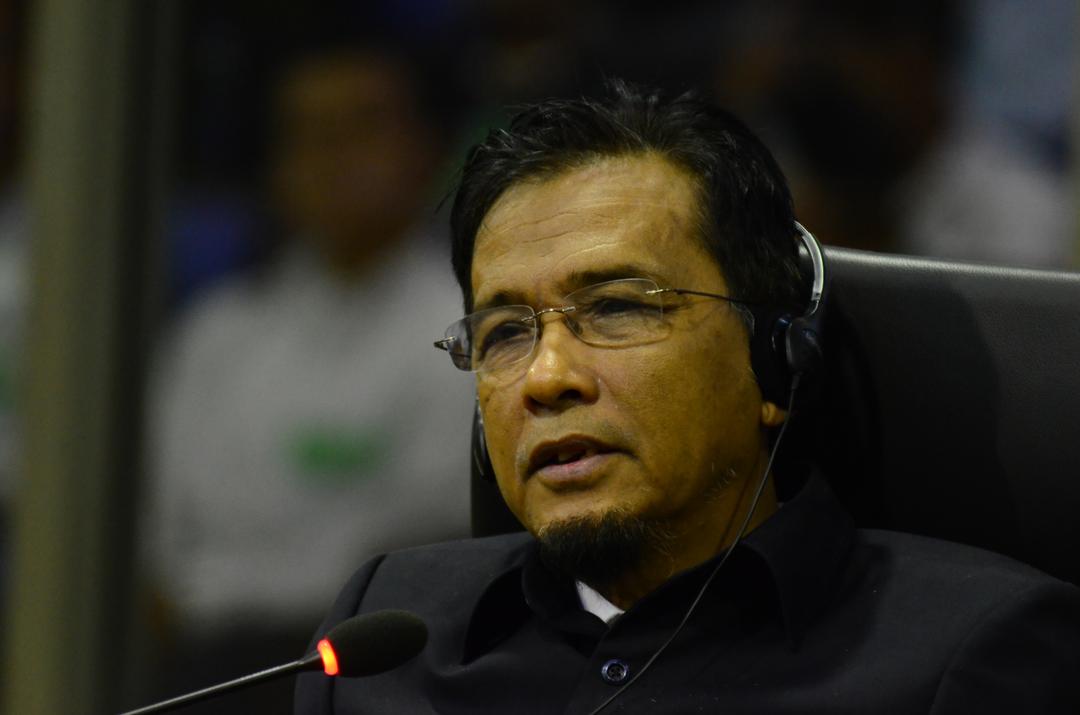
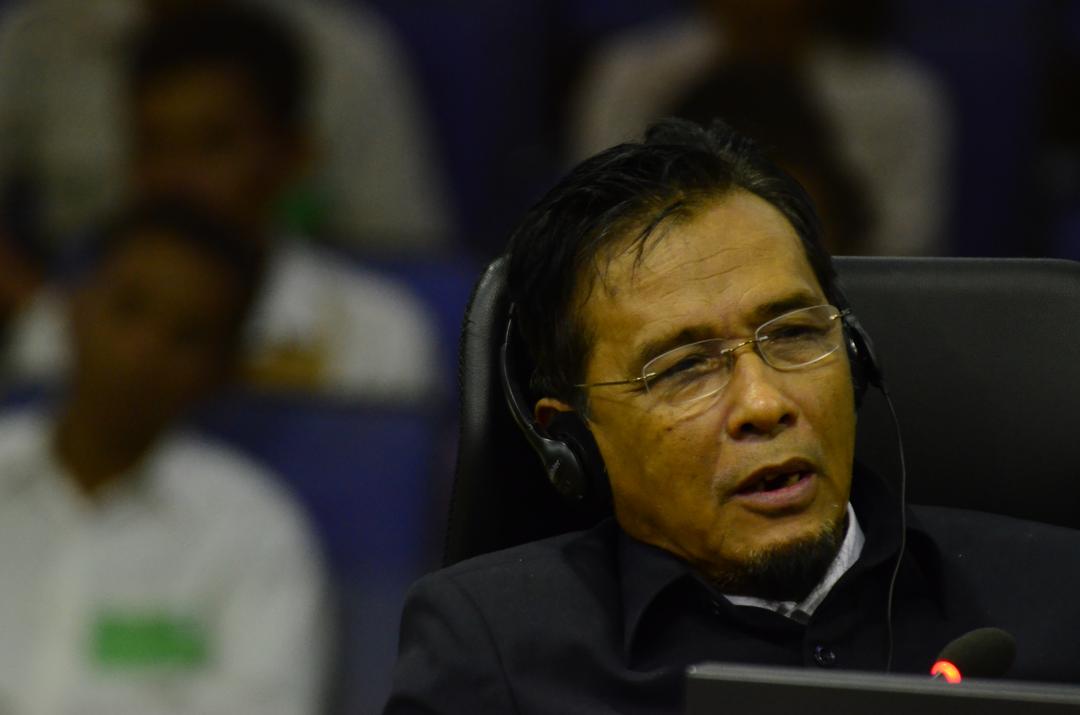
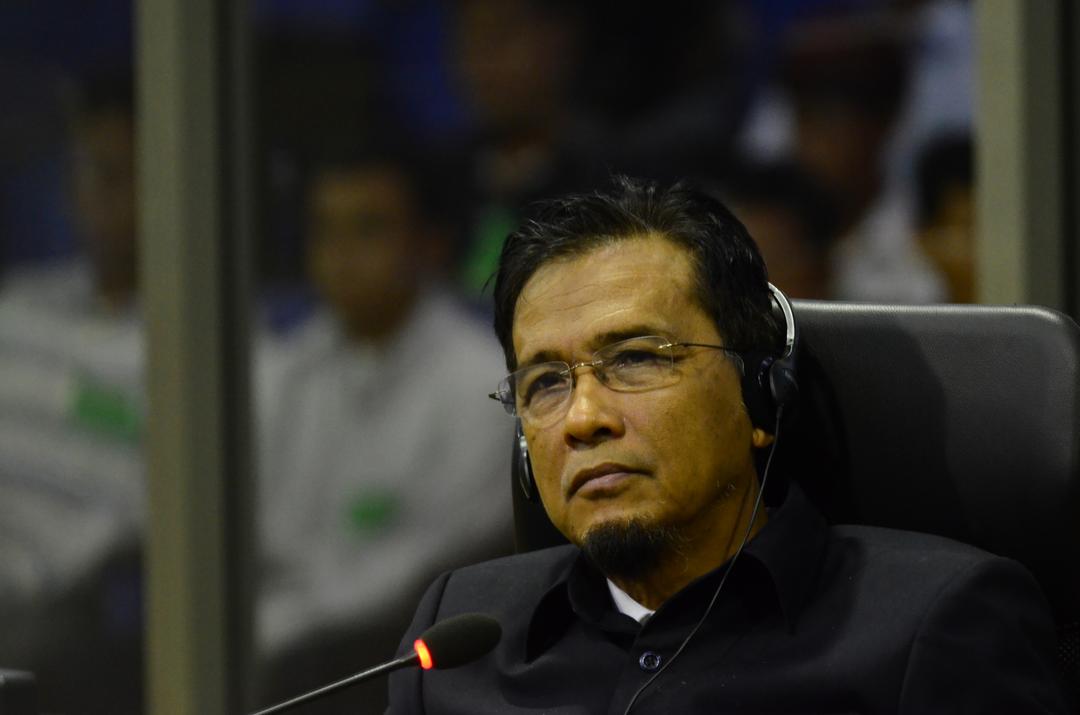
SOH Kamrei
Pseudonym: 2-TCW-827
Cases: Case 002/02
Category: Witness
Background and role
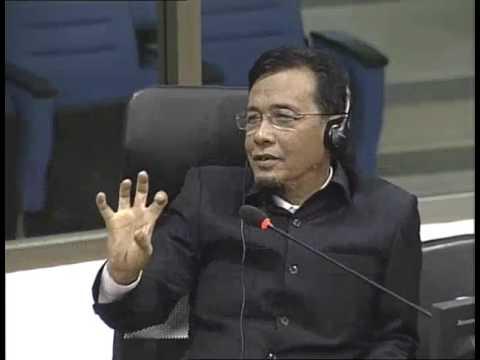
Soh Kamri
1
, whose full Islamic name is Kamaruttin Yusof
2
, is a Cham person
3
currently working as the director of the Supreme Islamic Centre.
4
Soh Kamri testified as a witness before the Trial Chamber in Case 002/02 on the treatment of the Cham during the Regime, in particular restrictions placed on their religious practices, evacuations of Cham people and targeted killings of the Cham.
Restrictions placed on Cham People
Before the Khmer Rouge entered his village (named Spueu village in Cheyyou commune, Chamkar Leu district, Kampong Cham province)
5
Soh Kamri was working in the plantation.
6
In 1973, he was teaching young Cham children, morality, and Islamic religion and Khmer Literature.
7
When the Khmer Rouge arrived, he was not allowed to continue his teaching following the CPK ban on practicing religion,
8
however people could continue studying Khmer literature.
9
Soh Kamri described how life changed when the Khmer Rouge took over and how the CPK placed a number of restrictions on the lives of Cham people. They were not allowed to eat in their own homes, and rather had to eat communally at a common kitchen.
10
They were banned from continuing their religious practices,
11
and could no longer wear their customary clothing.
12
They were also banned from speaking their Cham language, but could speak to one another when they were not being observed.
13
He added that Cham people could also not gather in large numbers.
14
The Trial Chamber accepted his testimony when finding that there was a significant increase in prohibiting Cham from practicing their religion and culture, first following the fall of Phnom Penh on 17 April, and later in reaction to the Koh Phal and Svay Khleang rebellions.
15
It further found that the Cham could no longer pray, that they had to wear the same dress and haircuts as Khmer people, Korans were destroyed, and mosques were dismantled or used for storage purposes, leaving “no sacred place for [the Cham] to pray”.
16
Evacuation of Cham People
At the time Khmer Rouge entered his village there was little more than 1,250 Cham families in the village,
17
with each family consisting of around 5 members on average.
18
Evacuations started in late 1974 or early 1975.
19
20% to 25% survived the regime, and many of those who perished may have been killed.
20
Some families were evacuated to other neighbouring communes in Chamkar Leu district, including his parents, and only 50 families were allowed to stay.
21
The people who were evacuated were not given a choice to stay in their village.
22
Killings of Cham People in Spueu village and his evacuation to Cheyyou village
He was aware that widespread killings of Cham people were happening
23
and saw dead bodies, but he did not witness the killing incidents.
24
He saw his neighbours being arrested when they were called out of the village.
25
Some were taken away at the worksites and some were taken out of their houses.
26
He would observe and monitor what happened to those who were arrested, and noticed that they were killed and buried.
27
By 1977, he testified that arrests and detentions happened on a massive scale in Spueu village.
28
Soh Kamri was afraid he would not survive in Spueu village due to the targeted treatment and killings of the Cham.
29
In early 1977, he moved to Cheyyou village for one year.
30
The witness recalled once when he was assigned to collect firewood from the forest while working in Cheyyou village, he saw many pits where dead bodies had been buried.
31
By mid-1978, the killings had stopped for about 6 months, and there was no longer any research being conducted into the background of villagers.
32
He returned to his previous village in early 1978
33
and remained living in the village until liberation day, and a month later he evacuated himself to live in Ponhea Kraek.
34
CPK meeting and booklet identifying the Cham as the enemy
In 1977 he attended a meeting in Bos Khnaor village in Chamkar Leu district in which the Khmer Rouge were talking about the destruction of enemies. The agenda for the meeting was to specify a plan called ‘the plan to smash the enemy’,
35
and they specifically identified Cham people as the enemy.
36
On another occasion, he saw a document named “The Plan for Progressive Cooperatives”,
37
which stated that the “Cham is the biggest enemy who must be totally smashed before 1980”.
38
He did not dare to read any further as he was scared.
39
The Chamber however did not rely on his statement regarding the existence of the booklet in assessing the alleged policy towards the Cham due to the lack of sufficient specificity.
40
Defence challenges to the witness’s credibility
The Chamber noted that despite the Defence’s submissions in relation to his lack of credibility, the Chamber drew no negative inference from his initial reluctance to testify or from his not taking the oath using the Koran.
41
The Chamber also found that there were no major contradictions between his various accounts and considered that the minor inconsistencies and memory lapses noted by the Defence were explained by the passage of time and related lapses of memory over time.
42
Videos