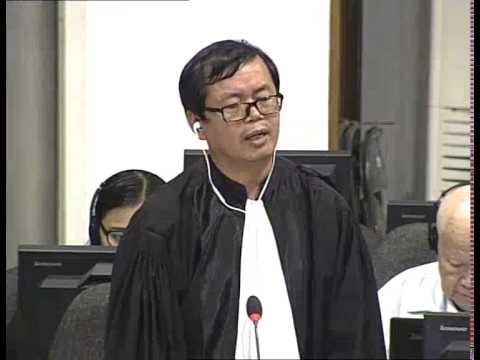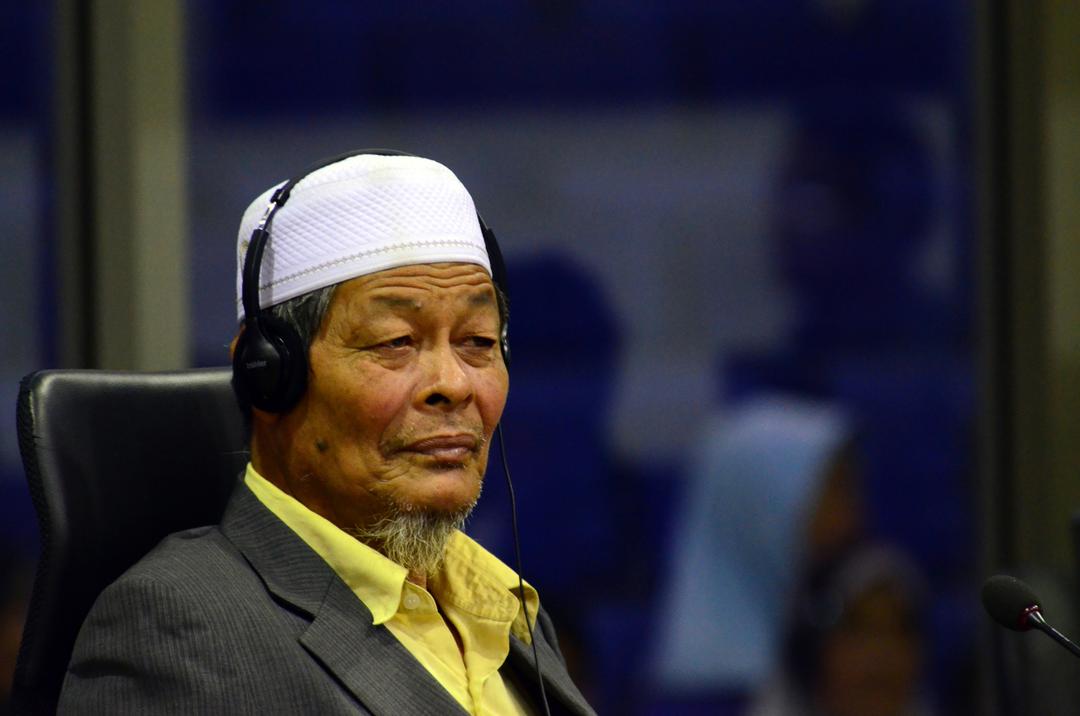
SOS Min
Pseudonym: 2-TCCP-244
Cases: Case 002/02
Category: Civil Party
Background and Role
Sos Min was a member of the Cham group who lived in Svay Khleang village before being evacuated to Svay Kambet village in Kampong Cham province in 1975.
1
He testified as a witness in Case 002/02 on the treatment of the Cham during the Democratic Kampuchea period.
2
The Trial Chamber relied on his testimony in finding that (i) the Communist Party of Kampuchea significantly increased restrictions to prohibit the Cham from practising their religion and cultural customs following the fall of Phnom Penh in 1975;
3
and (ii) two rebellions occurred in September to October 1975 which resulted in many deaths and the evacuation of the Cham population.
4
Party Policy
Under the Khmer Rouge’s initial control before April 1975, Sos Min described that the policy and leadership respected the Cham’s religion, and they sought the Cham’s help to liberate the country together.
5
However, he stated that arrests in the village occurred from 1973 to 1975,
6
and the first targets of arrest by the Khmer Rouge were Muslim leaders and teachers of Islam who were arrested in 1974.
7
He recounted that the two mosques in Svay Khleang village, which were built to accommodate many Cham people in the area, were later dismantled by the Khmer Rouge after the liberation of Phnom Penh.
8
Following 17 April 1975, he noted that the Cham were treated like other evacuees from Phnom Penh and no longer had the right to practise their religion or speak the Cham language.
9
The Trial Chamber relied on Sos Min’s testimony in finding that: (i) despite the lack of social interaction, the Cham enjoyed good relations with Cambodians before 1975, including in areas under Khmer Rouge control, and were able to speak their native language and practise their religion freely until 1972;
10
(ii) the Khmer Rouge imposed few, if any, restrictions on Cham religious and cultural practices before 1973;
11
(iii) in 1975, there was a significant increase in prohibiting the Cham from practising their religion and culture following the fall of Phnom Penh;
12
and (iv) the Khmer Rouge imposed restrictions on the clothing and grooming practices, dietary regime, and religious customs of the Cham.
13
However, the Trial Chamber noted that much of the evidence it heard, including Sos Min’s testimony, about arrests or killings of religious leaders referred to events which took place prior to 1975.
14
The Trial Chamber was therefore unable to conclude that Cham religious leaders were particularly targeted for killings or imprisonment during the Democratic Kampuchea period.
15
Restrictions on the Cham
Sos Min recalled that the cooperative chief or commune chief would pass down restrictions on the Cham that were ordered by the upper echelon at meetings, including forcing Cham women to cut their hair short.
16
He explained that the Cham were forced to eat food that they could not eat, failing which they were accused of not giving up on their religious practice and deemed an enemy of Angkar, which would be grounds for arrest or disappearance.
17
He added that announcements were made at meetings prohibiting the use of the Cham language.
18
He also stated that the Cham people were not allowed to read the Koran and the same was collected and placed in an office.
19
He commented that these restrictions were “harmful to the Cham identities” and rendered their way of life “extremely difficult”.
20
The Trial Chamber relied on Sos Min’s testimony in finding that: (i) instructions prohibiting Cham religious and cultural practices in Kroch Chhmar district, Sector 21, East Zone, came from the upper echelon and that anybody opposing them would be considered as an enemy of Angkar;
21
(ii) policies were often announced through open meetings, during which the Cham were advised to stop practising Islam and women were instructed to cut their hair short and stop wearing head scarves;
22
and (iii) the prohibition of the Cham language targeted Cham culture.
23
The Supreme Court Chamber also referred to Sos Min’s testimony in: (i) dismissing Khieu Samphan’s argument on appeal that there was insufficient and unreliable evidence that Cham were forced to eat pork;
24
and (ii) finding that the Cham were prohibited from worshipping.
25
1975 Rebellions in Kroch Chhmar District
Sos Min described that there were two instances of rebellions by the Cham:
26
the first rebellion was in Koh Phal village and the second in his Svay Khleang village.
27
He recounted that, after he received information that the Khmer Rouge were planning to arrest 80 Cham, he and seven friends organised themselves to collect and burn the list with the names of those 80 people so that they would not be arrested.
28
Since he and his friends were worried that they would be killed for having taken the list, they decided to “stage the revolt that night”.
29
He recalled fighting the Khmer Rouge soldiers until the evening of the following day,
30
until they were surrounded by the Khmer Rouge and the Cham surrendered.
31
He described that the fighting resulted in hundreds of casualties for the Cham and fewer casualties for the Khmer Rouge forces as the latter were armed with different kinds of weapons and artillery.
32
After the fighting, he described that the Cham were taken away and detained in different locations, where they were given inadequate food, interrogated, and tortured during interrogations.
33
The Trial Chamber relied on Sos Min’s testimony in finding that: (i) two rebellions occurred in two Cham communities within Kroch Chhmar district in September to October 1975 in response to earlier restrictions imposed on Cham religious and cultural traditions, and that the situation further worsened for the Cham as a result;
34
(ii) the Communist Party of Kampuchea cracked down on both rebellions within days;
35
and (iii) the rebellions resulted in a great number of Cham being killed and the remaining Cham population was forcibly removed from the villages of Koh Phal and Svay Kleang.
36
Videos