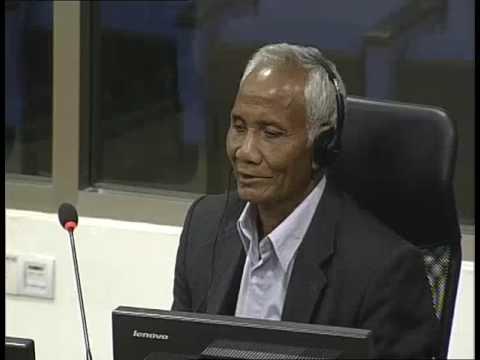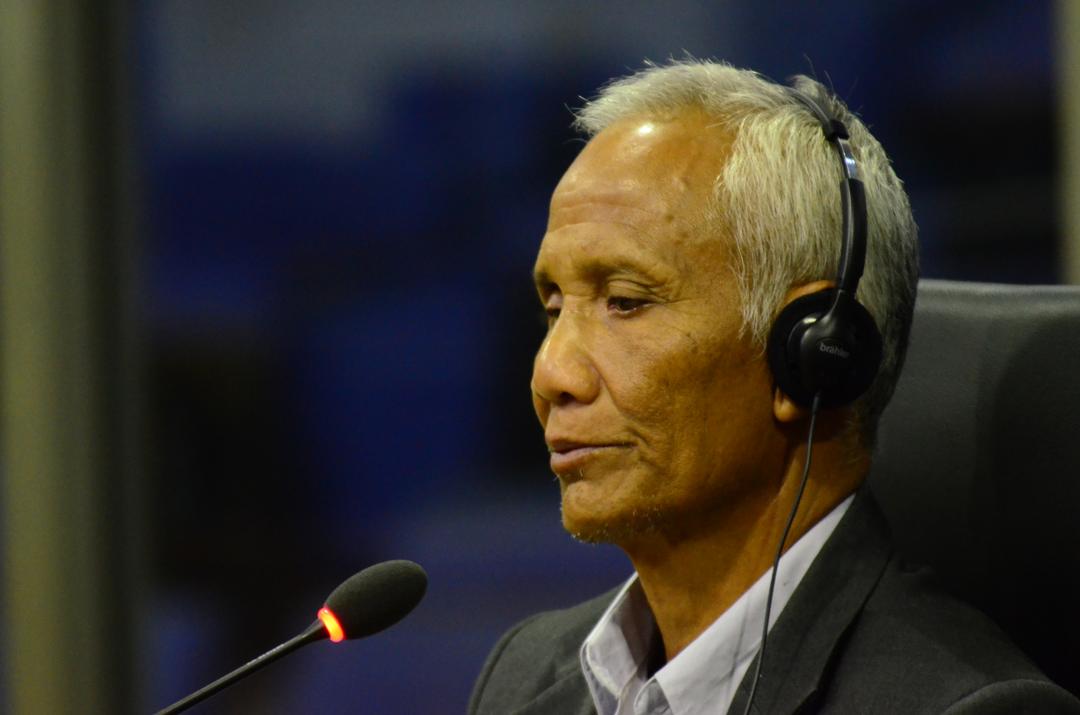
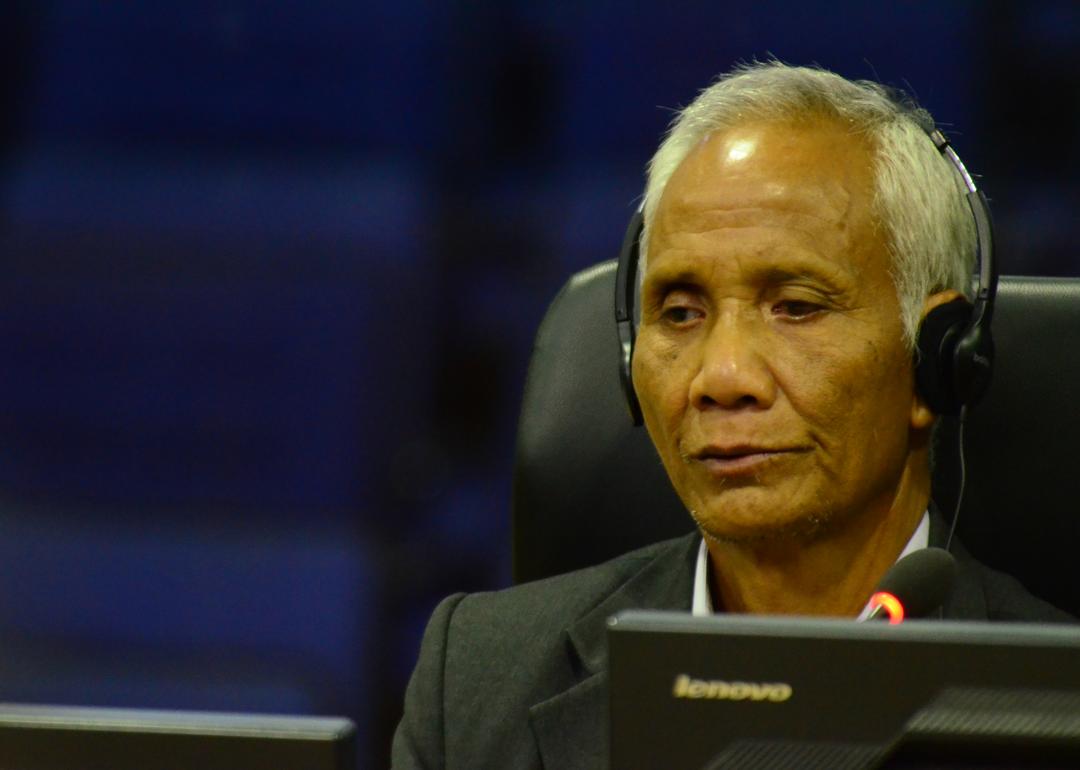
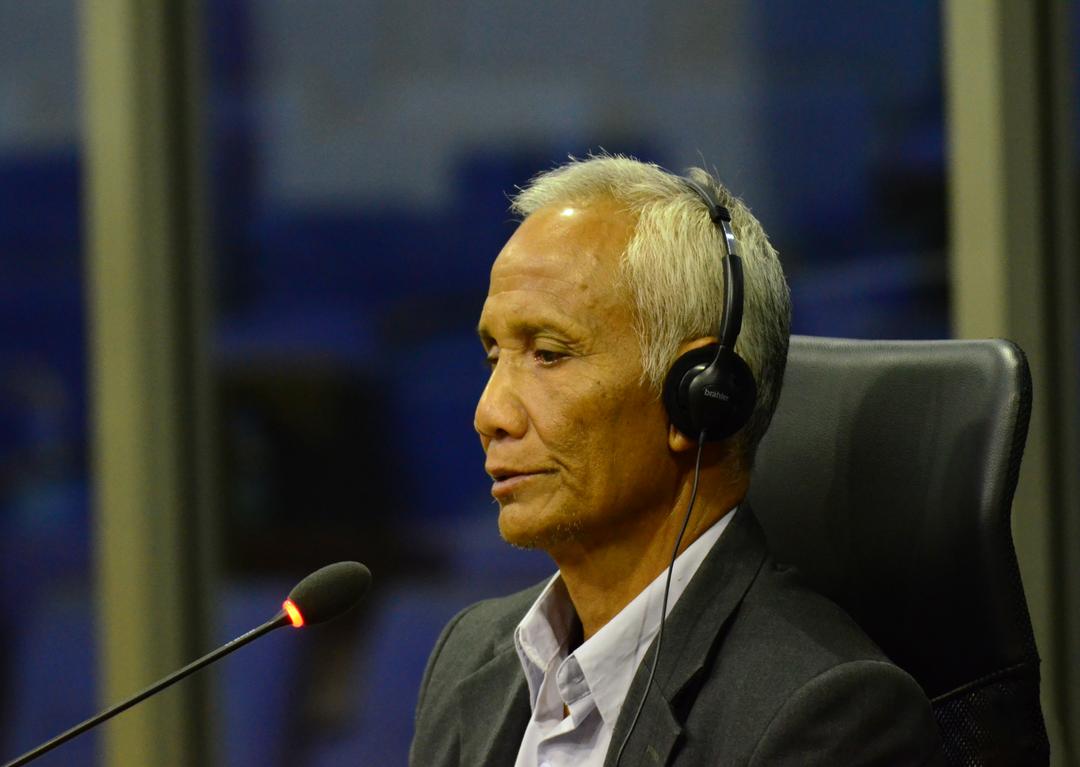
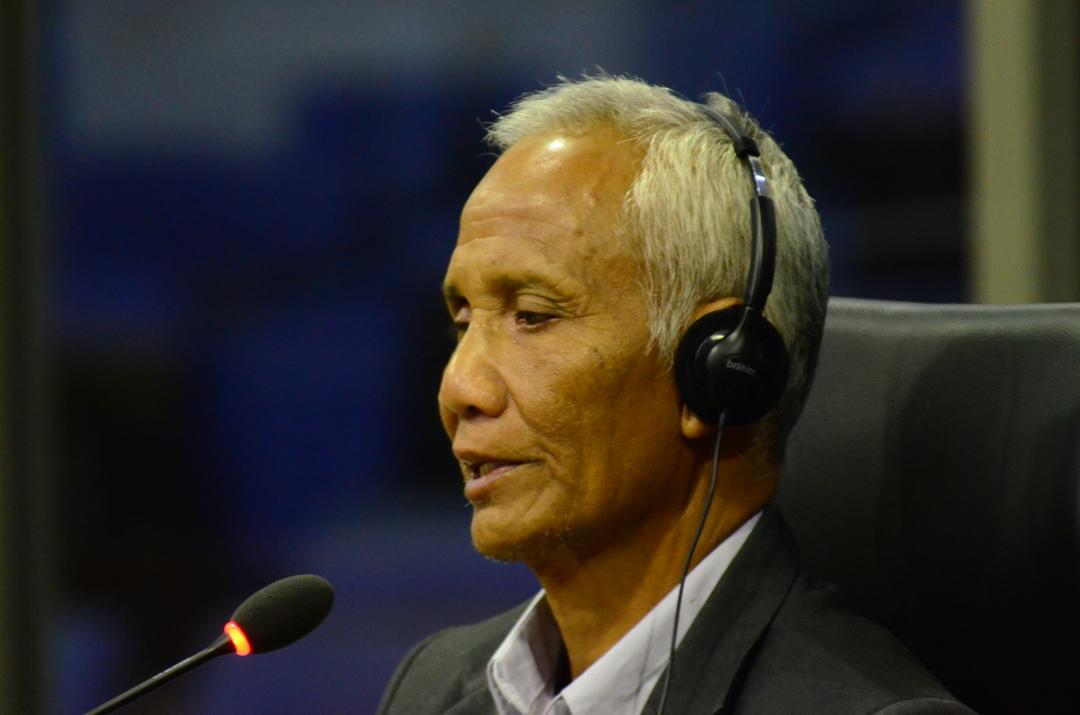
SOV Maing
Pseudonym: 2-TCW-1045
Cases: Case 002/02
Category: Witness
Background and role
Sov Maing was Sao Sarun’s younger brother – Sao Sarun was the last secretary of the Mondolkiri “sector 105”, under the Khmer Rouge regime.
1
Sov Maing lived in Mondolkiri before 1975.
2
In 1975, he became a Khmer Rouge soldier in Regiment 2 of the Mondolkiri sector military.
3
From 1976 onwards, he was stationed at, and patrolled along, the Cambodian-Vietnamese border at Dak Dam in Ou Reang district, Mondolkiri sector.
4
Sov Maing testified as a witness before the Trial Chamber in Case 002/02 in relation to the administrative and military structure in the Mondolkiri sector, Phnom Kraol prison, internal purges in the Mondolkiri sector, and the armed conflict with Vietnam.
Administrative and military structures in Mondolkiri sector
Laing was the Mondolkiri sector secretary, and was replaced by Sov Maing’s brother, Sao Sarun, after Laing’s death.
5
Sophea, Sov Maing’s brother in-law,
6
was the Mondolkiri sector military chief and subordinate to Laing.
7
There were two regiments in the Mondolkiri sector military.
8
Each regiment was subdivided into three battalions.
9
Regiment 1 was commanded by Lan, and had its headquarters in the western area on top of Phnom Kraol mountain.
10
Regiment 2 was commanded by Leng as commander in chief, with Vieng as deputy and Sov Maing as a member.
11
The sector appointed them to their respective positions.
12
Regiment 2 was headquartered at the Phnom Kraol dam that was about one kilometre away from the Regiment 1.
13
Regiment 2’s main task was to work along the border area. Vieng commanded a company stationed at Bou Srar, whereas Sov Maing commanded a company stationed at Saen Monourom and Dak Dam in Ou Reang district.
14
There were 100 soldiers under Sov Maing’s command.
15
Sophea and Leng had their respective offices at K-11 located nearby Phnom Kraol dam in Mondolkiri province.
16
Phnom Kraol was the administrative multiplex, and there was a prison therein named Phnom Kraol prison.
17
Phnom Kraol prison and internal purges in Mondulkiri sector
Phnom Kraol prison was located next to the Phnom Kraol dam in the Regiment 2 compound, close to the base of mountain.
18
It had a thatched roof,
19
and was surrounded by a fence.
20
Sov Maing could see the prison from a distance when he passed by the area in order to visit his wife.
21
He saw prisoners taken out of the building to bathe and to clear grass.
22
Sophea and Leng were in charge of arresting people to be sent to the prison.
23
Leng was responsible for the operation of Phnom Kraol prison,
24
whereas Phai – who was in charge of a company of soldiers and “worked together with Leng” - was in charge of the administration.
25
Vieng told the witness that Leng was “called to study” and disappeared.
26
Sov Maing denied having promoted and/or replaced Leng at Phnom Kraol after his arrest in 1978.
27
Sov Maing said: “my main responsibility was to look after my troops and Vieng was the one who was above me.”
28
He further said that it was “Phai” who took over the tasks after Leng disappeared.
The Trial Chamber considered that “although he denied taking over from Leng as the operational head of Phnom Kraol Prison, there is convincing evidence before the Chamber that Sov Maing had indeed assumed this post”.
30
The Trial Chamber relied on his testimony in addition to others, however, to find that Leng and other cadres and military from sector 105 were purged as a result of their perceived status as, or collaboration with, Party enemies, and subsequently detained and executed at S-21.
31
Collaboration between the sector army and Division 920
There were many soldiers from Division 920 – the Centre army - who guarded the border in Dak Dam.
32
Division 920 and Sov Maing’s sector’s forces coordinated with each other because soldiers from Division 920 who came from other regions of the country did not know the geographical aspects of the area very well.
33
The groups were based close to each other.
34
The Trial Chamber relied on the witness’s testimony in addition to others to find that Division 920 and the sector military collaborated closely within the territory of sector 105 to identify, arrest and detain suspected enemies after April 1977.
35
Armed conflict with Vietnam
Sov Maing attended meetings during which Laing, Sarun, Sophea, or Leng gave instructions to defend the country and not to allow Vietnamese troops to enter Cambodian territory.
36
In 1976, Leng instructed him and his company of soldiers to go to the border in Ou Reang district, go on patrol, and fight against the Vietnamese troops if they encountered them in Cambodian territory.
37
Sov Maing said: “soldiers at the border were to patrol along the border and if they entered our territory, then we would fight them and if they did not, then we only stayed within our territory.”
38
There was no fighting inside Vietnamese territory.
39
Spikes or mines were planted along the border area,
40
when the Vietnamese troops advanced into Cambodian territory.
41
The Vietnamese side had larger numbers and more modern weaponry than the Cambodian side.
42
Sov Maing recalled that there had been Vietnamese soldiers in Mondolkiri before 1975, but did not know about their relationship with the local population or the Khmer Rouge.
43
The attacks started in 1976, in particular at Dak Dam’s border, and became more intensified throughout 1977 and 1978.
44
He said: “Sometimes it happened once a month, sometimes once in two months. And it became more frequent by 1978 until the time we fled.”
45
Sometimes both sides retreated, sometimes there were casualties – some soldiers were wounded.
46
Vietnamese troops advanced into Cambodian’s territory, and the Cambodian side had to retreat.
47
The major clash took place in 1979 when the Vietnamese troops attacked and entered Mondolkiri province.
48
Videos